Searching for boat fiberglass repair near me connects vessel owners with specialized composite technicians capable of diagnosing structural hull delamination, bottom osmosis blistering, and cosmetic gelcoat degradation. Through the audited boatyard network of Pertulma Ultramarina, captains and yacht managers locate certified composite repair facilities, vacuum-infusion craftsmen, and marine chandleries equipped to handle major collision remediation or scheduled refits.
Composite Hull Fundamentals: Resins, Core Materials and Structural Stress Zones
Fiberglass reinforced plastic (FRP) has formed the backbone of recreational and commercial boat construction for over six decades. A modern composite hull represents an engineered matrix of high-strength glass fibers suspended within a cured thermoset polymer resin. Understanding the distinct properties of matrix resins is critical when planning structural repairs versus surface cosmetic touch-ups.
Technicians distinguish between three primary marine resin chemistries:
- Ortho and Isophthalic Polyester Resins: Widely used in original production molds due to low cost and rapid cure times. However, polyester resin exhibits higher moisture absorption rates (up to 1.5 to 2.0 percent by weight) and limited secondary bonding strength on cured laminate, making it unsuitable for high-stress structural repairs below the waterline.
- Vinylester Resins: Modified epoxy-backbone resins that offer superior osmotic resistance, enhanced elongation before break (3.5 to 5.0 percent), and excellent secondary adhesion. Vinylester is the industry standard for underwater skin coats, barrier coats, and major collision repairs on vinylester-built hulls.
- Epoxy Resins: The gold standard for structural repairs, core replacement, and transom rebuilds. Marine epoxy forms mechanical and chemical bonds with cured laminates exceeding 2,000 PSI tensile shear strength, completely resists water vapor migration, and cures without styrene gas outgassing.
Vessel hulls experience dynamic hydro-mechanical loads distributed across five critical structural zones: keel joints, transom motor mountings, stringer grids, chainplate bulkheads, and chines. Inspecting boatyards indexed in Fiberglass, Refit, Propellers & Marine Suppliers ensures that technicians select resin formulations compatible with the vessel's original laminate schedule.
Comparative Engineering Matrix: Marine Resins and Core Substrates
Selecting the correct resin and structural core material dictates the longevity, stiffness, and resale value of the repaired hull:
| Material Type | Tensile Strength (PSI) | Flexural Modulus (KSI) | Moisture Absorption (24h) | Secondary Bond Adhesion | Primary Marine Application |
|---|---|---|---|---|---|
| Polyester (Isophthalic) | 7,500 - 9,500 | 450 - 550 | 0.8% - 1.2% | Moderate (Mechanical only) | Topsides cosmetic repairs, mold making |
| Vinylester Marine | 11,000 - 13,500 | 500 - 600 | 0.15% - 0.25% | High (Tensile shear 1,200 PSI) | Osmosis barrier coats, bottom skin coats |
| Marine Structural Epoxy | 12,000 - 16,000 | 450 - 550 | < 0.10% | Maximum (Tensile shear > 2,000 PSI) | Transom replacement, keel stringer bonding |
| Marine Plywood (BS 1088) | 6,500 - 8,000 | 1,000 - 1,200 | High (Requires encapsulation) | High when abraded | Traditional stringers and transom cores |
| Coosa Bluewater 26 Board | 2,800 - 3,200 | 320 - 380 | < 1.5% (Impervious to rot) | Excellent with epoxy | Rot-proof transom and deck coring |
| Structural PVC Foam (Divinycell H80) | 360 - 420 | 11.5 - 14.5 | < 0.5% (Closed-cell) | Vacuum-bagged with vinylester | Lightweight cored hulls and deck panels |
When undertaking engine repowers or heavy transom modifications alongside propulsion maintenance, cross-referencing certified engine installers in Mercury Outboard Engine Repair Guide ensures proper torque distribution across composite transoms.
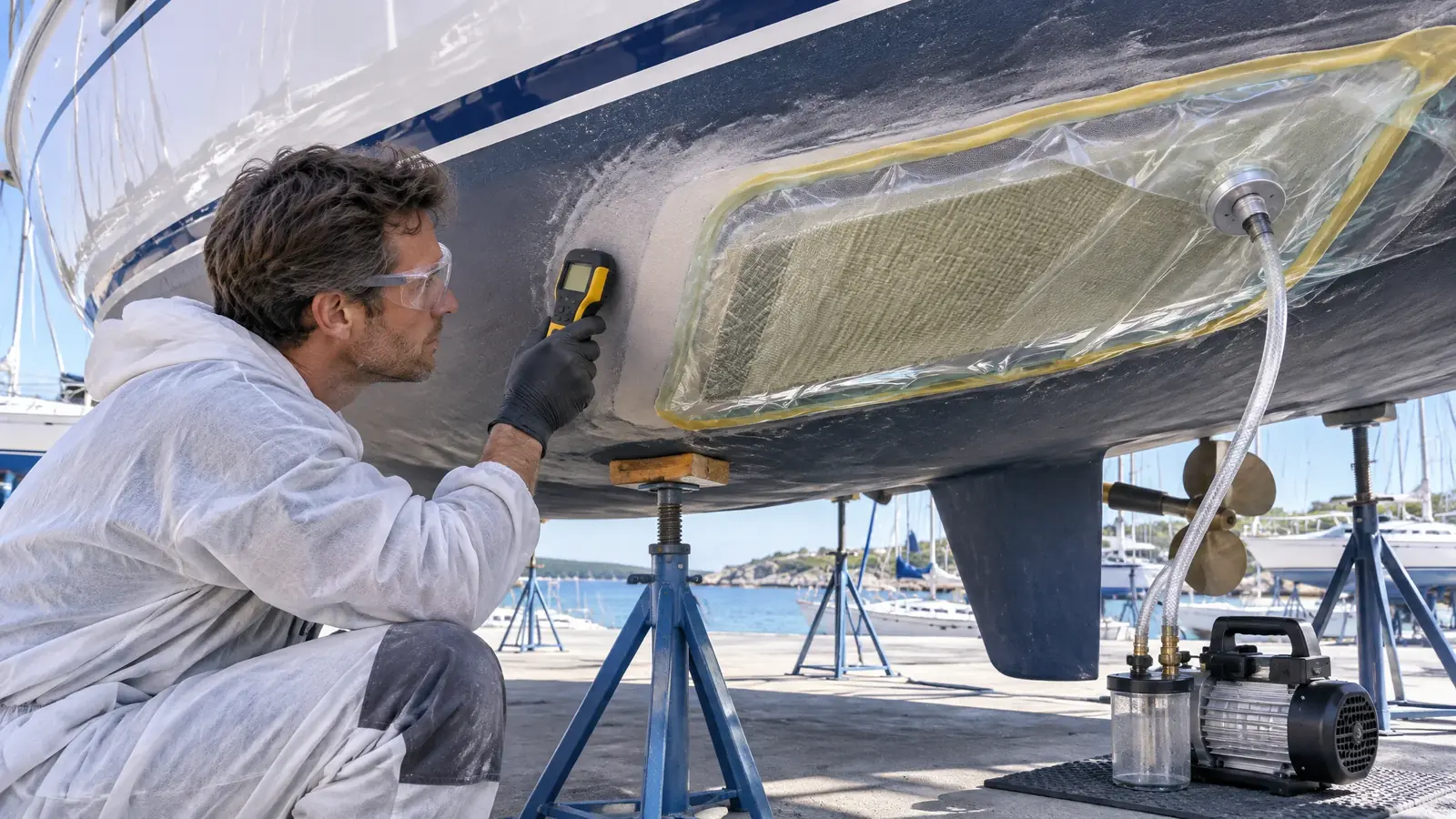
Component-by-Component Field Inspection Breakdown (boat fiberglass repair near me)
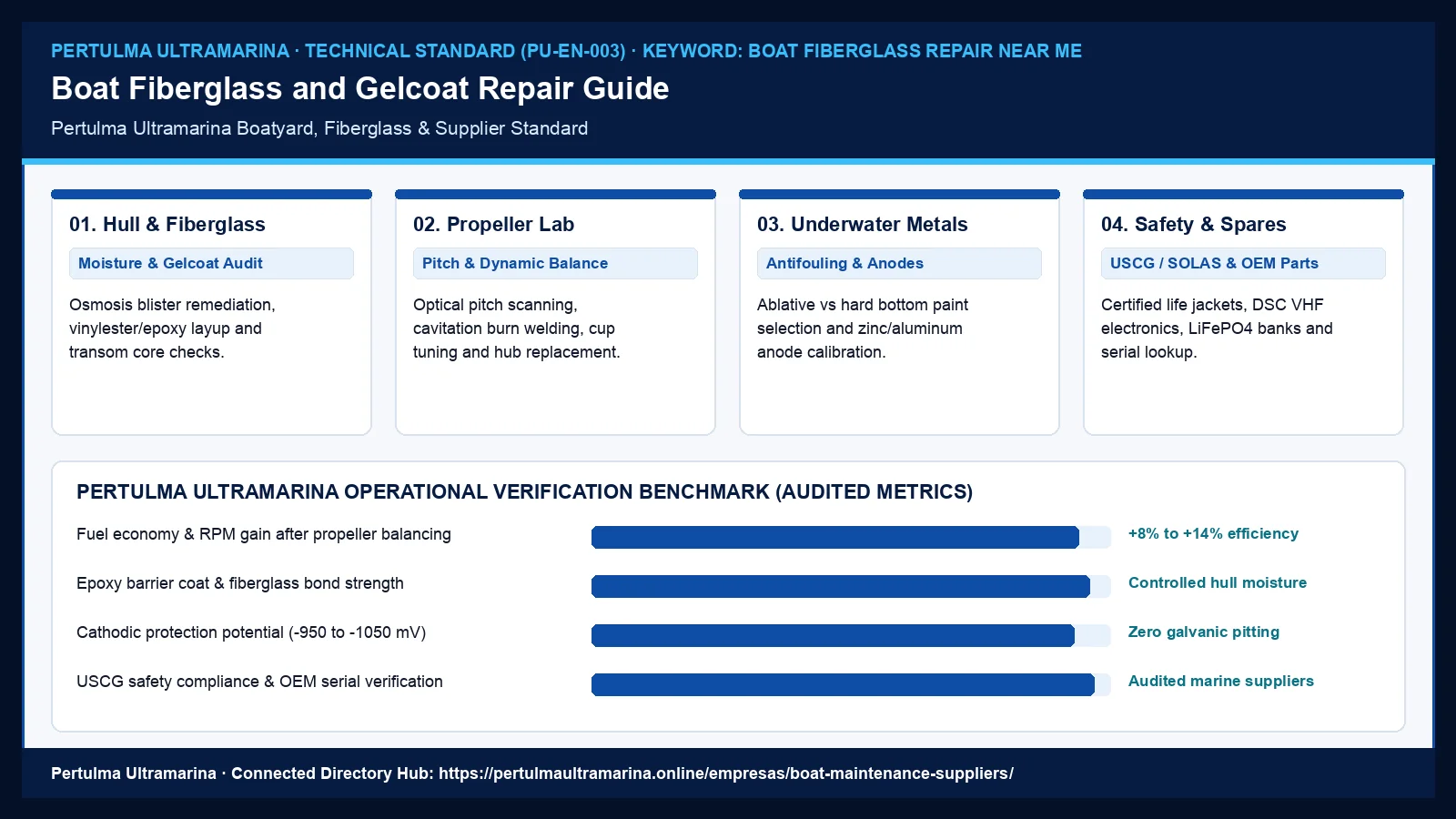
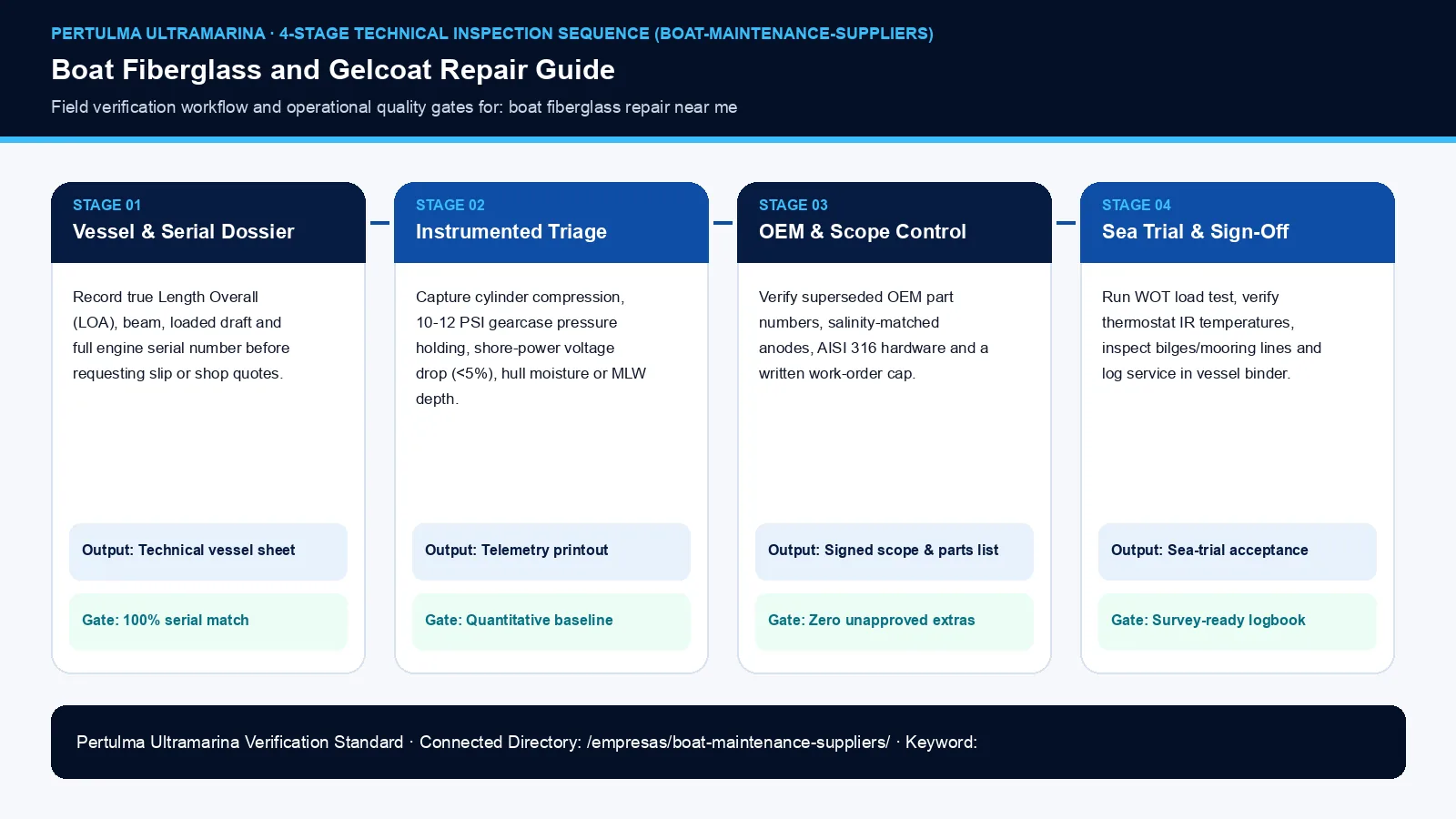
To ensure every boat fiberglass repair near me evaluation is backed by empirical marine engineering evidence, Pertulma Ultramarina audits four physical subsystems on site:
- Dielectric Moisture Mapping: Grid readings across transom core, stringers and below-waterline laminate before grinding.
- 12:1 Structural Scarf Ratio: Stepped biaxial fiberglass layup restoring original flexural strength across impact or blister zones.
- Epoxy Barrier Coat System: Minimum 10-mil (250-micron) dry film thickness to block hydrostatic water vapor permeation.
- Post-Cure Barcol Hardness: Surface cure verification prior to fairing, topcoat application or travelift launch.
Diagnosing Hull Damage: Osmosis Blistering, Moisture Meter Readings and Sounding
Before grinding into fiberglass, surveyors and marine repairers employ non-destructive testing (NDT) to map the boundaries of hidden structural damage. Seawater trapped between laminate plies causes microscopic hydrolytic reactions that expand into visible blisters.
The standard diagnostic progression includes three field methods:
- Acoustic Percussion Sounding: Using a phenolic plastic tapping hammer or small brass hammer, the technician lightly taps the hull surface across a 6-inch grid. Sound solid laminate produces a crisp, sharp ring. A dull, hollow thud indicates subsurface voiding, delamination between glass plies, or rot inside a balsa or plywood core.
- Capacitance Moisture Meter Evaluation: Marine moisture meters, such as the Tramex Skipper Plus or Protimeter Aquant, use radio-frequency capacitance to detect water beneath gelcoat layers without puncturing the surface. Comparative readings between topsides (benchmark dry) and underwater hull sections indicate whether the laminate requires localized drying or comprehensive peel stripping.
- Fluid Sampling and pH Indication: When an osmosis blister is lanced with a sharp awl, trapped acetic fluid escapes under pressure. Testing this fluid with litmus paper typically reveals a pH between 3.5 and 5.0 (acidic vinegar scent), confirming active chemical hydrolysis of polyester binder resins.
Vessel owners can consult technical directories at Pertulma Ultramarina to locate boatyards equipped with dehumidified drying bays and infrared heating arrays to accelerate hull desiccation before applying barrier coats.
Gelcoat Repair Protocol: Color Matching, Catalyst Ratios and Sanding Grits
Gelcoat is an unreinforced, pigmented isophthalic polyester or vinylester resin layer (typically 18 to 25 mils thick) that protects underlying fiberglass from UV degradation and water ingress while providing a mirror-gloss finish. Repairing dock rash, gouges, and spider stress cracks requires disciplined craftsmanship.
Step-by-Step Gelcoat Repair Sequence
- Beveling and Contaminant Removal: Open the gouge or scratch using a rotary Dremel tool with a carbide burr bit, beveling the edges at a 45-degree angle. Clean thoroughly with pure acetone to remove marine wax, salt residues, and fuel exhaust films.
- Color Tinting Formulation: Factory white gelcoats vary dramatically from cool titanium white to warm off-white or oyster hues. Starting with a neutral white base paste, mix concentrated tinting pigments (black, yellow iron oxide, raw umber) in natural sunlight until matching the weathered hull tone.
- Catalyzation with MEKP: Add Methyl Ethyl Ketone Peroxide (MEKP) catalyst at exactly 1.5 to 2.0 percent by volume at ambient temperatures between 65 and 80 degrees Fahrenheit (18 to 27 degrees Celsius). Insufficient catalyst causes tacky curing, while excessive MEKP induces yellowing and brittleness.
- Air Inhibition Barrier: Because gelcoat remains air-inhibited (tacky) when exposed to oxygen, spray a liquid polyvinyl alcohol (PVA) film or tape clear Mylar film over the patch to ensure complete surface polymerization.
- Progressive Wet Sanding and High-Speed Polishing: Once fully cured (minimum 4 to 6 hours), block-sand the patch flat using 400-grit wet sandpaper lubricated with soapy water. Progress through 600, 800, 1000, 1500, and 2000 grits. Finish with a heavy-cut marine compound on a rotary wool pad at 1500 RPM, followed by a finishing glaze on a yellow foam pad.
For extensive topside repaints or hull re-gelcoating, review audited marine service providers across the directory at Pertulma Ultramarina Marine Directory.
Structural Fiberglass Lamination: 12:1 Scarf Ratio, Epoxy vs Vinylester and Vacuum Bagging
Repairing a structural breach resulting from a collision or grounding requires reconstructing the original laminate schedule while ensuring stress transfer across the repair boundary. Simply slapping fiberglass tape over a crack creates a surface stress riser that will fail under sea wave impacts.
Engineers specify the 12:1 Scarf Ratio Rule for structural fiberglass repairs:
For every millimeter of hull thickness, the edges of the damaged hole must be ground back at a gradual taper of 12 millimeters. On a half-inch thick (12.7 mm) solid fiberglass hull, the ground scarf taper must extend 6 inches (152 mm) in all directions around the perimeter of the cutout.
The structural lamination process follows exact technical steps:
- Laminate Schedule Reconstitution: Alternate between biaxial stitch-bonded glass fabric (such as 1708: 17 oz per sq yard biaxial cloth stitched to 3/4 oz chopped strand mat) and heavy woven roving. Biaxial cloths provide directional stiffness across 45-degree shear angles without the resin-rich weakness of chopped mat.
- Step-Down Ply Stacking: Laminate plies are cut sequentially from largest (covering the outer edge of the scarf) to smallest (filling the innermost void), or in reverse order, saturating each ply with low-viscosity epoxy resin using a grooved aluminum laminating roller to expel entrained air bubbles.
- Vacuum Bag Compaction: For high-performance sportfishers and offshore yachts, applying a vacuum bagging film with peel ply and bleeder fabric at 25 inHg compaction pressure squeezes out excess resin. This optimizes the fiber-to-resin ratio to 60:40 by weight, maximizing structural strength while eliminating dead weight.
Captains seeking full-service boatyards with climate-controlled composite repair bays should explore our international infrastructure guide in the Pertulma Ultramarina International Marina Directory.
Core Delamination and Transom Replacement: Marine Plywood, Coosa and High-Density Foam
Transom rot in outboard-powered boats and deck softness on cruising yachts are among the most expensive composite repairs. Traditional builders sandwiched Douglas fir marine plywood between thin fiberglass skins. When transom mounting bolts, speedometer pickups, or swim platforms are installed without epoxy potting, water enters the wood core, rotting the transom from within.
Modern composite boatyards replace rotted cores using three proven approaches:
- Inner Skin Removal and Complete Coosa Board Core: Technicians cut away the interior fiberglass skin while preserving the outer hull gelcoat. The decomposed wood is removed using pneumatic chisels. Dual sheets of high-density fiberglass-reinforced polyurethane foam board (such as Coosa Bluewater 26) are bedded in structural epoxy paste, through-bolted with temporary clamping plates, and re-laminated with three layers of 1708 biaxial cloth.
- Pourable Ceramic Transom Compounds: For complex transom geometries where skin removal is unfeasible, the wood core is cleared through a top slit. Pourable composite putties (such as Arjay 6011 or SeaCast) containing chopped fiberglass fibers and polyester or vinylester resin are poured into the void, curing into a solid structural monolith.
- Deck Soft Spot Re-Coring with Structural PVC Foam: When moisture meters reveal wet balsa in deck sandwich panels, the top skin is peeled open. The waterlogged balsa is replaced with closed-cell Divinycell PVC foam scored in contour squares, vacuum-bonded, and faired with microballoon-filled fairing compound.
Audited composite repair shops that specialize in structural transom fabrication can be located in Fiberglass, Refit, Propellers & Marine Suppliers.
Yard Equipment, Travelift Haul-Out and Professional Boatyard Verification
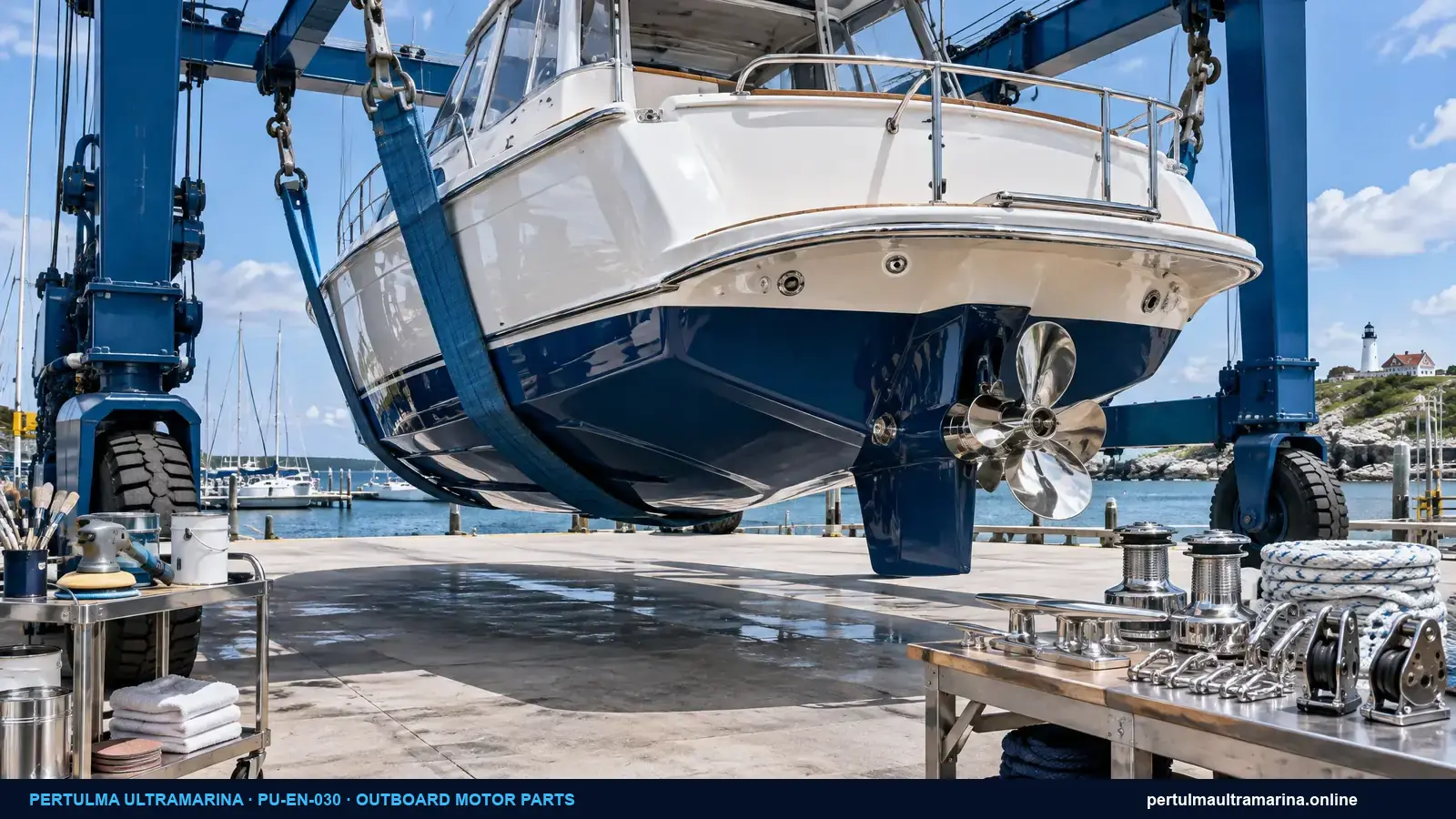
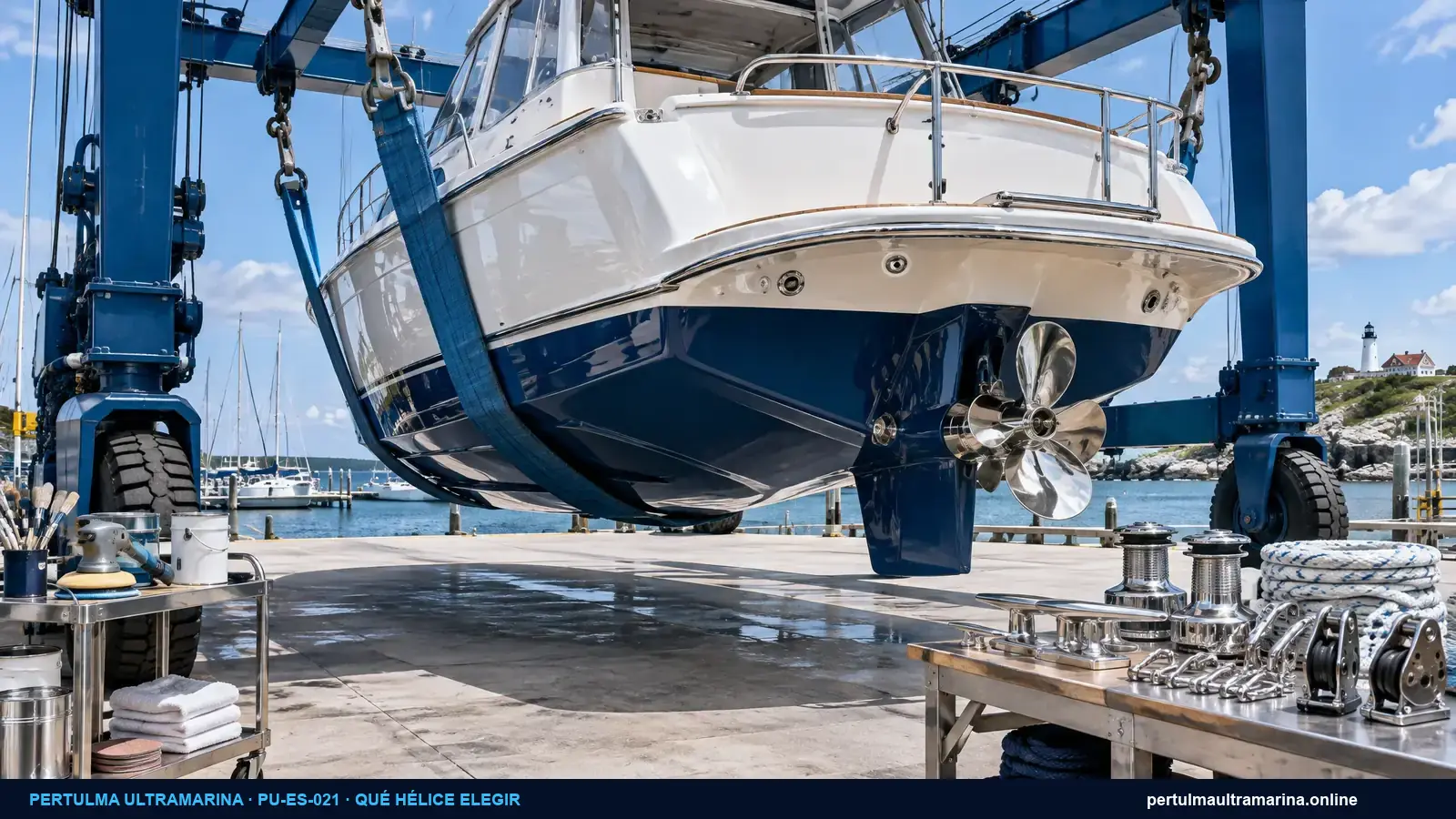
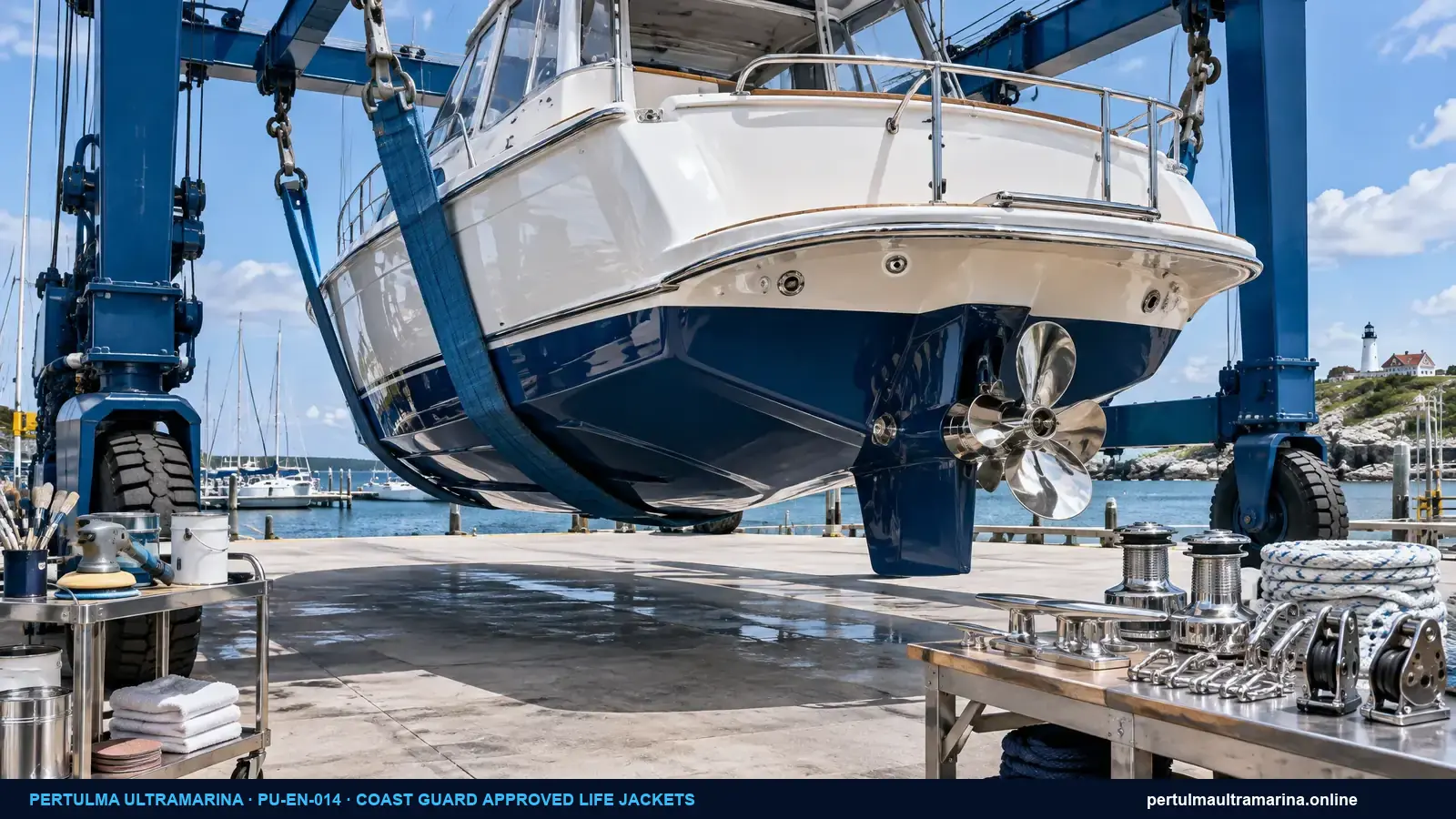
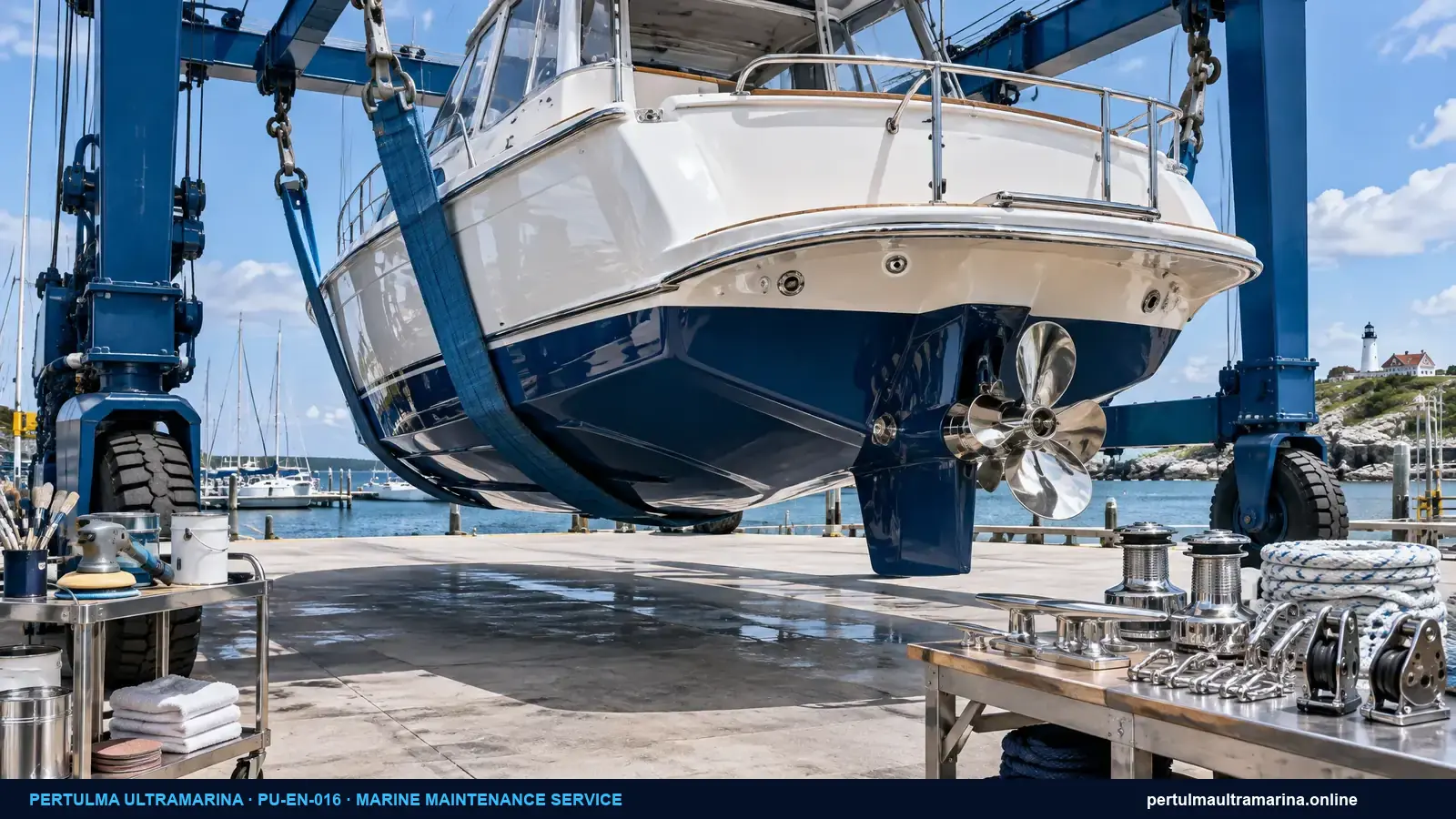
Executing major fiberglass repairs necessitates heavy shipyard infrastructure. A mobile mechanic working on a boat lift or trailer can complete minor gelcoat cosmetic repairs; however, structural stringer replacements and osmosis bottom peeling require controlled boatyard conditions.
When evaluating a fiberglass repair facility through Pertulma Ultramarina, verify the following yard parameters:
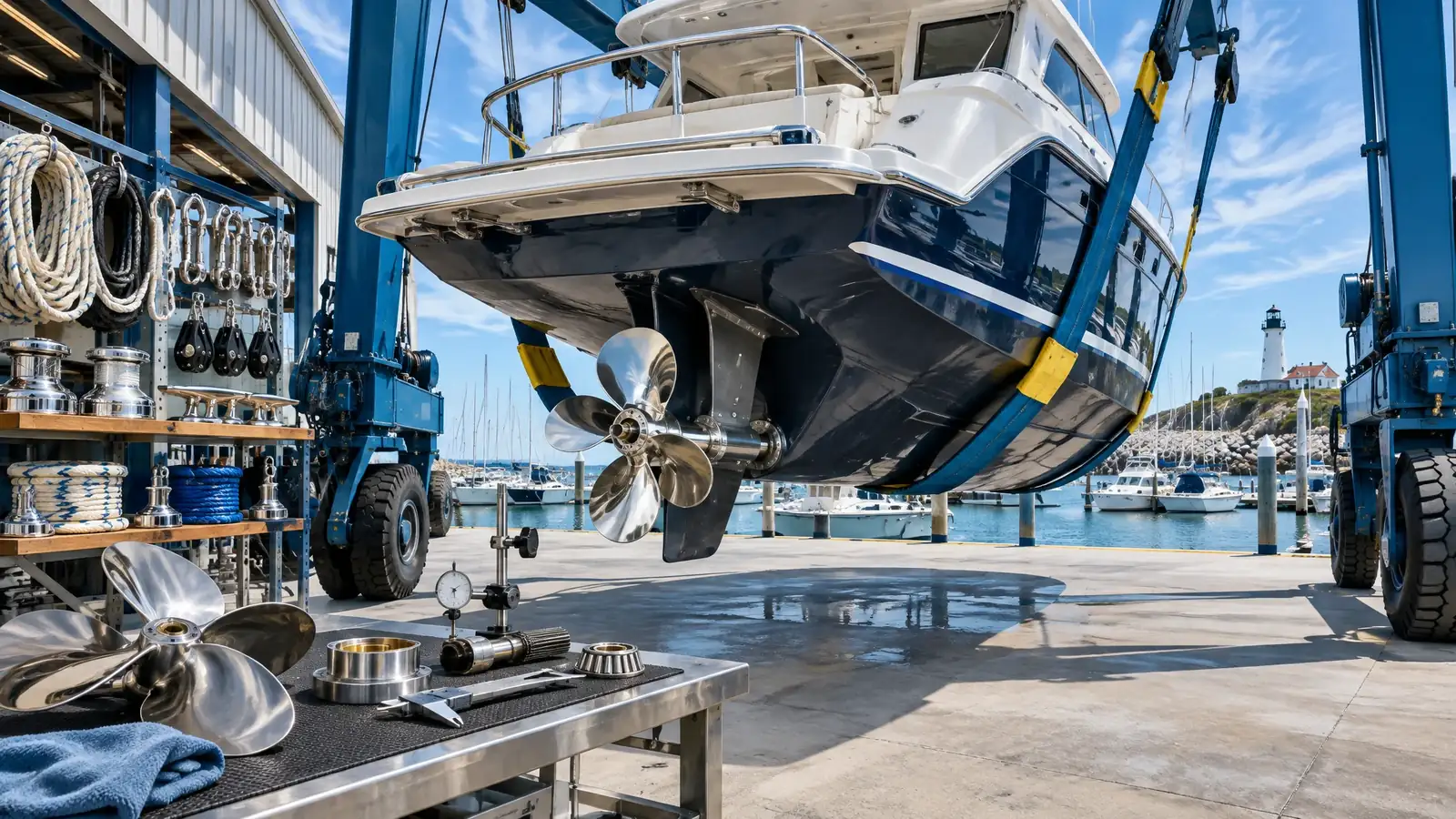
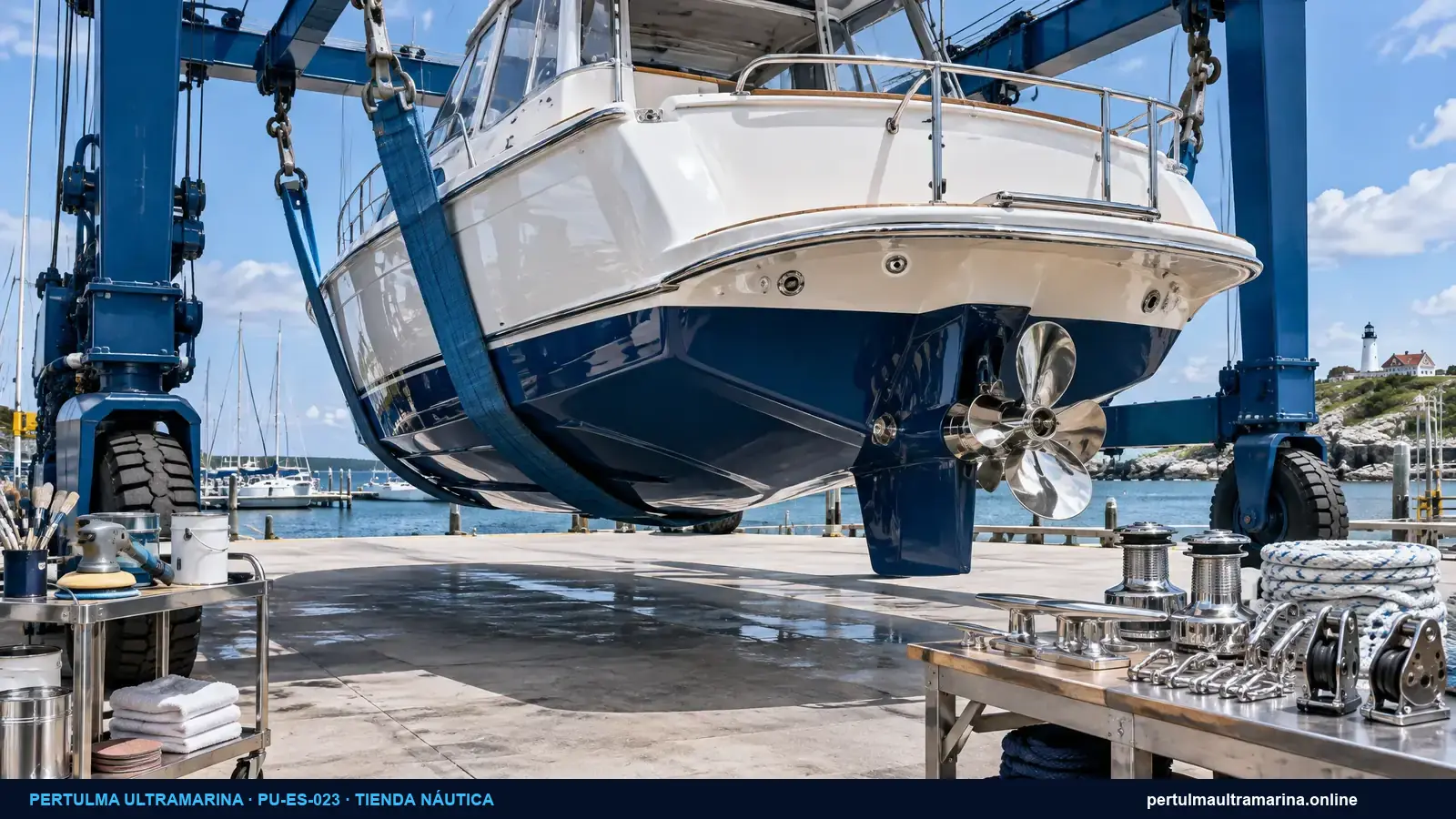
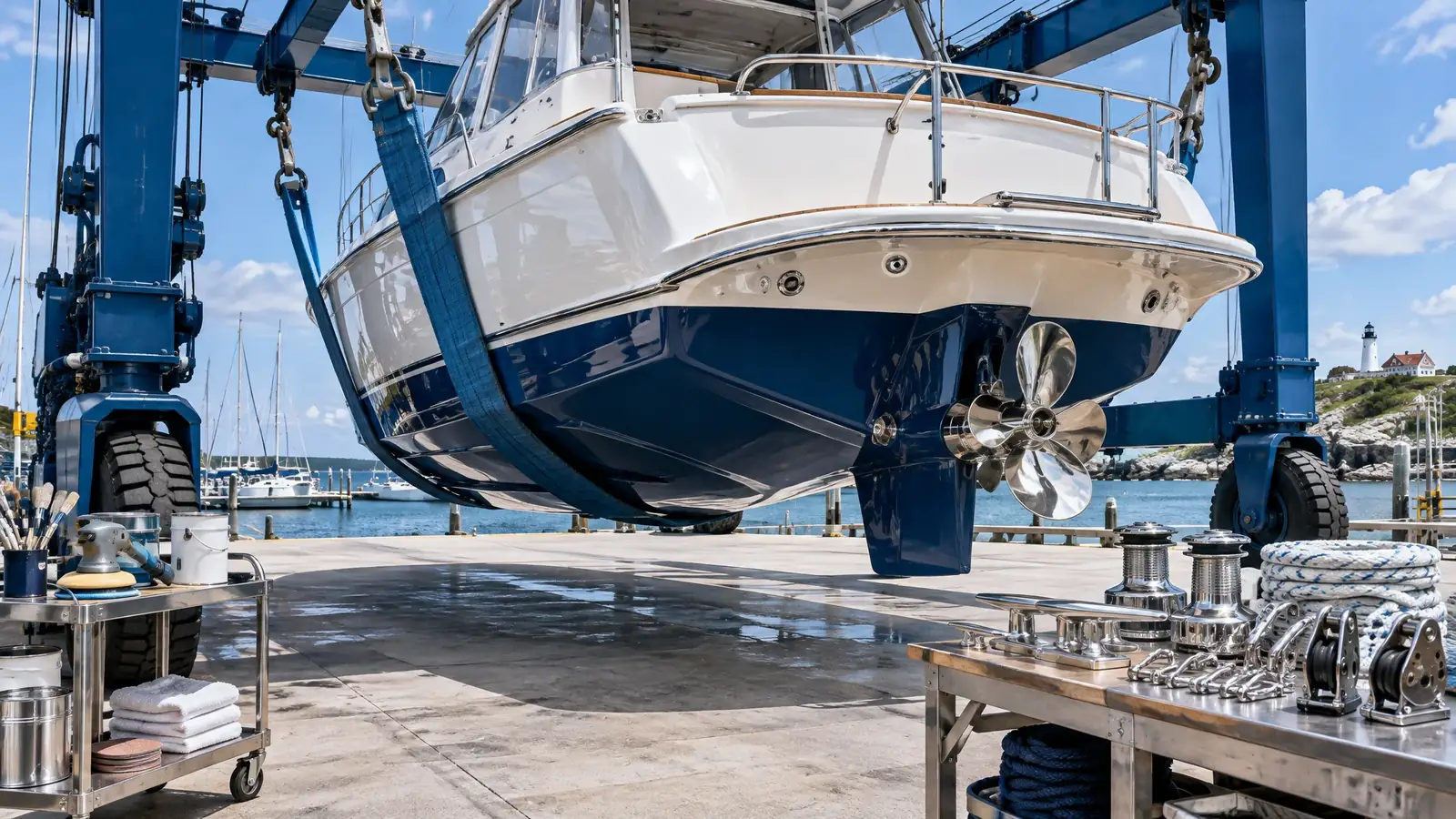
- Travelift Capacity and Sling Placement: Ensure the boatyard operates a mobile marine hoist (Travelift) rated with adequate safety margin for the vessel's loaded displacement. Slings must be placed over reinforced hull bulkheads marked with sling tags to prevent crushing light cored topsides.
- Environmental Blasting and Dust Containment: Hull peeling and soda blasting must take place inside curtained containment areas equipped with negative-pressure vacuum extractors to capture hazardous glass fibers and toxic antifouling dust.
- Controlled Climate Bays: Epoxy and vinylester resins require steady ambient temperatures (above 65 degrees Fahrenheit) and relative humidity below 70 percent during layup and initial post-cure cycles to prevent amine blush and incomplete resin cross-linking.
Review the comprehensive marine service directory at Pertulma Ultramarina Marine Directory to compare commercial shipyards, dry storage berths, and technical composite contractors worldwide.
Frequently Asked Questions
How much does professional boat fiberglass repair cost per foot?
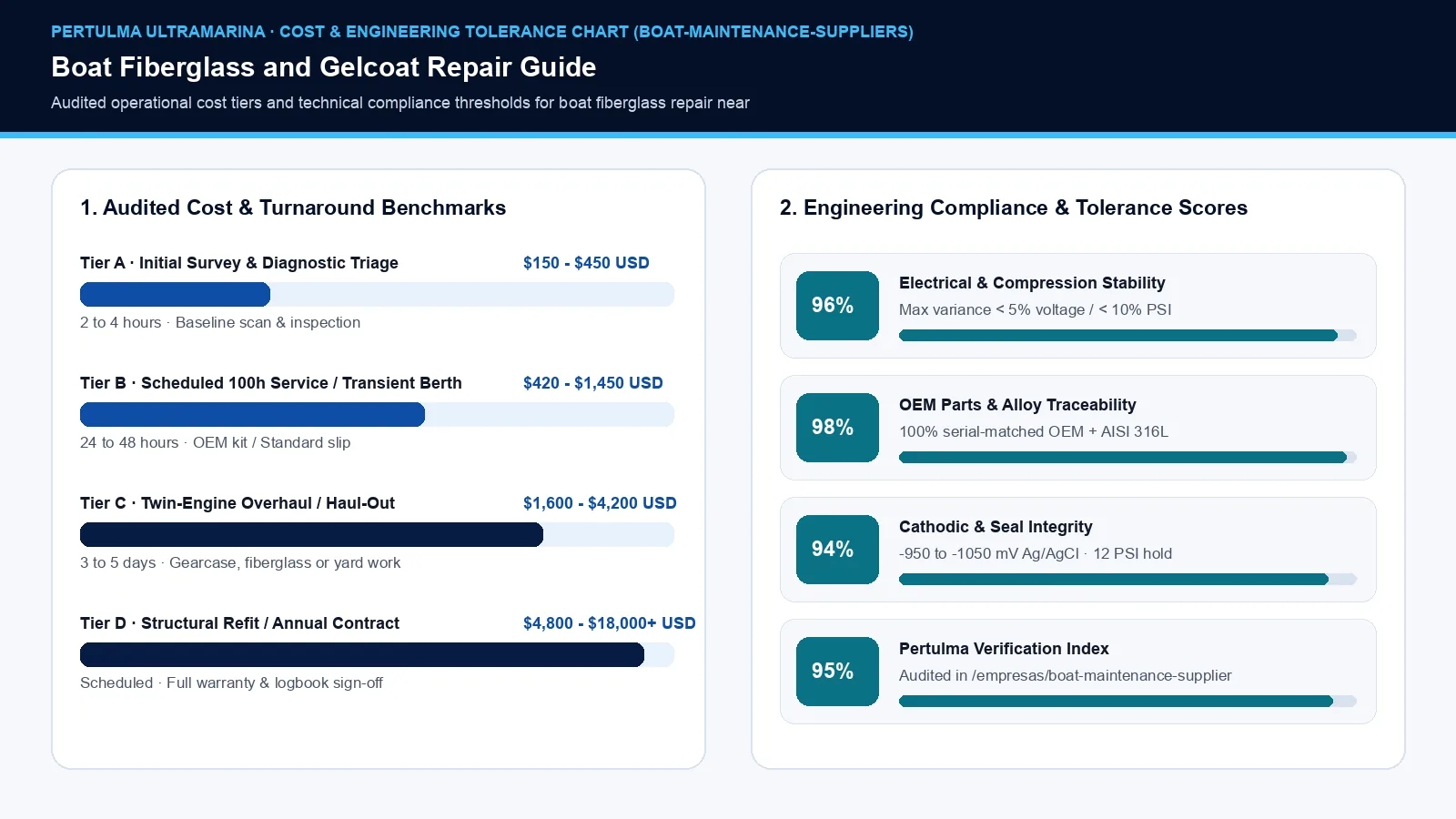
Minor cosmetic gelcoat repairs typically cost between 75 and 150 dollars per foot for localized dings. Comprehensive bottom osmosis treatment (peeling, washing, dehumidified drying, and multi-coat vinylester/epoxy barrier application) ranges from 250 to 500 dollars per foot. Transom replacement costs vary from 3,500 to 9,000 dollars depending on engine horsepower and hull size.
Can epoxy resin be used over existing polyester fiberglass?
Yes. Epoxy forms a tenacious mechanical bond over cured polyester and vinylester fiberglass, provided the substrate is ground clean with 36 to 80-grit abrasive and washed thoroughly with solvent. However, polyester resin and gelcoat should never be applied directly over uncured epoxy, as unreacted amine curing agents inhibit polyester polymerization.
What is the 12:1 scarf ratio in fiberglass repair?
The 12:1 scarf ratio is an engineering rule requiring that the edges around a hole or crack in a fiberglass hull be ground down at a slope 12 times wider than the thickness of the laminate. This gentle slope distributes shear stress across multiple overlapping fabric plies rather than focusing stress along a single seam.
How can I tell if my boat deck or transom has rotted core material?
Tell-tale indicators include a hollow or dull thud when tapped with a plastic mallet, visible flexing underfoot on deck panels, brown liquid weeping from engine mount bolt holes, and readings above 25 percent on a calibrated marine moisture meter.