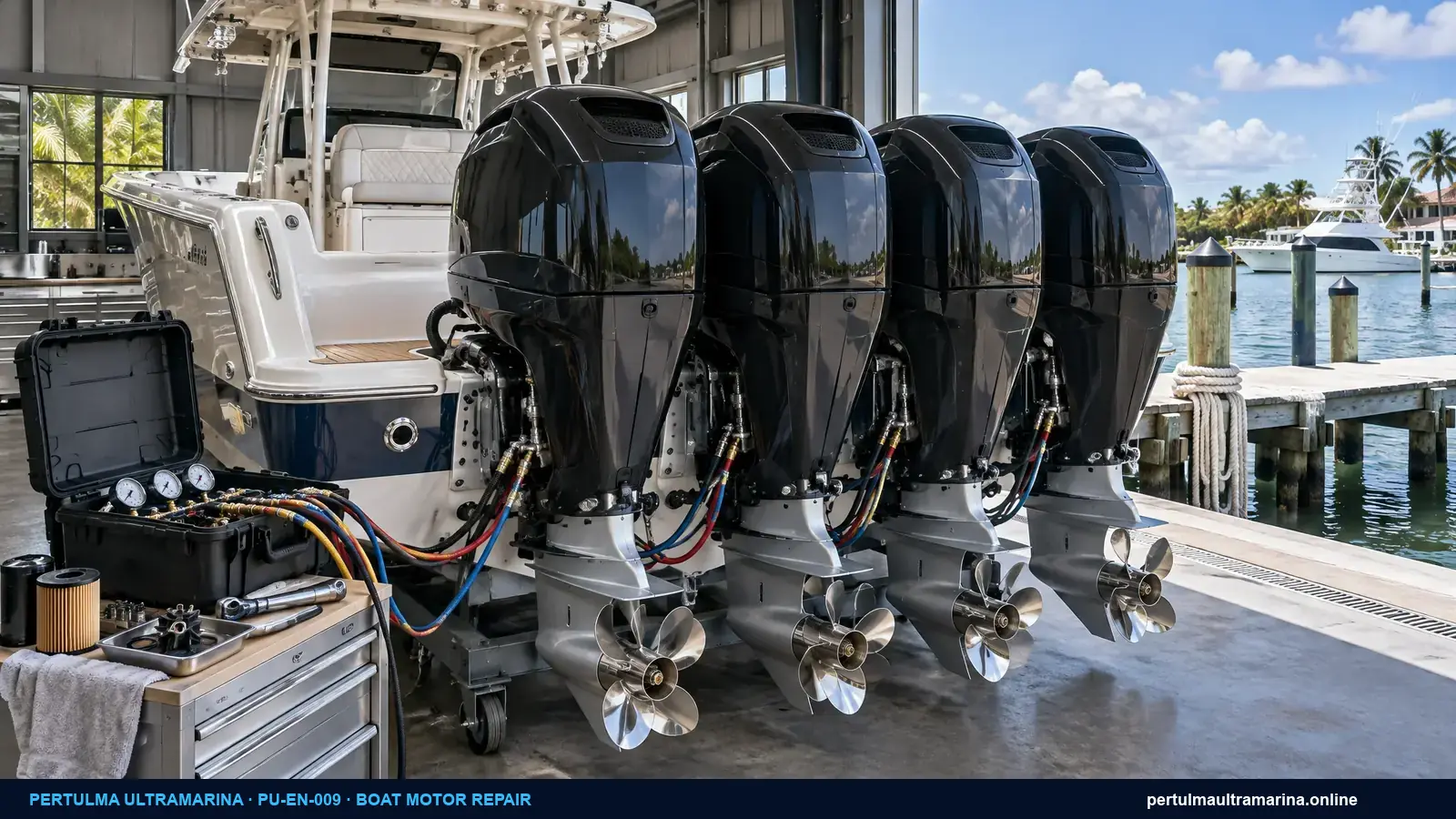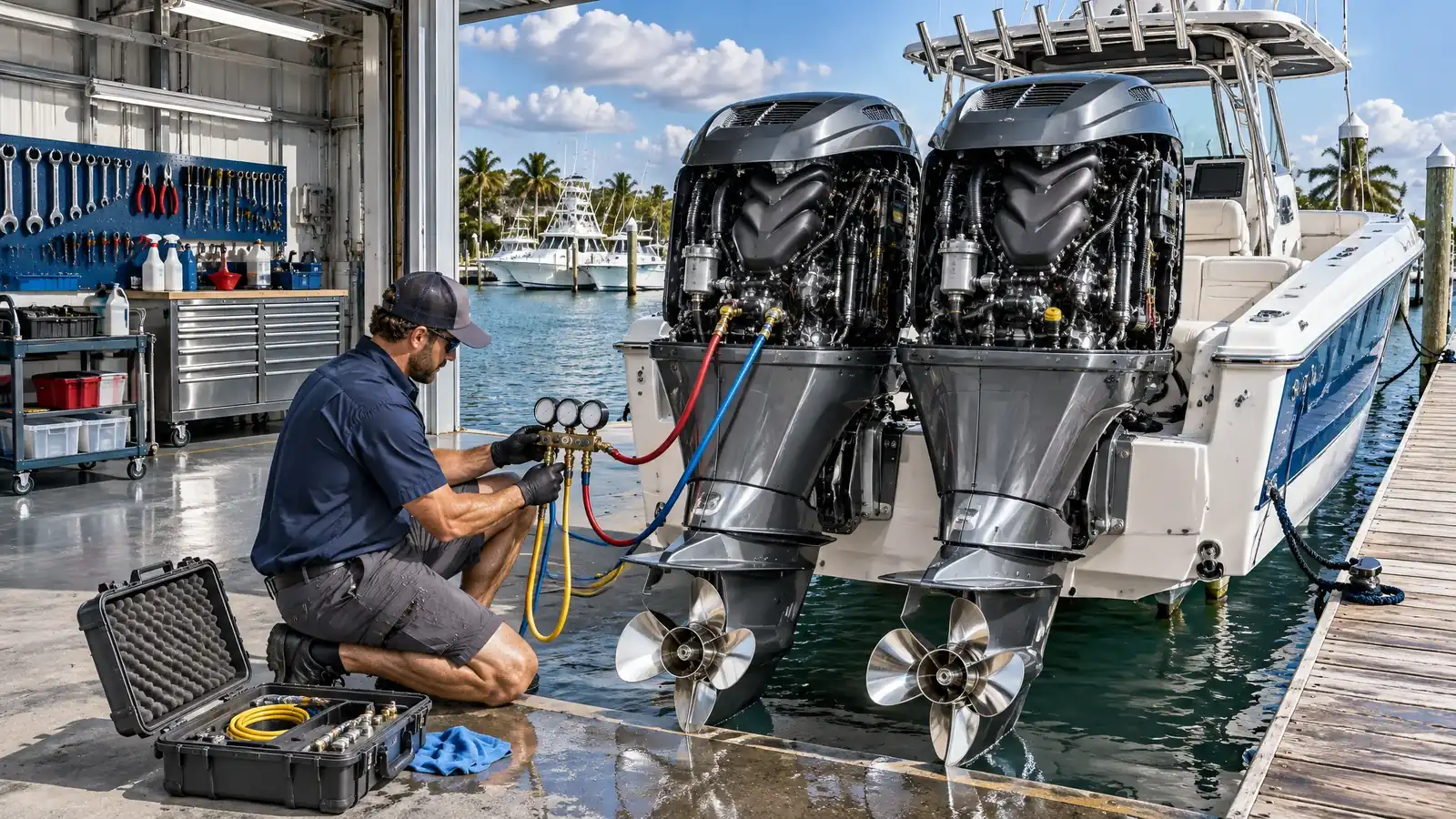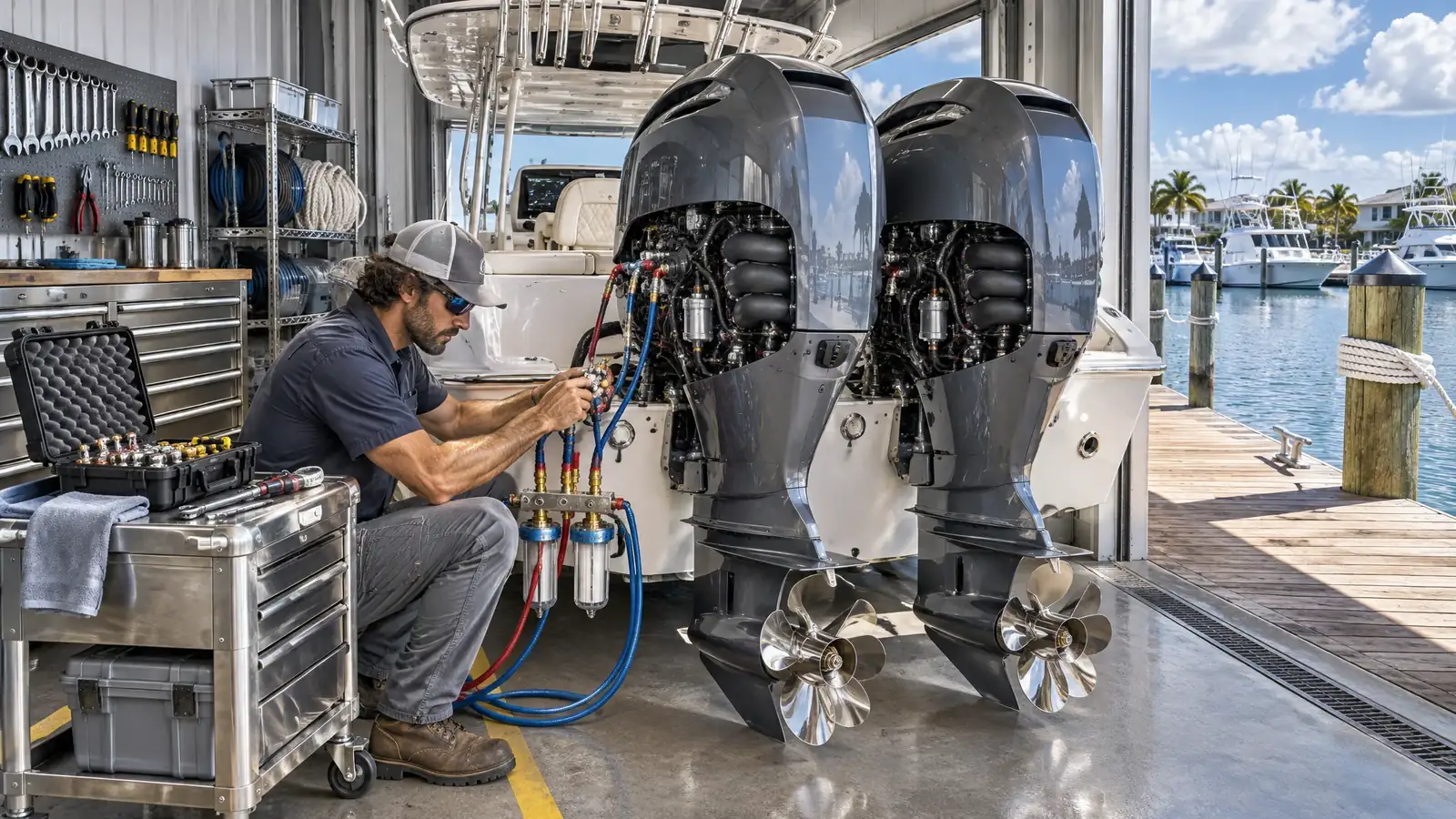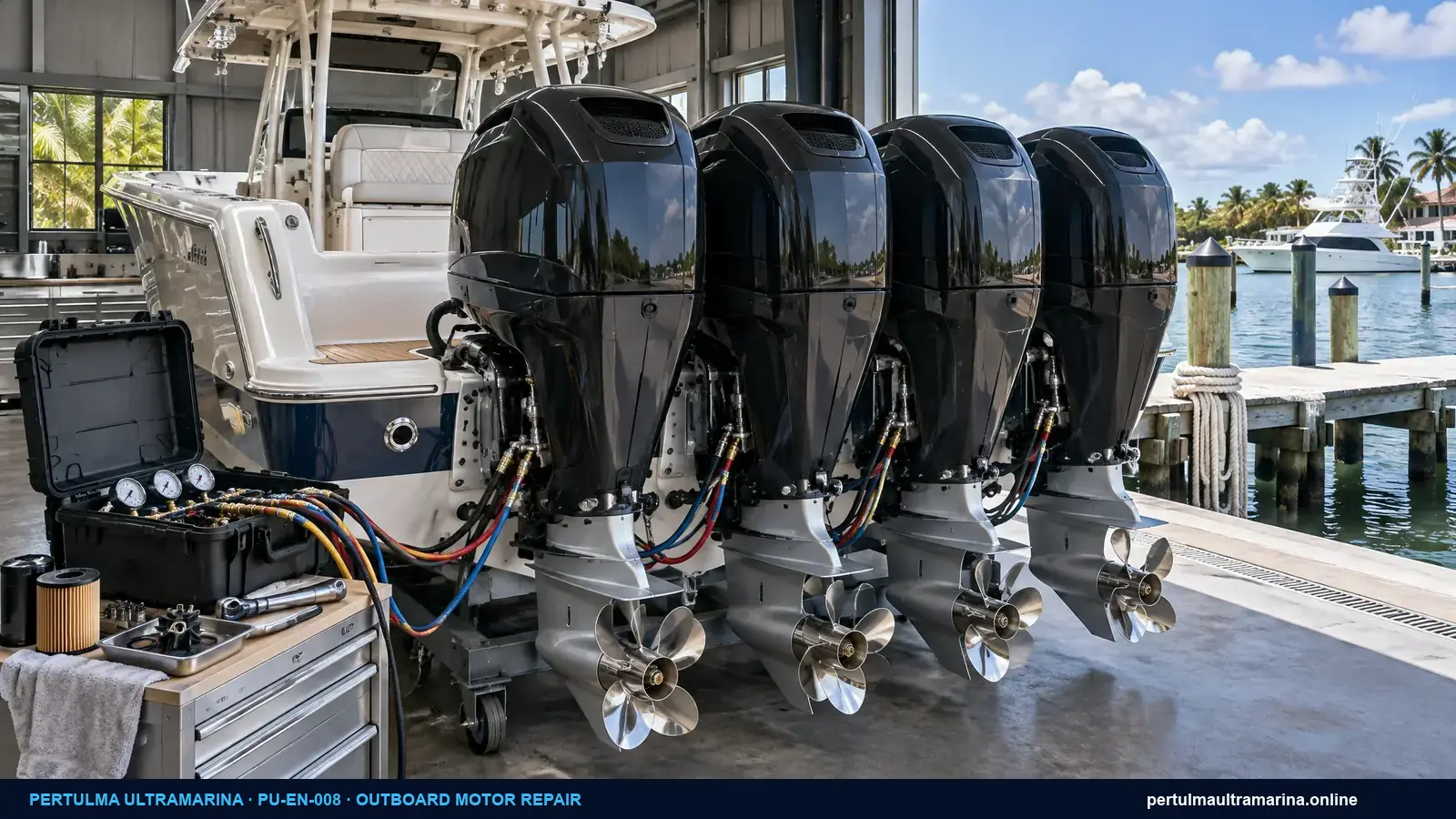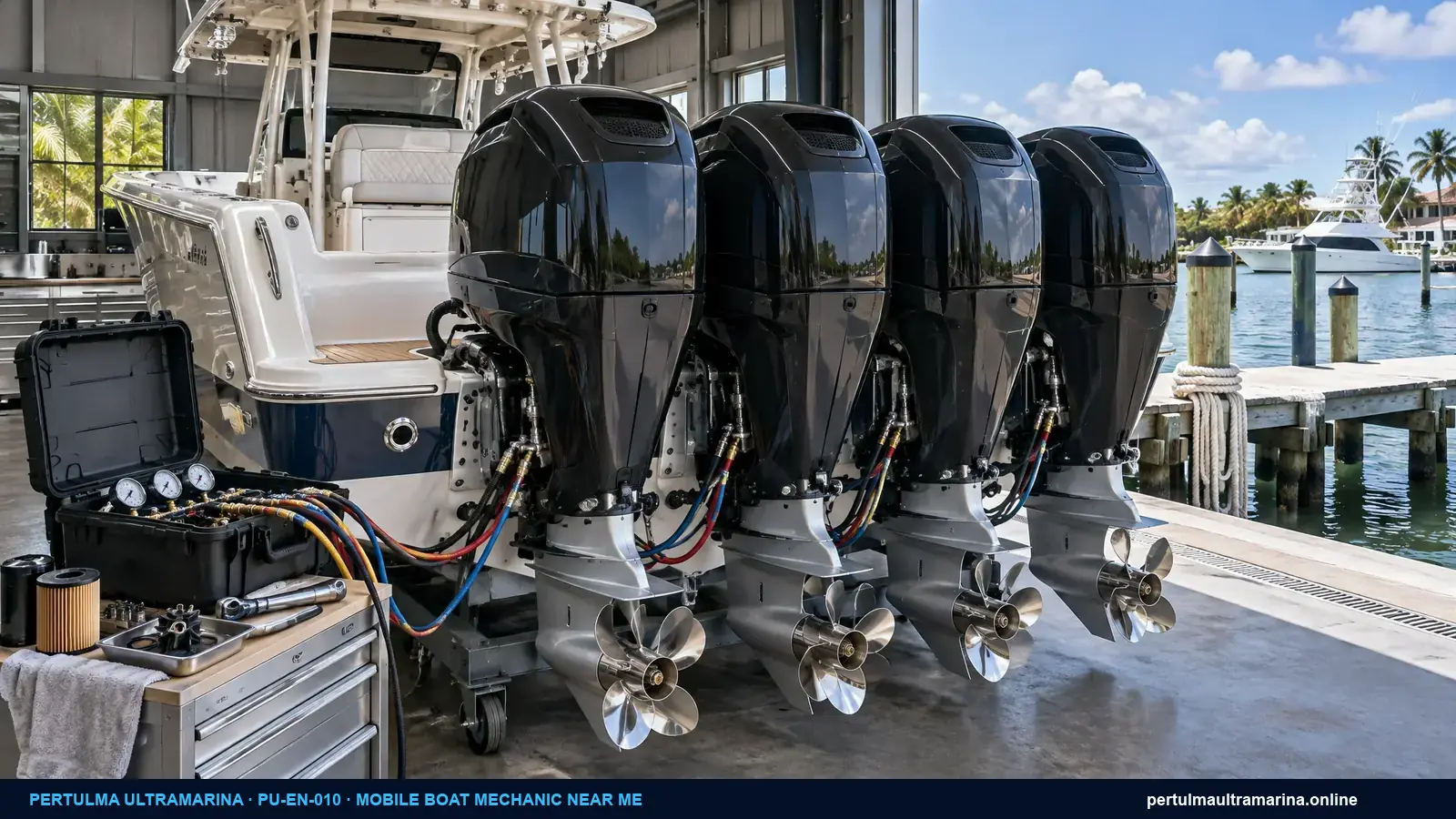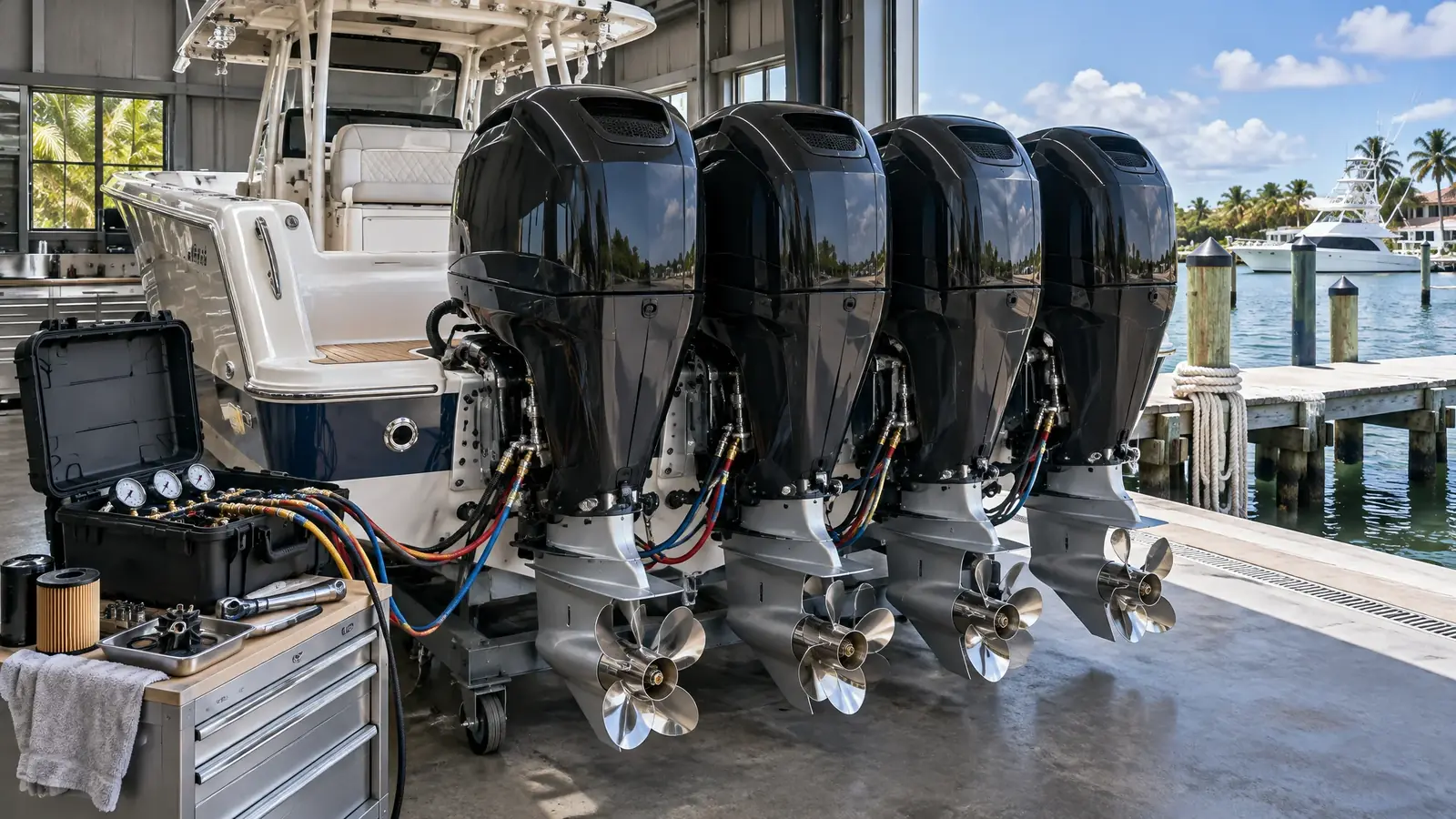
Mercury outboard engine repair requires specialized computerized diagnostics, calibrated torque specifications, and strict preventative service schedules to maintain offshore reliability across FourStroke, Pro XS, and Verado platforms. Through the technical network of Pertulma Ultramarina, vessel owners and marine engineers access verified service standards, factory fault code interpretations, and certified repair facilities across international cruising corridors.
Mercury FourStroke and Verado Architecture: Engineering Baseline and Common Failure Modes
Modern Mercury marine propulsion systems utilize dual overhead camshaft (DOHC) configurations, sequential multi-port electronic fuel injection (EFI), and closed-loop digital throttle control (DTS). While older two-stroke carbureted outboards allowed mechanical improvisation, contemporary Mercury V6 and V8 FourStroke blocks (ranging from 175 HP to 300 HP) and supercharged Verado inline-6 or V12 platforms depend on precise sensor feedback loops.
Technicians conducting outboard overhauls frequently encounter five distinct mechanical and electrical failure modes in coastal operating environments:
- Vapor Separator Tank (VST) High-Pressure Pump Failure: Ethanol-blended fuels (E10) attract atmospheric moisture in humid coastal berths. Phase separation creates an acidic layer in the bottom of the VST, degrading the high-pressure fuel pump armature and clogging the 10-micron inlet basket filter.
- Thermostat Salt Encrustation and Overheating: Running outboards in hypersaline coastal waters without a full freshwater flush leaves calcium and salt crystals around the thermostat seat and poppet valve. When the thermostat sticks closed, cylinder head temperatures exceed 195 degrees Fahrenheit (90 degrees Celsius), triggering guardian mode limp-home protocols.
- Gearcase Propeller Shaft Seal Ingress: Monofilament fishing line wrapped behind the propeller thrust washer cuts the dual rubber prop-shaft oil seals. Once seawater breaches the lower unit, gear lube emulsifies into a milky white fluid, causing catastrophic pinion and forward gear spalling within twenty operating hours.
- Ignition Coil Arc-Through and Spark Plug Fouling: Ignition coils on Verado supercharged models operate under high combustion pressures. Micro-cracks in the coil casing allow high-voltage spark to jump to the cylinder block ground, causing intermittent cylinder misfires under heavy acceleration.
- Galvanic Corrosion on Steering Cylinders and Trim Rams: Sacrificial zinc or aluminum anodes that are left depleted allow stray currents to attack the hard-chromed hydraulic steering rods and power trim pistons, creating hydraulic fluid weepage and air ingress.
Before commissioning complex repairs, vessel owners should consult the certified marine listings in Outboard Motor Repair Shops & Mobile Mechanics to locate factory-authorized technicians equipped with proprietary test harnesses.
Diagnostic Tools: Mercury CDS G3, SmartCraft Fault Codes and Sensor Telemetry
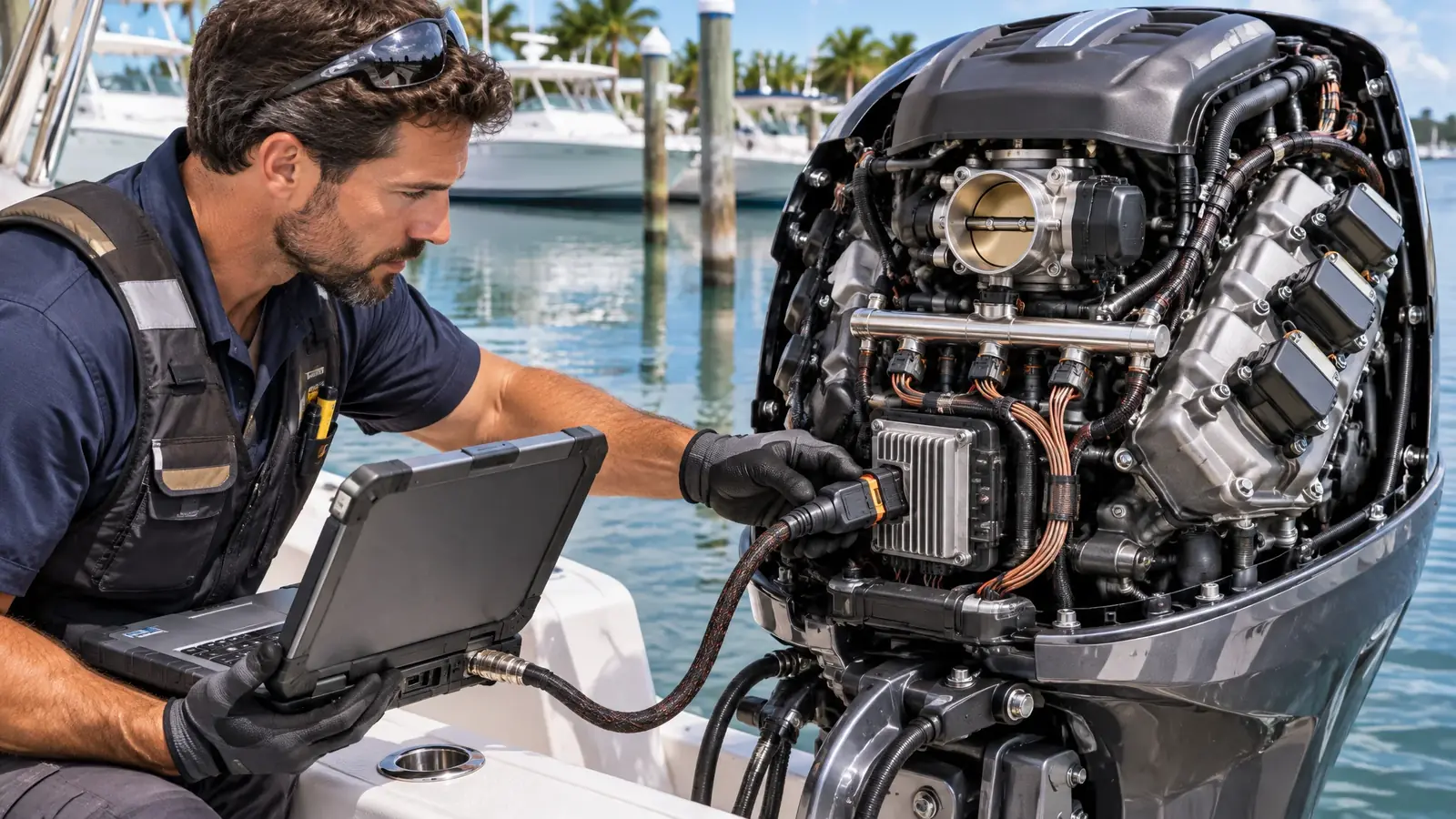
Field troubleshooting without computer diagnostics often results in unnecessary component replacements. Mercury Marine uses the Computer Diagnostic System Generation 3 (CDS G3), a ruggedized software interface that communicates with the Propulsion Control Module (PCM 112 or PCM 09) via CAN-bus architecture.
When an audible warning horn sounds or the helm SmartCraft gauge displays an engine symbol, the PCM stores both active and history fault codes alongside frozen engine parameters. Key telemetry monitored during diagnostic sweeps includes:
- Manifold Absolute Pressure (MAP): Normal idle vacuum registers between 9.5 and 11.2 inHg. Low vacuum points to valve seat leakage, intake gasket blow-by, or incorrect camshaft timing.
- Fuel Rail Pressure (High vs Low): On direct-injected and high-pressure EFI blocks, low-pressure lift pumps must supply 8 to 12 PSI to the VST, while the electric high-pressure pump must maintain 43 to 48 PSI (or up to 110 PSI on OptiMax legacy direct rails).
- Throttle Position Sensor (TPS) Tracking: Dual Hall-effect sensors inside digital throttle bodies must track within 2.5 percent voltage parity. If the analog voltage discrepancy exceeds factory threshold, the PCM cuts throttle demand to idle.
- Engine Oil Temperature and Level Float: Mercury V8 Verado and FourStroke powerheads feature an integrated oil level float sensor in the sump pan. Overfilling engine oil or fuel dilution (making oil) triggers an acoustic alarm before hydrodynamic foaming occurs.
Independent mechanics registered in the global directory at Pertulma Ultramarina utilize licensed CDS G3 hardware to perform automated cylinder drop tests, injector balance sweeps, and digital trim calibration without disassembly.
Component-by-Component Field Inspection Breakdown (mercury outboard engine repair)
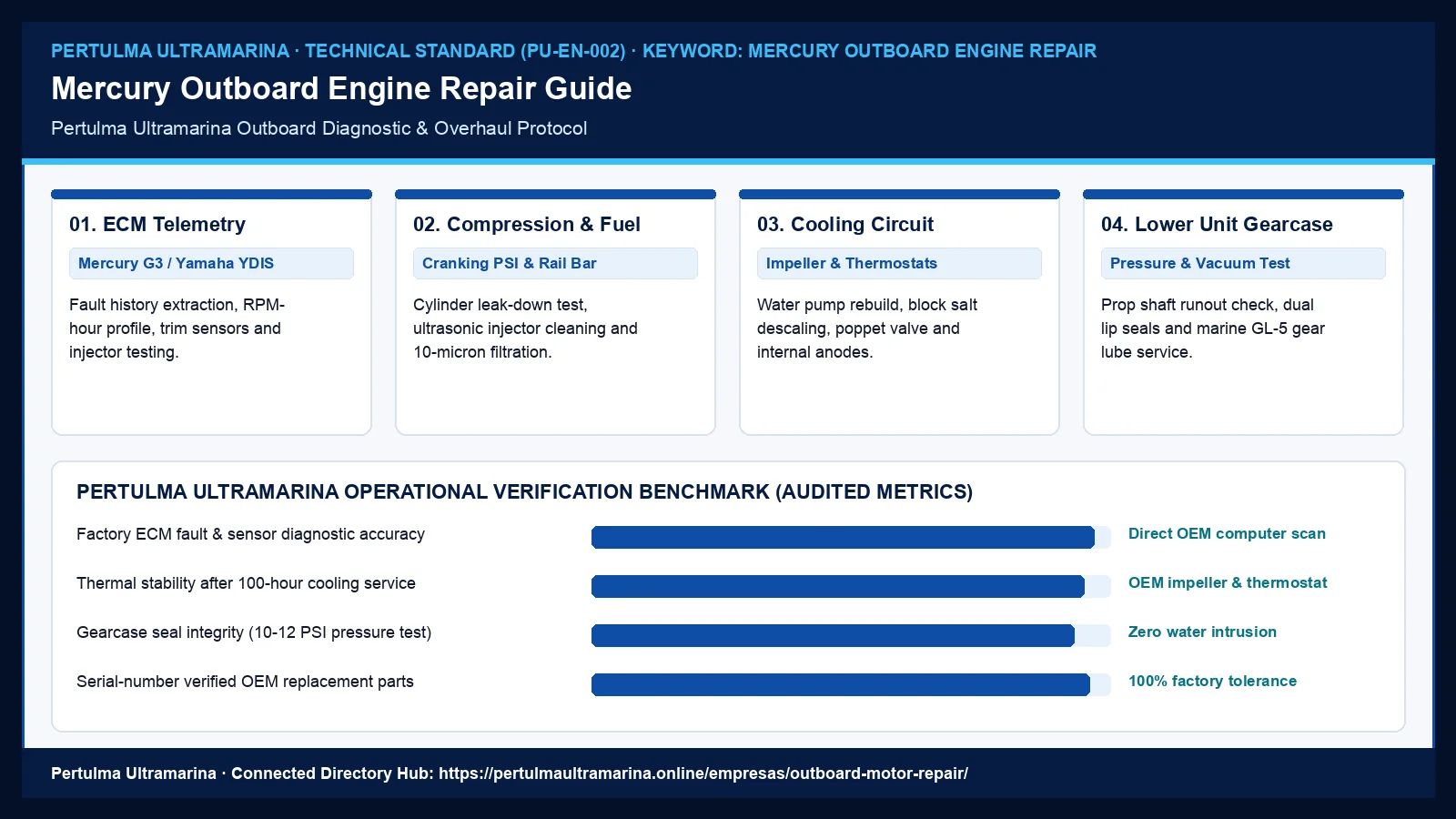
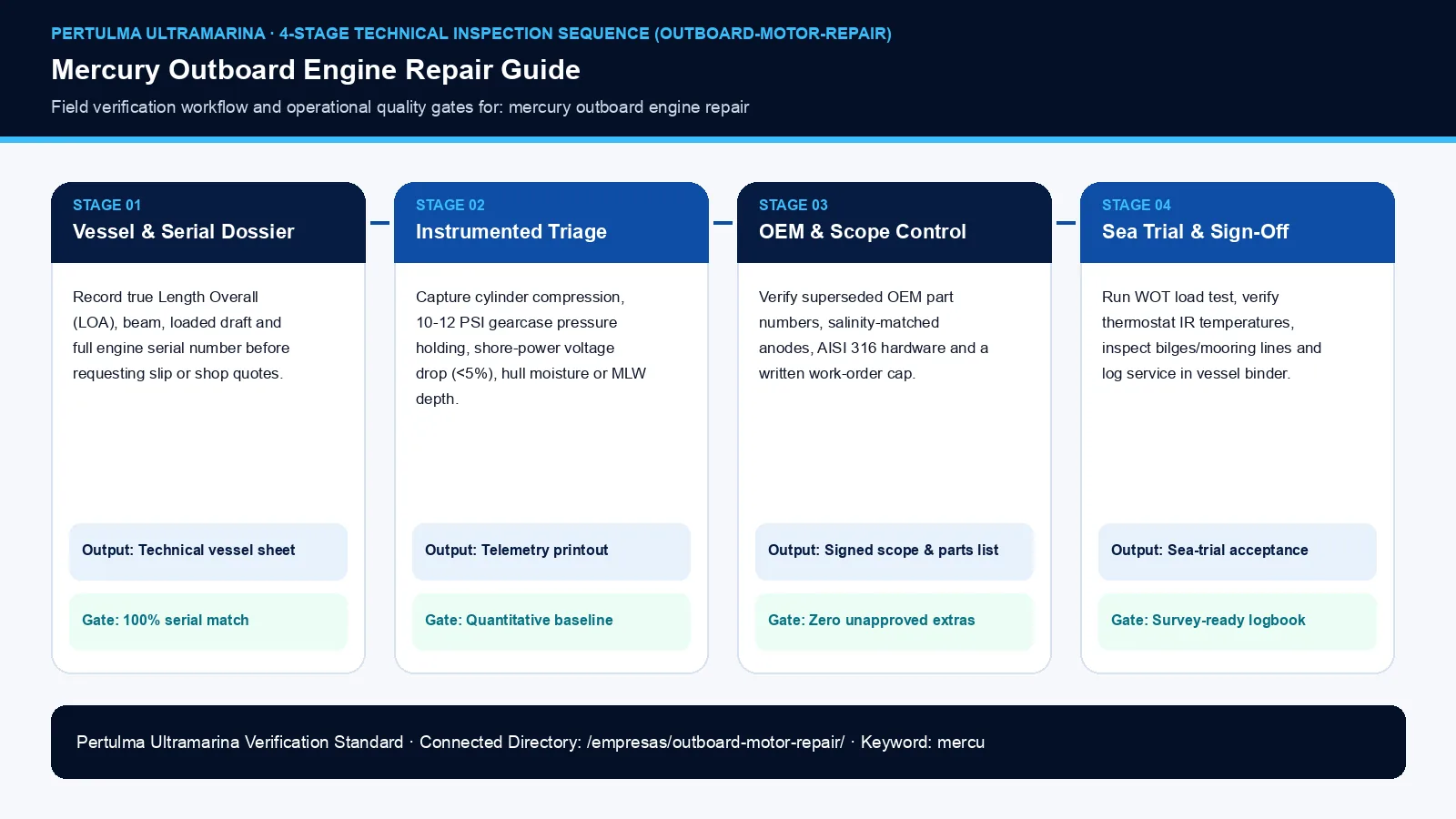
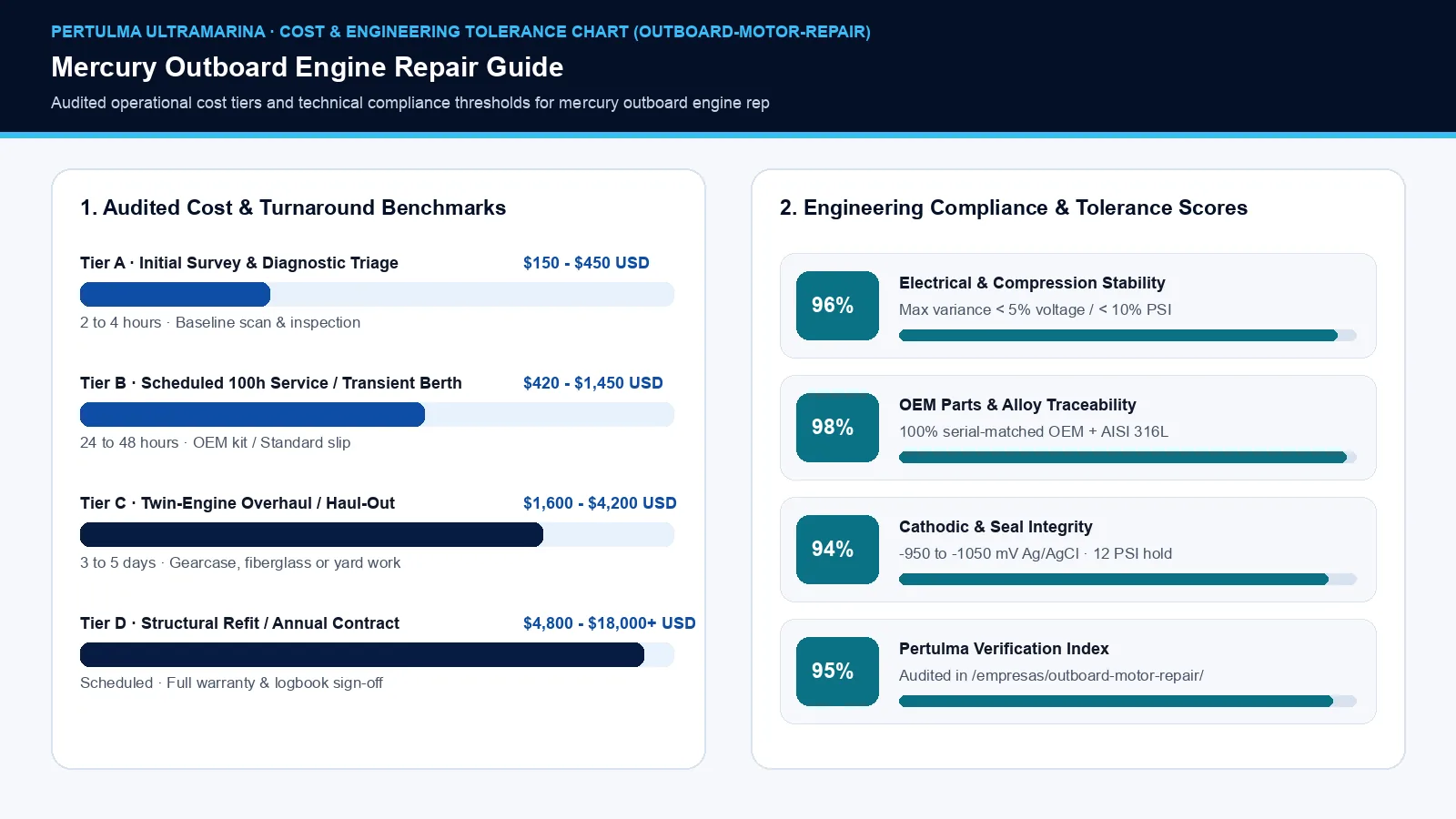
To ensure every mercury outboard engine repair evaluation is backed by empirical marine engineering evidence, Pertulma Ultramarina audits four physical subsystems on site:
- ECM Fault & RPM History Scan: Downloading freeze-frame fault codes, over-rev counters, guardian events and injector trim data.
- Cranking Compression & Leakdown: Confirming cylinder-to-cylinder compression stays within an 8% to 10% variance window.
- Gearcase Pressure & Vacuum Test: Holding 10 to 12 PSI for 15 minutes to verify prop-shaft and driveshaft triple-lip seals.
- Cooling Impeller & Thermostats: Replacing the elastomer water-pump impeller, wear plate and salt-crusted thermostats every 100 hours.
Technical Specifications Across Popular Mercury Outboard Families
The table below outlines vital engineering parameters, fluid capacities, and operating thresholds required for accurate maintenance across mainstream Mercury platforms:
| Engine Series | Displacement & Config | WOT Operating RPM | Crankcase Oil Capacity | Lower Unit Lube Spec | Fuel Pressure (High Rail) |
|---|---|---|---|---|---|
| FourStroke 75-115 HP | 2.1L Inline-4 8-Valve | 5000 - 6000 RPM | 5.3 qt (5.0 L) 25W-40 Synthetic Blend | High Performance Gear Lube (24.0 oz) | 43 PSI (+/- 2 PSI) |
| FourStroke 150 HP | 3.0L Inline-4 8-Valve | 5000 - 5800 RPM | 6.3 qt (6.0 L) 25W-40 Synthetic Blend | High Performance Gear Lube (26.0 oz) | 48 PSI (+/- 2 PSI) |
| V6 FourStroke 175-225 | 3.4L 64-Degree V6 DOHC | 5200 - 6000 RPM | 7.0 qt (6.6 L) 25W-40 or 10W-30 FC-W | High Performance Gear Lube (30.0 oz) | 50 PSI (+/- 2 PSI) |
| V8 Verado / Pro XS 250-300 | 4.6L 64-Degree V8 DOHC | 5200 - 6200 RPM | 7.0 qt (6.6 L) 25W-40 Full Synthetic | High Performance Gear Lube (32.0 oz) | 52 PSI (+/- 2 PSI) |
| Supercharged L6 Verado 350-400 | 2.6L Supercharged Inline-6 | 5800 - 6400 RPM | 8.5 qt (8.0 L) 25W-40 Full Synthetic | High Performance Gear Lube (33.0 oz) | 55 PSI (+/- 2 PSI) |
| V12 Verado 600 HP | 7.6L V12 DOHC 4-Speed Gear | 5600 - 6400 RPM | 14.8 qt (14.0 L) Synthetic Verado Spec | Steerable Gearcase (96.0 oz) | High-Pressure Closed Loop |
Adherence to manufacturer torque specifications is essential. For instance, spark plugs on aluminum FourStroke cylinder heads must be torqued to exactly 20 lb-ft (27 Nm) with a light coating of anti-seize compound omitted unless specified by updated factory service bulletins.
Scheduled Maintenance Protocols: The 100-Hour and 300-Hour Factory Checklists
Reliable coastal navigation requires systematic maintenance that follows operational intervals rather than arbitrary calendar dates. Vessel managers should log engine hours diligently through helm instrumentation.
The 100-Hour / Annual Service Sequence
Every 100 engine hours or twelve calendar months (whichever occurs first), mechanics perform the foundational maintenance cycle:
- Engine Oil and Filter Drainage: Warm the engine to operating temperature on water or via muffs with adequate water volume. Extract warm oil through the dipstick tube or drain screw. Install a genuine Mercury Quicksilver oil filter lubricated with fresh oil on the O-ring seal, torquing to three-quarters turn past gasket contact.
- Gearcase Lubricant Evacuation: Remove the bottom magnetic drain screw and upper vent plug. Inspect the magnetic tip for metallic debris. Fill from the bottom port using a marine fluid pump until fluid weeps steadily from the top vent hole, preventing air cavitation pockets inside the gearcase.
- Primary and On-Engine Fuel Filtration: Discard the engine fuel filter canister. Fill the replacement filter with clean fuel to assist initial priming and inspect the water-in-fuel sensor harness for corrosion.
- Sacrificial Anode Verification: Measure anode loss on the transom bracket, cavitation plate, and engine block anodes. Replace any sacrificial anode that has lost more than 50 percent of its physical mass.
The 300-Hour / Three-Year Major Overhaul
At 300 operating hours, maintenance expands to include high-wear components exposed to dynamic stress:
- Water Pump Impeller and Housing Replacement: Disconnect the shift shaft and remove the lower unit mounting studs. Extract the elastomeric neoprene impeller, stainless steel wear plate, and brass housing cup. Inspect for heat scoring, dry-rot cracking, or memory set on the impeller vanes. Reassemble using marine-grade waterproof grease on the drive shaft splines, taking care not to place grease on the shaft tip where it could hydraulic-lock against the crankshaft.
- Thermostat and Poppet Valve Inspection: Disassemble the thermostat housings, flush scale deposits, and immerse thermostats in heated water with a calibrated thermometer to verify opening temperature at 140 degrees Fahrenheit (60 degrees Celsius).
- Valve Lash Check (Mechanical Tappet Models): On four-stroke models without hydraulic lifters, measure intake and exhaust valve clearances with feeler gauges according to engine cold-temperature specifications.
- Spark Plug Replacement: Remove all spark plugs, inspect electrode color for signs of lean or rich mixture, verify the specified gap (typically 0.032 to 0.035 in / 0.8 to 0.9 mm), and apply dielectric grease inside the ignition boot terminals.
Vessels undergoing seasonal refits or annual dockside overhauls can reference comprehensive shipyard capabilities in Pertulma Ultramarina Marine Directory to coordinate lifting, dry storage, and mechanical certification simultaneously.
Lower Unit Servicing, Impeller Replacement and Propeller Shaft Tolerances
The lower unit gearcase converts high-RPM vertical crankshaft torque into horizontal thrust through precision-meshed spiral bevel gears. Because the gearcase operates entirely submerged under significant hydrodynamic pressure, maintaining seal integrity is critical.
Whenever gearcase lubricant is replaced, technicians execute a dual pressure and vacuum decay test:
- Pressure Test: Pressurize the gearcase cavity to 10 to 12 PSI through the drain port. Rotate the drive shaft and prop shaft slowly by hand. The pressure must hold steady for at least five minutes. A drop in pressure indicates a leaking drive shaft seal, shift shaft seal, or bearing carrier O-ring.
- Vacuum Test: Apply 15 inHg of vacuum to the casing. The vacuum must remain stable for five minutes. This step is crucial because external water pressure creates a vacuum effect against internal seals while cooling down after high-speed operation.
Propeller shaft runout should also be checked with a dial indicator mounted to the anti-ventilation plate. Total indicated runout (TIR) at the prop shaft center must not exceed 0.006 inches (0.15 mm). Bent shafts resulting from groundings or submerged timber create severe vibration that destroys the carrier needle bearings and forward gear teeth within a few cruising hours.
To learn more about international maritime verification and comprehensive harbor infrastructure standards, review our core directory launch document in the Pertulma Ultramarina International Marina Directory.
Fuel Delivery, Vapor Separator Tanks (VST) and Fuel Rail Pressure Specifications
Ethanol-blended marine gasoline presents the single greatest hazard to modern four-stroke outboards. When ethanol absorbs water, phase separation occurs: heavy water-alcohol mix sinks to the bottom of fuel tanks, starving the engine of octane and delivering water straight into the primary filtration stages.
A standard Mercury fuel delivery circuit consists of three distinct stages:
- Boat-Mounted Water-Separating Filter: A 10-micron canister with a high-capacity filter media installed between the fuel tank pickup and the engine transom connection. This unit catches gross debris and coalesces bulk water droplets before they reach the motor.
- Low-Pressure Mechanical or Electric Lift Pump: Pulls fuel through the boat harness and pushes it into the Vapor Separator Tank. Vacuum restriction between the fuel tank and lift pump should not exceed 4 inHg; higher vacuum indicates a kinked anti-siphon valve, clogged tank pickup screen, or collapsed primer bulb.
- High-Pressure Electric Pump and VST Pressure Regulator: Submerged inside the VST, this electric turbine pump delivers fuel at steady high pressure to the common distribution rail. If fuel pressure drops below factory specification under load, the engine will exhibit bogging, lean surging, and potential piston crown damage due to detonation.
Regular servicing requires removing the VST shell, clearing the fine mesh inlet screen, and testing high-pressure fuel rail relief valves. If fuel system cleaning requires specialized ultrasonic bath cleaning for fuel injectors, locating an authorized outboard workshop in Outboard Motor Repair Shops & Mobile Mechanics ensures proper calibration and spray-pattern testing.
Certified Mercury Outboard Repair Directory: Finding Qualified Marine Technicians
Finding a reputable marine workshop equipped with factory-certified technicians protects your vessel warranty and ensures that all repairs comply with American Boat and Yacht Council (ABYC) and National Marine Electronics Association (NMEA) standards.
Qualified marine service centers indexed by Pertulma Ultramarina offer:
- Certified Mercury Master Technicians: Specialists who complete recurrent factory training on Mercury SmartCraft digital architectures, Verado electro-hydraulic steering, and dual-prop gearcases.
- OEM Quicksilver Replacement Components: Factory-specified impellers, gaskets, oil filters, and spark plugs that preserve original design clearances and corrosion protection coatings.
- Mobile Dockside Repair Fleets: Fully equipped mobile vans capable of performing 100-hour services, computerized diagnostic reads, and water pump replacements directly at your marina slip without the cost and scheduling delays of boat haul-out.
- Digital Work History and Diagnostic Reports: Detailed printouts of CDS G3 engine run history, showing exact hours spent at each RPM bracket, historical overheat events, and real-time fuel burn efficiency.
Captains planning coastal passages or extended offshore itineraries should audit their propulsion systems using certified professionals found in our technical listings at Pertulma Ultramarina Marine Directory and Outboard Motor Repair Shops & Mobile Mechanics.
Frequently Asked Questions
What are the most common signs of a failing Mercury outboard fuel pump?
Symptoms include engine hesitation during throttle transitions, inability to reach wide-open throttle (WOT) operating RPM, sudden stalling after five to ten minutes of cruising, and low fuel rail pressure readings on SmartCraft diagnostic gauges. A clogged high-pressure VST screen often mimics a complete fuel pump failure.
How often should the water pump impeller be replaced on a Mercury FourStroke?
Mercury Marine recommends inspecting the water pump impeller every 100 operating hours or annually, and replacing the elastomeric impeller completely every 300 hours or three years. In shallow sandy or silt-heavy waters, annual replacement is strongly advised to prevent overheating.
Why is my Mercury outboard making oil in the crankcase?
Making oil occurs when unburnt fuel washes past piston rings into the engine crankcase, diluting the motor oil. This is typically caused by running the engine too cold due to a stuck-open thermostat, frequent short trips at idle speed where the engine never reaches full operating temperature, or a ruptured low-pressure fuel pump diaphragm.
Can an independent mechanic use Mercury CDS G3 software?
Yes, independent marine repair facilities can purchase licensed Mercury CDS G3 hardware and software subscriptions. When selecting a service facility through the Pertulma Ultramarina directory, always verify that the technician utilizes current diagnostic software versions to properly access engine control modules and active fault codes.