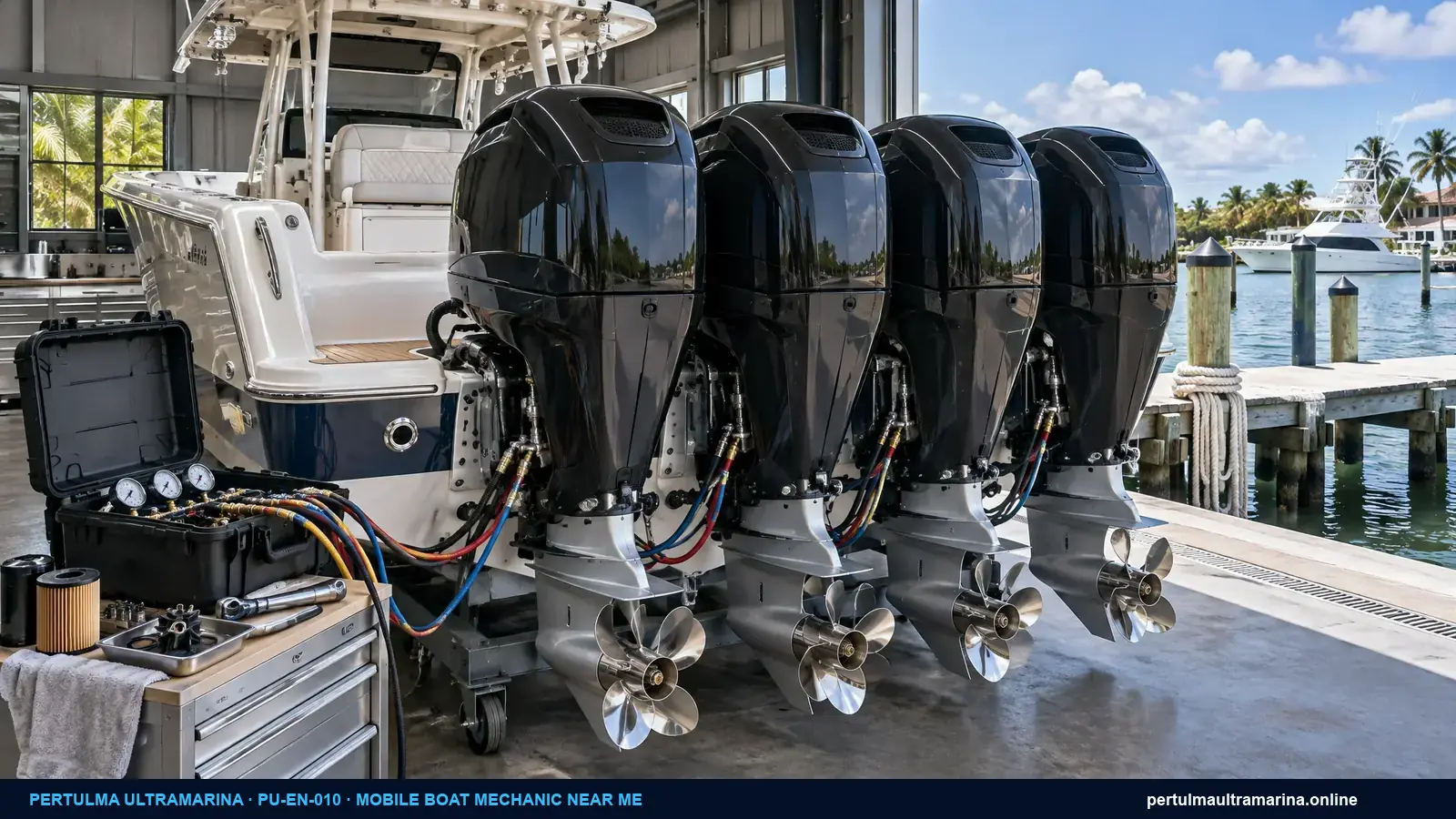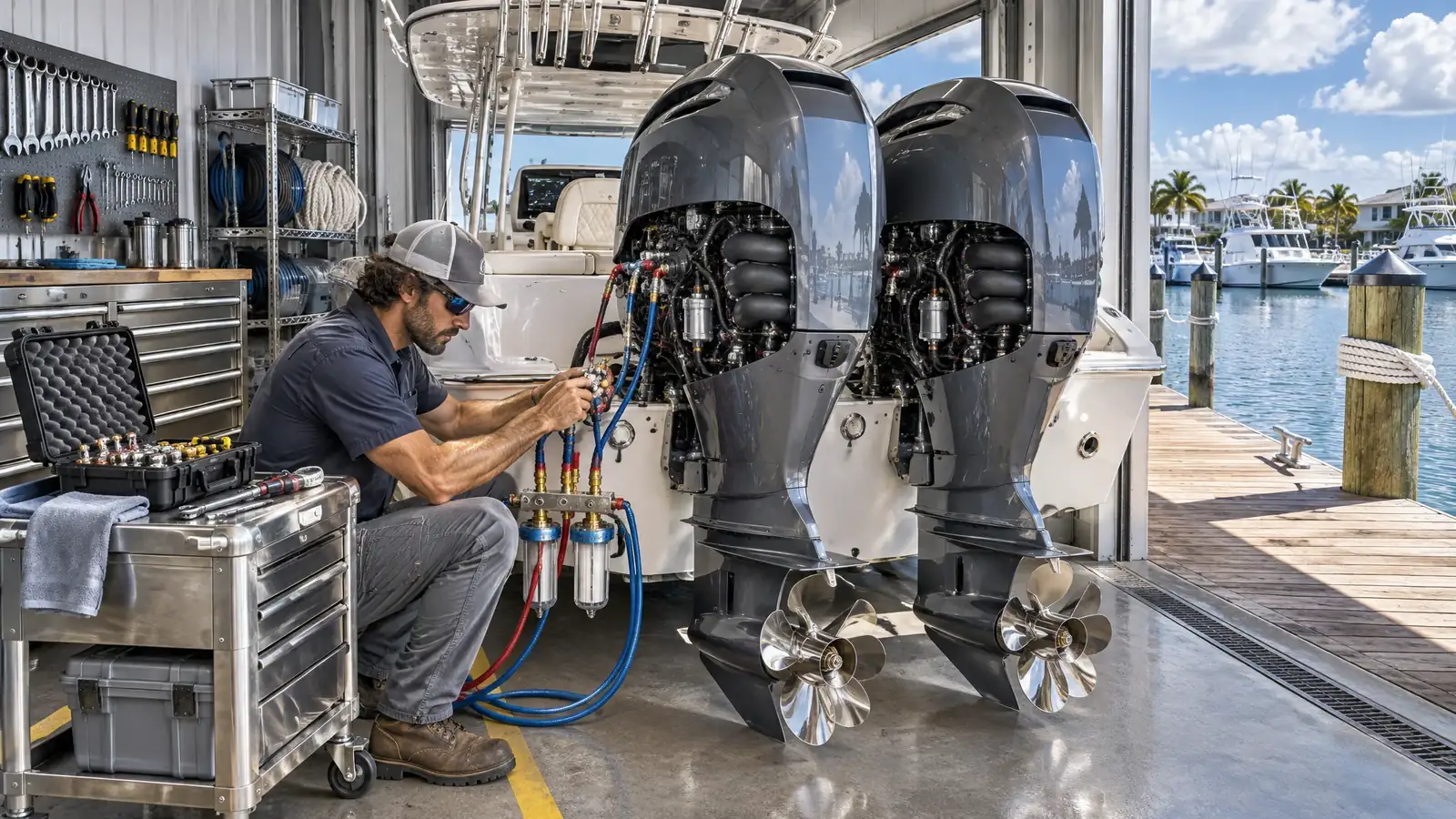
Hiring a qualified boat mechanic near me requires examining technical trade credentials, factory diagnostic subscriptions, and commercial insurance coverage before signing a binding marine work order. Through the engineering network of Pertulma Ultramarina, yacht owners and fleet captains access rigorous vetting criteria to audit mobile mechanics, independent marine workshops, and shipyard technicians across international recreational and commercial ports.
The Hierarchy of Marine Technical Credentials: ABYC, NMEA and Factory OEM Certifications
Unlike automotive repair, where state licensing and standardized ASE certifications provide baseline consumer safeguards, the marine industry features wide variations in technician qualification. An individual with basic mechanical hand tools can advertise as a marine mechanic without regulatory scrutiny. Entrusting modern electronic propulsion or high-voltage marine electrical systems to unvetted labor risks catastrophic electrical fires, underwater mechanical failure, and voided hull insurance.
Professional maritime institutions maintain rigorous certification tiers:
- American Boat and Yacht Council (ABYC): The recognized authority for voluntary boat manufacturing and repair safety standards. ABYC offers distinct certifications in Marine Systems, Marine Electrical, Gasoline Engines, Diesel Engines, Composites, and Corrosion Analysis. Technicians who achieve certification across three or more fields earn the prestigious status of ABYC Master Marine Technician.
- National Marine Electronics Association (NMEA): The benchmark for marine navigation, data networks, and electronic integration. Technicians holding Basic Marine Electronics Installer (MEI) and Advanced Marine Electronics Installer (AMEI) credentials specialize in NMEA 0183 and NMEA 2000 micro-c cabling, CAN-bus termination, and radar installation.
- Manufacturer Factory Certifications (OEM Master Technician): Conferred directly by propulsion manufacturers including Mercury Marine, Yamaha Marine, Suzuki Marine, Volvo Penta, and Cummins. These credentials require hands-on factory school testing, electronic diagnostic competency, and recurrent recertification every two years.
Captains seeking verified marine workshops with documented trade certifications can search our global registry in Outboard Motor Repair Shops & Mobile Mechanics.
Marine Technician Certification Audit Matrix
The table below outlines core marine technical credentials, certifying bodies, examination requirements, and critical competencies verified by Pertulma Ultramarina:
| Certification Title | Issuing Institution | Recertification Interval | Core Technical Competencies | Critical Verification Parameter |
|---|---|---|---|---|
| ABYC Master Marine Technician | American Boat & Yacht Council | Every 5 years (CEU units) | Electrical E-11, fuel systems, hull plumbing, corrosion mitigation | Minimum 3 concurrent ABYC specialized modules |
| NMEA Certified Marine Electronics | National Marine Electronics Assoc. | Every 3 years | NMEA 2000 backbone load calculation, radar RF safety, AIS transponders | Verification of certified digital test harness |
| Mercury Master Outboard Technician | Mercury Marine University | Every 2 years | CDS G3 software, SmartCraft digital throttles, Verado superchargers | Active OEM dealer portal account and factory tool IDs |
| Yamaha Master Technician (YMT) | Yamaha Marine Technical School | Every 2 years | YDIS 3.0 telemetry, Command Link Plus, high-pressure fuel loops | Passing score on 5-day hands-on factory lab practical |
| ABYC Marine Corrosion Technician | American Boat & Yacht Council | Every 5 years | Silver/silver chloride reference electrodes, stray-current testing | Silver-cell potential test kit and isolation testing |
For deeper technical insight into factory outboard service workflows and diagnostic schedules, explore our companion manual on Outboard Repairs and Diagnostics.
Component-by-Component Field Inspection Breakdown (boat mechanic near me)
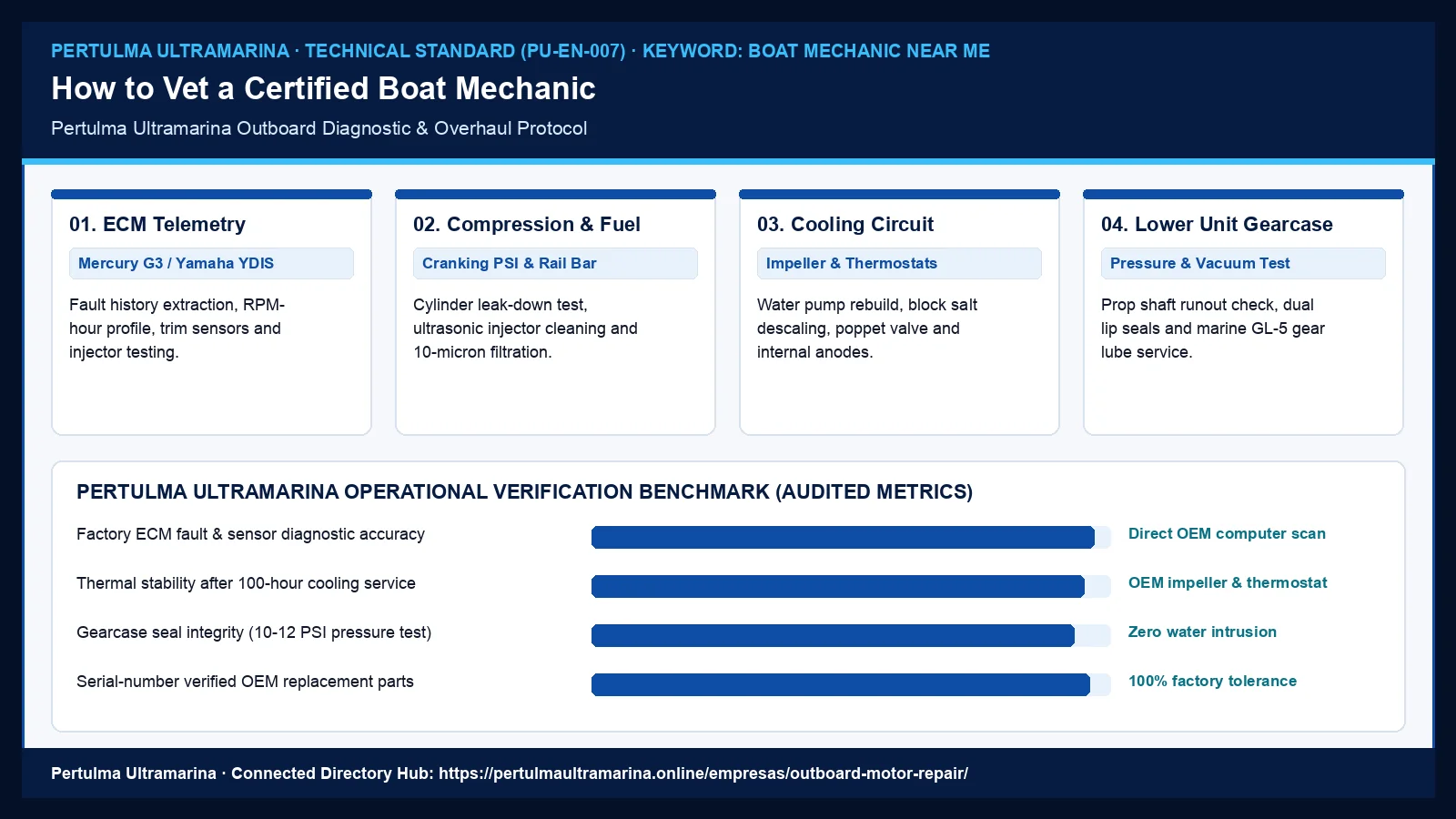
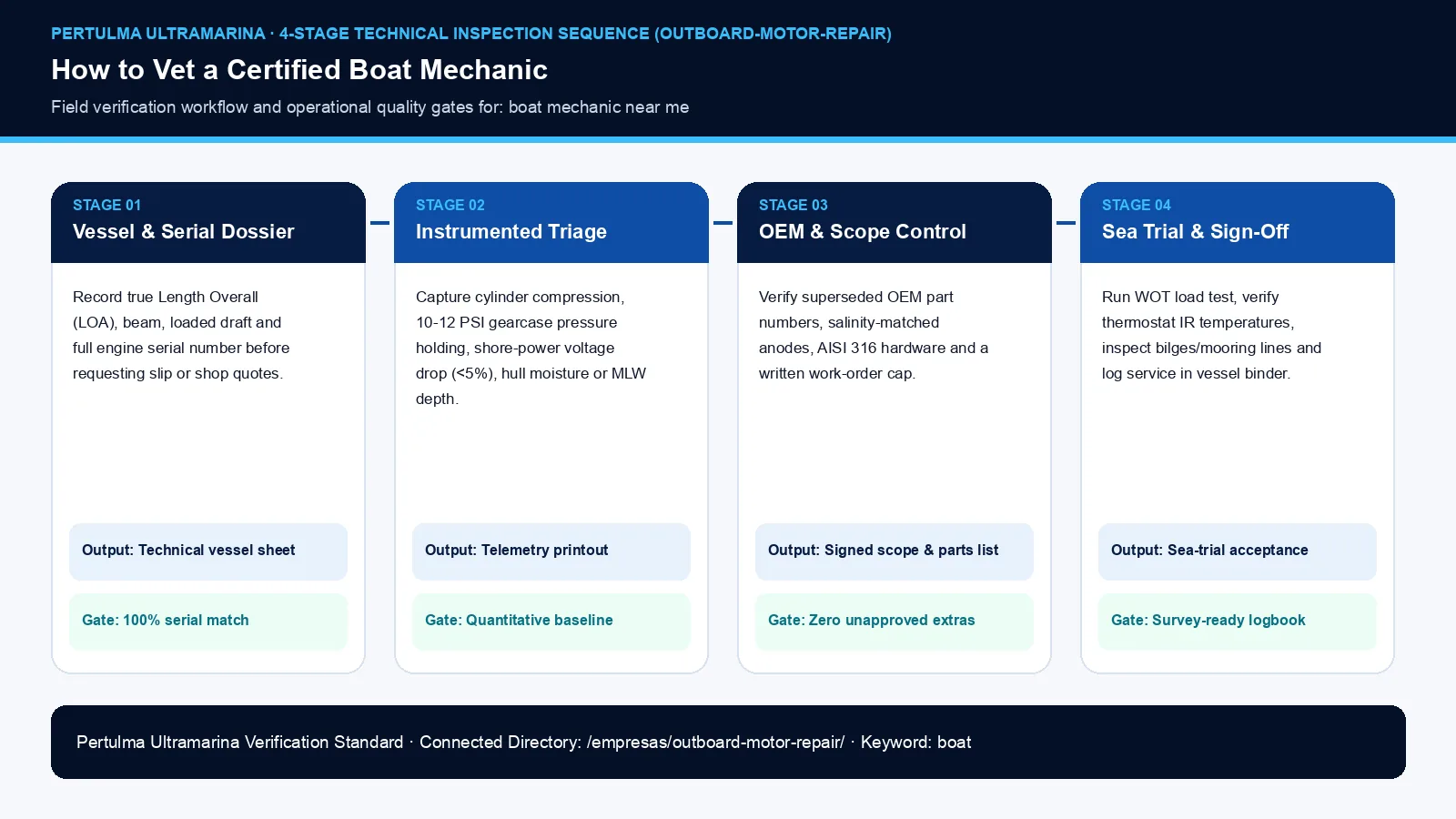
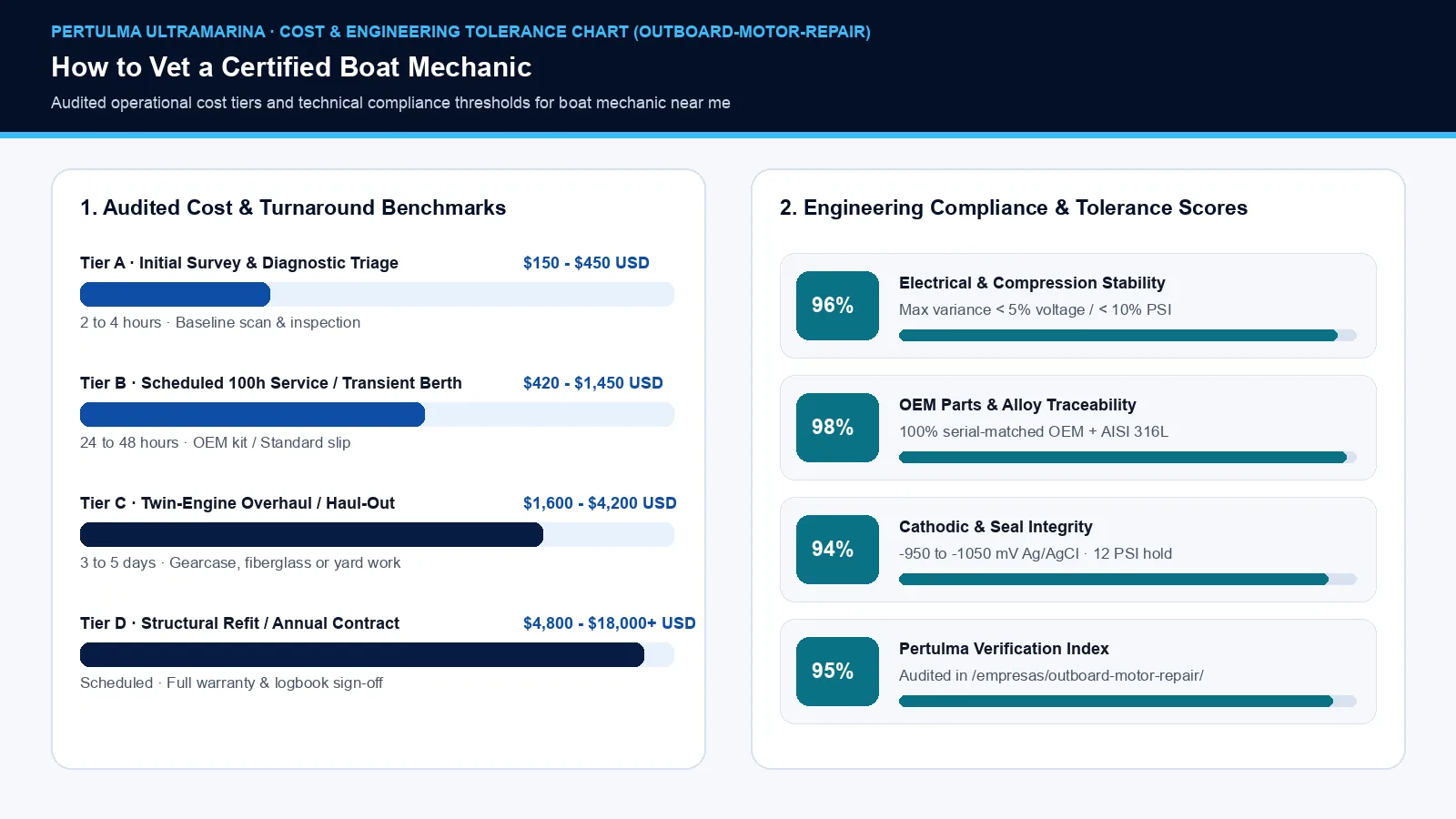
To ensure every boat mechanic near me evaluation is backed by empirical marine engineering evidence, Pertulma Ultramarina audits four physical subsystems on site:
- ECM Fault & RPM History Scan: Downloading freeze-frame fault codes, over-rev counters, guardian events and injector trim data.
- Cranking Compression & Leakdown: Confirming cylinder-to-cylinder compression stays within an 8% to 10% variance window.
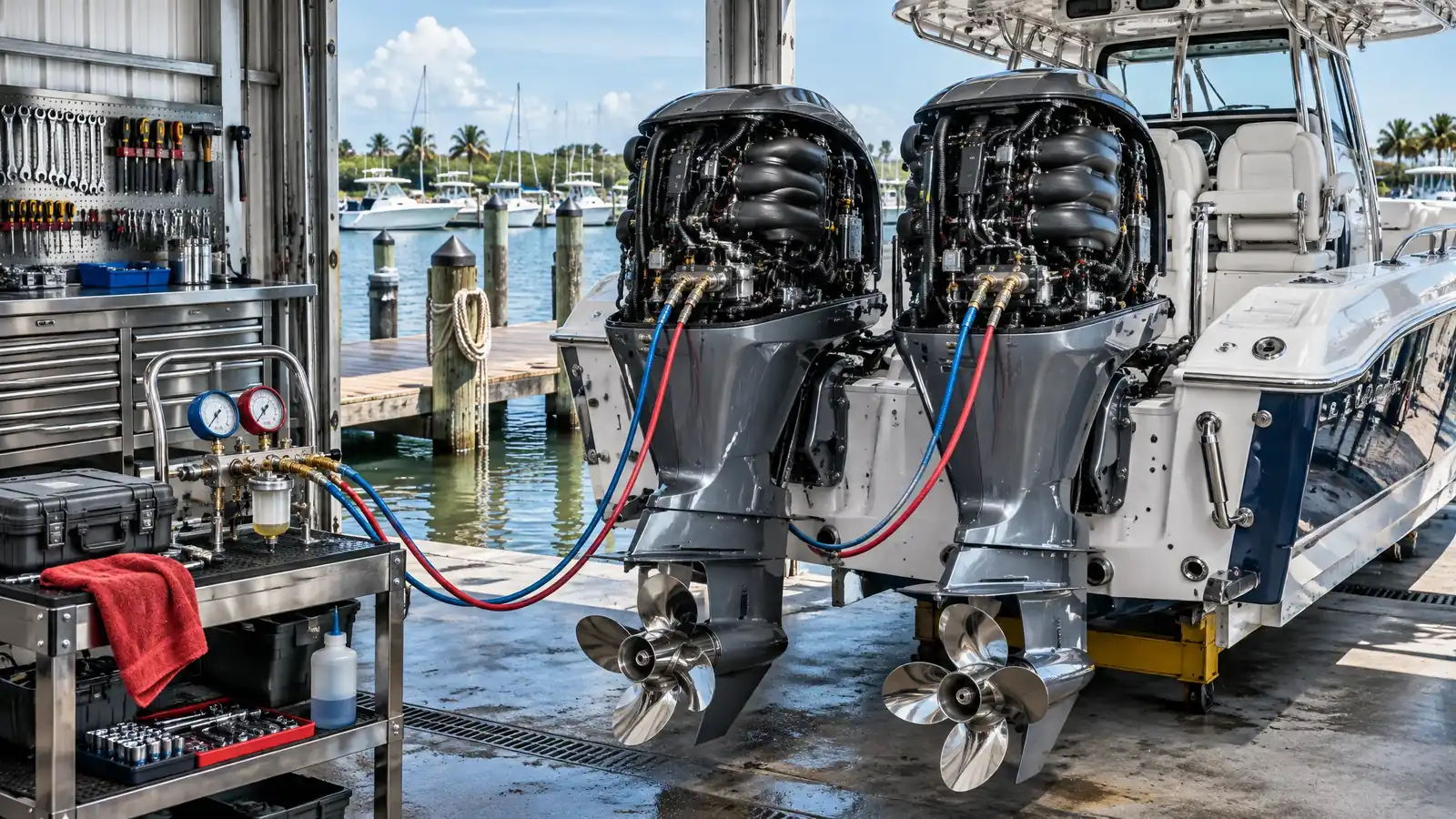
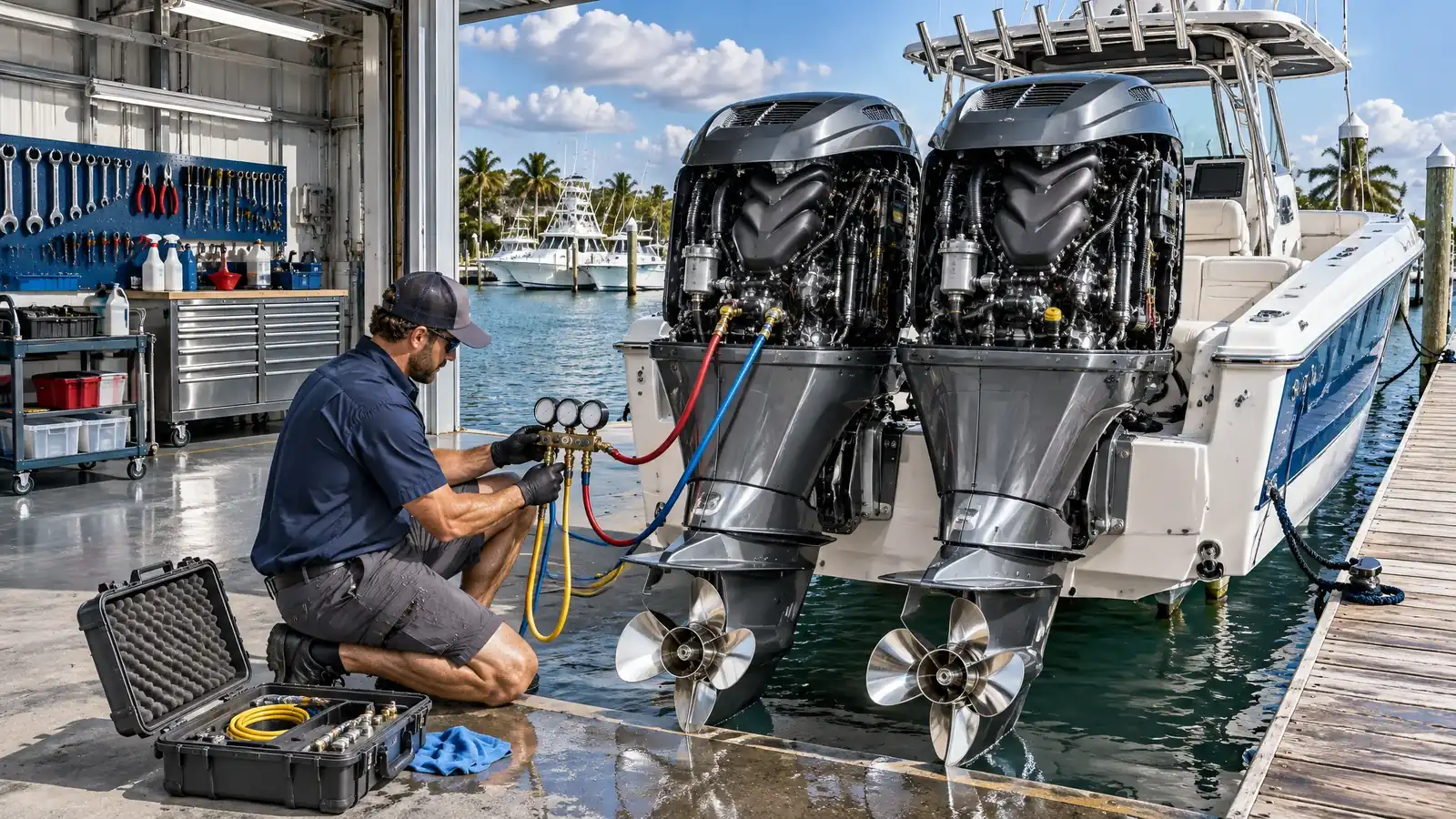
- Gearcase Pressure & Vacuum Test: Holding 10 to 12 PSI for 15 minutes to verify prop-shaft and driveshaft triple-lip seals.
- Cooling Impeller & Thermostats: Replacing the elastomer water-pump impeller, wear plate and salt-crusted thermostats every 100 hours.
Diagnostic Software and Tooling: Licensed OEM Kits vs Generic Automotive Scanners
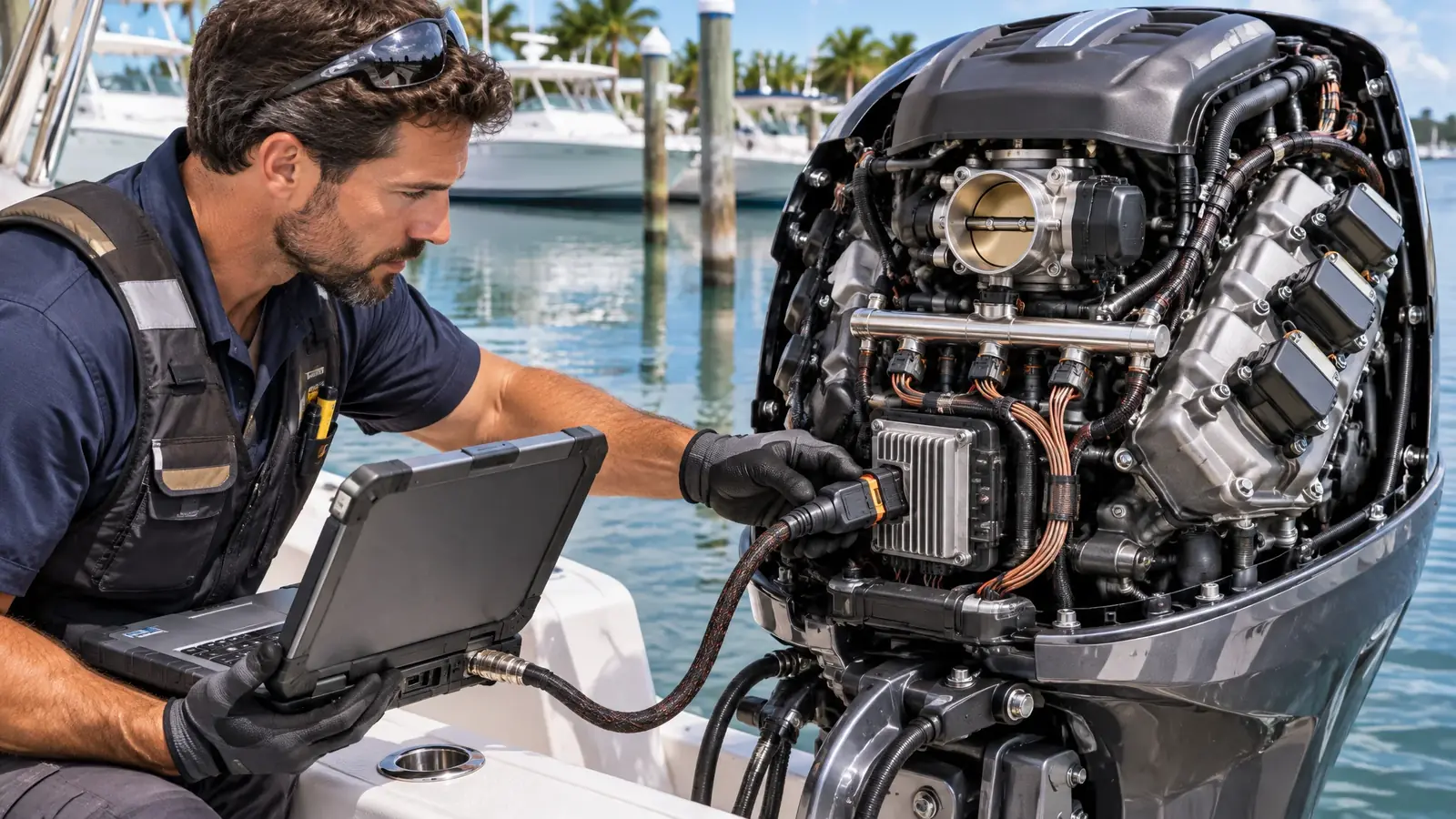
Modern four-stroke outboards and common-rail marine diesels rely on multi-sensor feedback loops and encrypted Engine Control Modules (ECM). Diagnostic sweeps performed with generic OBD-II automotive scanners or unlicensed reverse-engineered scan tools cannot read proprietary marine telemetry.
Before authorizing diagnostic labor, vessel managers should verify that the technician deploys legitimate factory interfaces:
- Mercury Marine CDS G3: A ruggedized diagnostic package operating on CAN-P and CAN-H networks. It commands dynamic injector kill sweeps, measures digital throttle position sensor voltage parity, tests poppet valve actuation, and pulls historical engine temperature histograms.
- Yamaha YDIS (Yamaha Diagnostic System): Software connecting to the engine diagnostic port to extract historical fuel-pressure drop data, active diagnostic trouble codes (DTC), knock sensor adaptation, and variable camshaft timing (VCT) advance angles.
- Calibrated High-Pressure Fuel Gauges and Manometers: Electronic multi-port fuel injection rails operate between 38 and 60 PSI (and over 100 PSI on direct-injection systems). Certified technicians use sealed brass gauge manifolds with relief valves to sample fuel under load without vapor hazards.
- Dynamic Digital Multimeters and Current Clamps: Automotive test lights have no place on modern vessels; piercing marine tinned-copper wire insulation introduces capillary saltwater wicking that destroys wiring harnesses. Certified marine technicians use non-invasive Hall-effect current clamps and digital multimeters with 10-megohm input impedance.
Captains planning routine maintenance or computerized fault scans can coordinate mobile dockside visits through our audited guide on Mobile Boat Repair Services.
Evaluating Marine Repair Work Orders, Labor Rates and Parts Traceability
A verbal agreement or handwritten estimate written on scrap paper is a major warning sign. Legitimate marine service providers utilize professional marine management software to generate detailed work orders with transparent flat-rate labor allocations.
When inspecting an estimate or work order before signing, audit the following items:
- Clear Scope of Work and Diagnosis Fees: The work order must clearly distinguish between initial diagnostic labor (typically 1.0 to 2.0 flat-rate hours) and downstream repair labor. Diagnostic fees should be credited toward approved repairs whenever feasible.
- Itemized OEM Part Numbers: The estimate must list individual manufacturer part numbers rather than generic descriptions like spark plugs or water pump kit. This ensures that the shop installs genuine OEM parts matched by engine serial plate rather than inferior aftermarket clones.
- Marine Flat-Rate Labor Hours: Professional boatyards bill mechanical labor according to established marine flat-rate manuals. Ask the service writer for the standard labor hour allocation for operations such as lower unit impeller replacement (typically 1.5 to 2.0 hours) or fuel VST overhaul (2.5 to 3.5 hours).
- Environmental and Shop Supply Surcharges: Transparent invoices separate hazardous material disposal fees (used crankcase oil, contaminated gasoline, spent antifreeze) from parts and labor, typically capping shop supplies at 5 to 10 percent of labor totals.
To compare comprehensive marine yard facilities and chandleries, explore our verified directory at Pertulma Ultramarina Marine Directory.
Insurance Verification, Liability Coverage and Marina Slip Access Rules
A mobile boat mechanic or subcontracted technician working on your boat at a marina dock presents significant liability risks. If an uninsured mechanic drops a heavy lower unit through your teak swim platform, sparks a fuel vapor fire, or suffers a personal injury while climbing onto your boat, the vessel owner and marina become targets for litigation.
Before granting dock access, demand a formal Certificate of Insurance (COI) that satisfies three legal thresholds:
- Commercial Marine General Liability: Minimum coverage of 1,000,000 to 2,000,000 dollars per occurrence, specifically including ship repairers legal liability endorsements.
- Longshore and Harbor Workers Compensation Act (USL&H): In the United States, maritime workers repairing vessels on navigable waters must be covered by federal USL&H insurance; state workers compensation policies explicitly exclude maritime injuries aboard floating vessels.
- Additional Insured Endorsement: The certificate of insurance must name the vessel owner and the specific marina facility as additional insured parties, providing a 30-day notice of cancellation.
When composite hull damage or structural gelcoat stress cracks are identified during mechanical inspections, consult vetted composite repair yards documented in Boat Fiberglass and Gelcoat Repair.
Red Flags When Hiring a Boat Mechanic: Warning Signs That Protect Your Vessel
Recognizing unqualified operators early protects your financial investment and keeps your propulsion systems dependable offshore.
Critical red flags that warrant terminating discussions immediately:
- Demanding 100 Percent Payment Up Front for Labor: Legitimate marine businesses may request a parts deposit for special-order engine blocks or major outdrives, but labor is billed upon completed milestones or post-repair sea trial verification.
- Absence of Dedicated Marine Commercial Vehicles: Professional mobile technicians arrive in organized vans equipped with oil evacuation drums, bench vises, and fire extinguishers. Mechanics operating out of passenger sedans without fluid containment setups violate clean marina regulations.
- Refusing to Return Replaced Worn Components: Industry ethical standards entitle the vessel owner to inspect all replaced components (such as scored impellers, corroded thermostats, or pitted gears) upon request.
- Reluctance to Perform a Post-Repair Water Test: A credible mechanic insists on water-testing the engine in the slip under gear load or during a brief sea trial to verify water pressure and fuel rail stability at wide-open throttle before closing the invoice.
Vessel owners can verify international harbor infrastructure, certified repair facilities, and master technicians by consulting the Pertulma Ultramarina International Marina Directory and our central homepage at Pertulma Ultramarina.
Frequently Asked Questions
What is the difference between an ABYC Certified Technician and an ABYC Master Technician?
An ABYC Certified Technician has passed a comprehensive written proctored examination in one specialized discipline, such as Marine Electrical or Marine Gasoline Engines. An ABYC Master Technician has achieved certification in three or more concurrent specialties, demonstrating cross-disciplinary mastery across electrical, mechanical, and hull systems.
Does an automotive mechanic have the required skills to repair a modern boat engine?
While fundamental internal combustion principles are similar, marine propulsion systems operate under continuous heavy torque loads and harsh corrosive saltwater environments. Marine engines utilize raw-water cooling circuits, Vapor Separator Tanks, water-in-fuel sensors, and explosion-proof marine starters and alternators complying with SAE J1171 safety standards that generic automotive mechanics are not trained to diagnose.
Can a certified mobile boat mechanic perform warranty repairs on a new engine?
Yes, provided the mobile mechanic operates an authorized OEM service franchise with factory credentials and active diagnostic subscriptions. Performing non-warranty servicing with genuine OEM parts and maintaining detailed service records will also protect your factory warranty rights under federal consumer law.
What should I do if a marine mechanic causes damage to my vessel?
Immediately document all damage with high-resolution photographs, halt further work on the vessel, and notify both your marine hull insurance carrier and the mechanic liability insurer named on their Certificate of Insurance. Never allow an unvetted third party to attempt makeshift repairs before an independent marine surveyor completes a formal damage inspection.