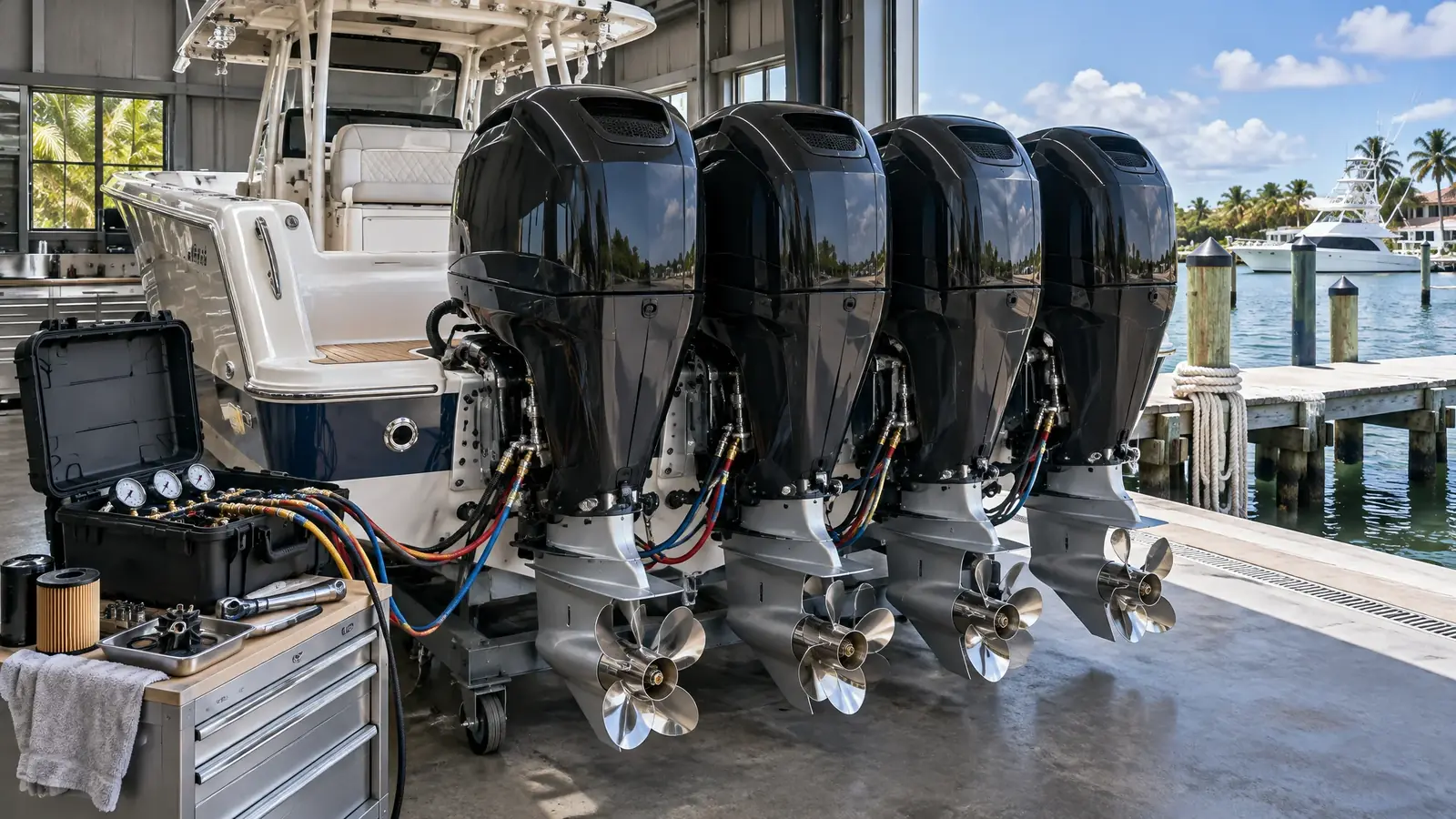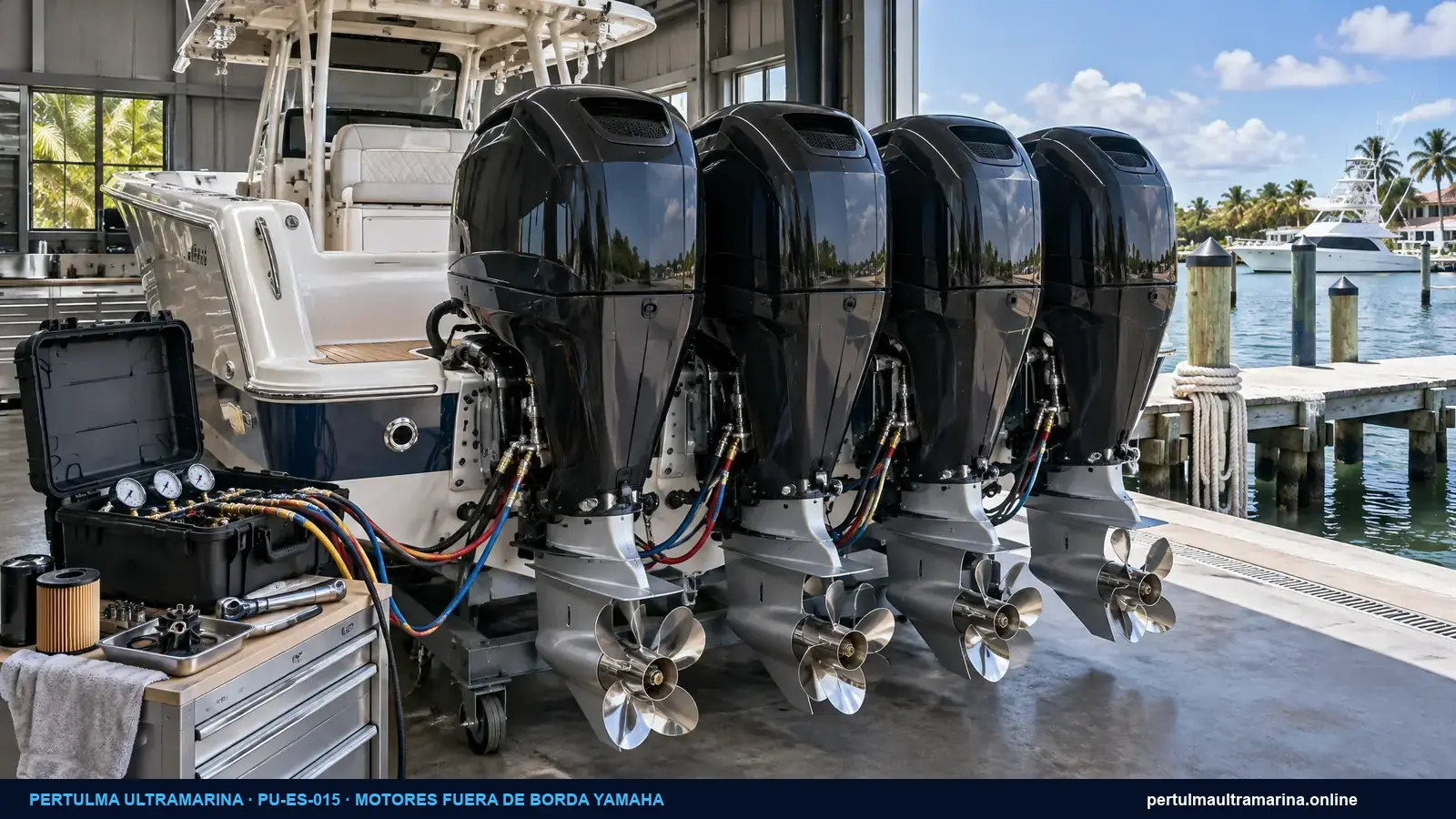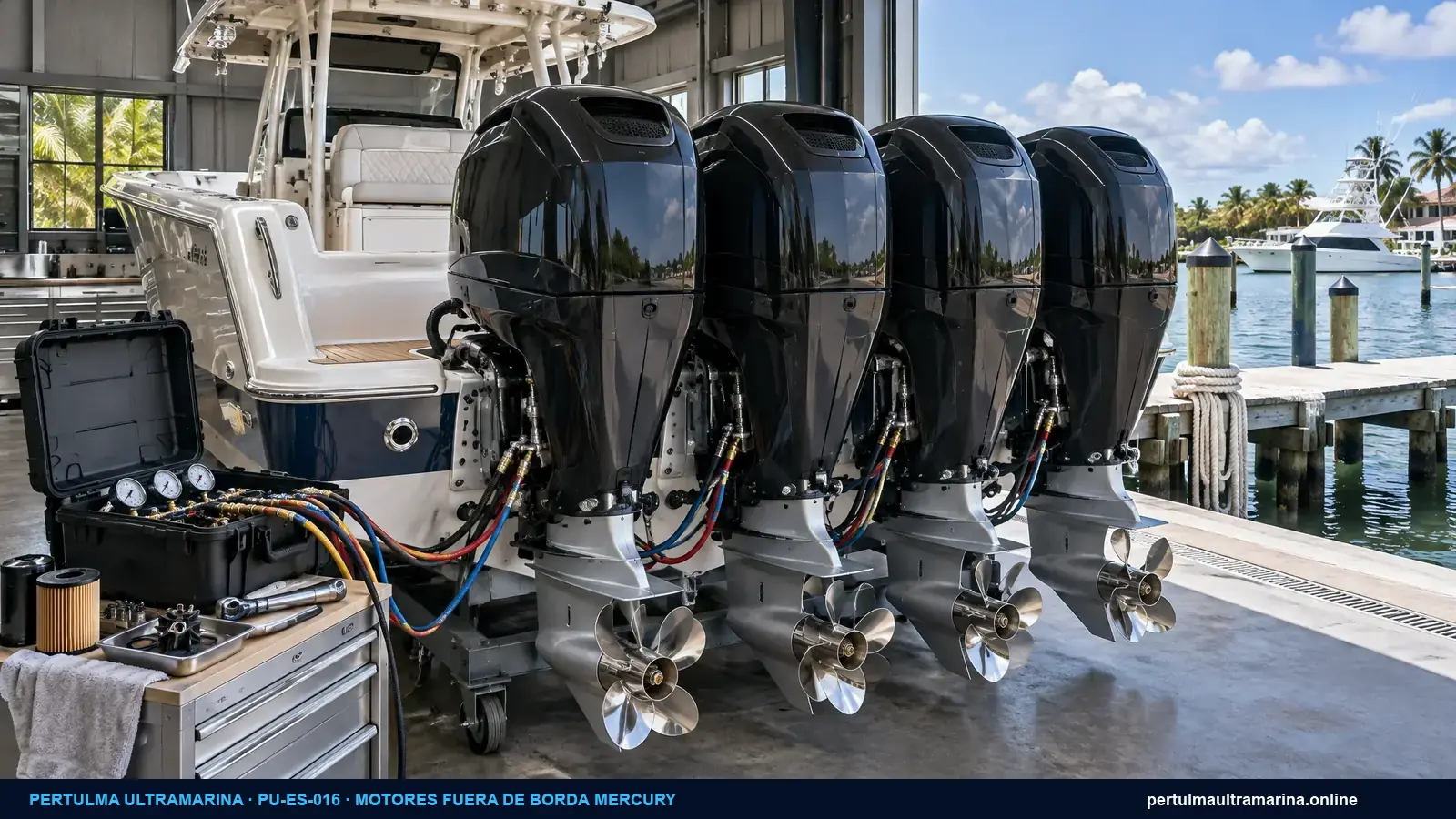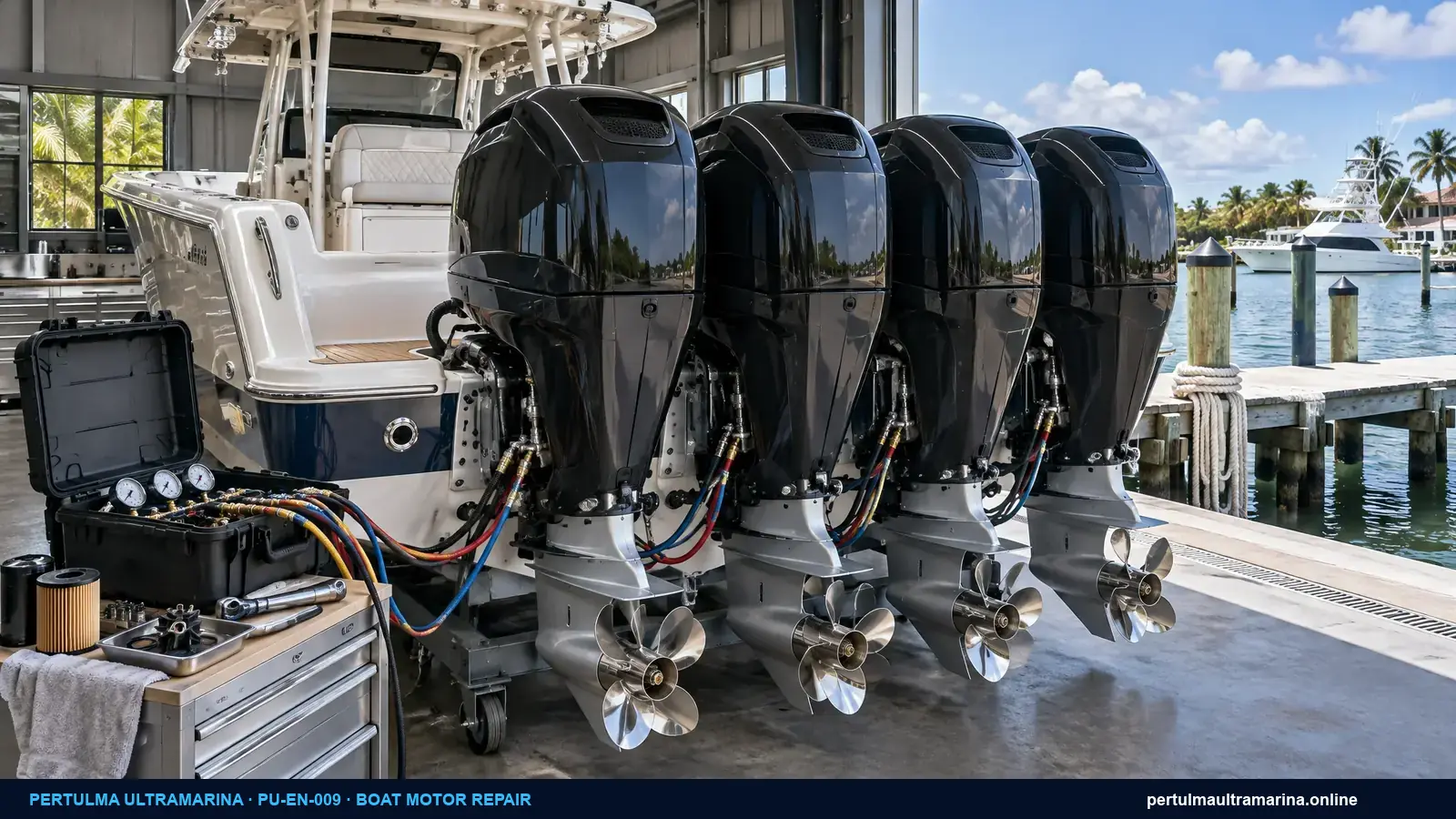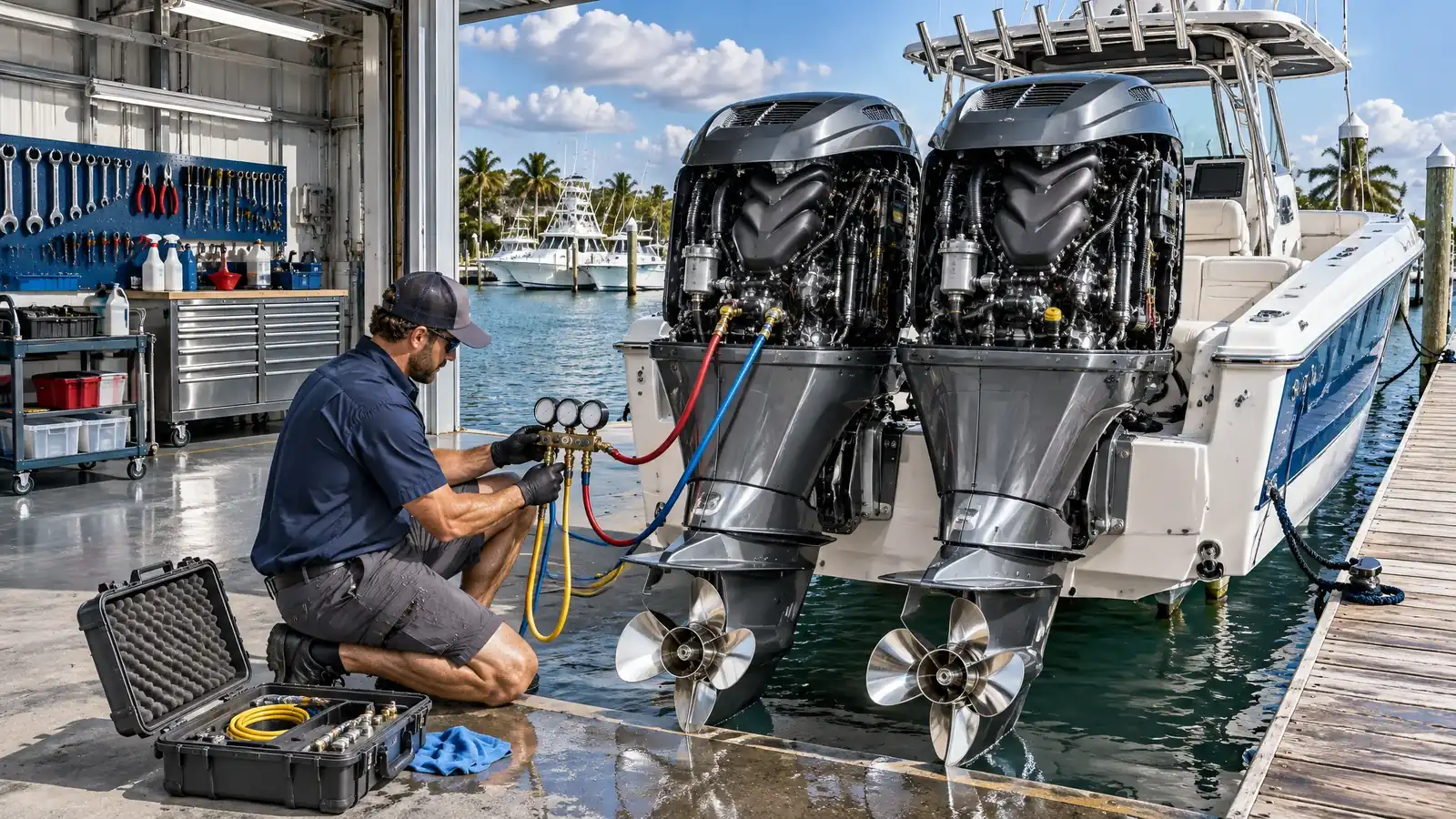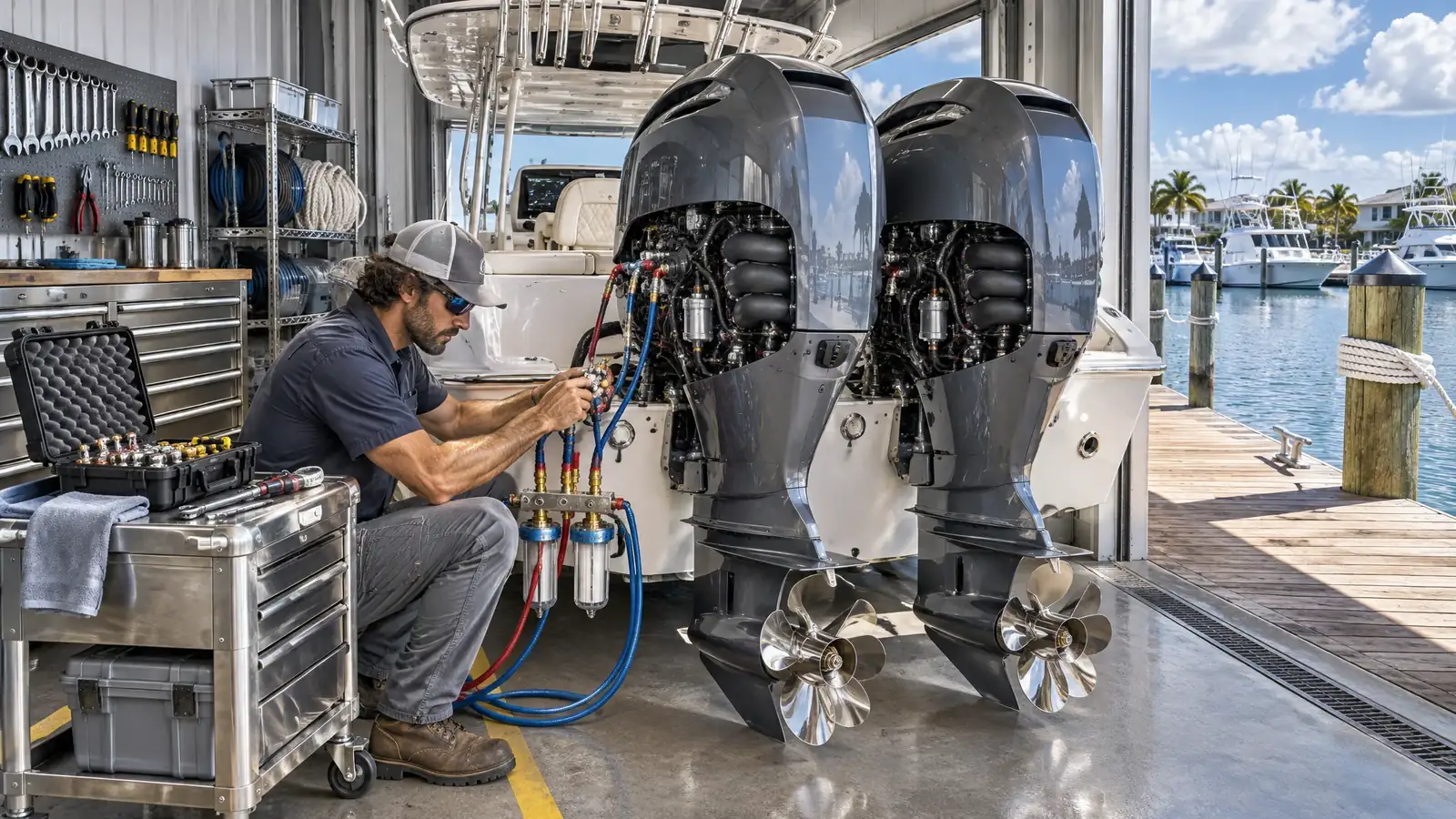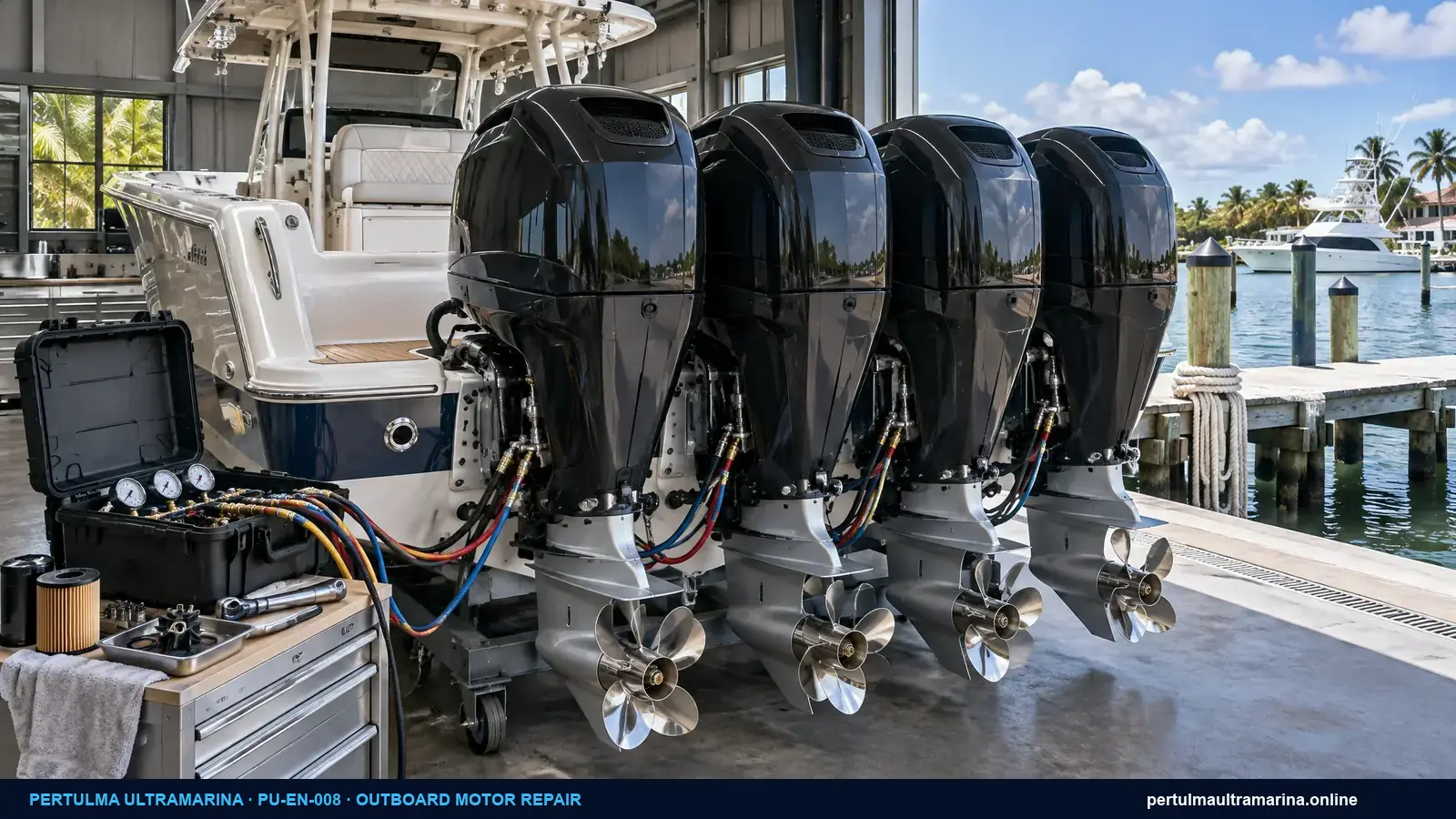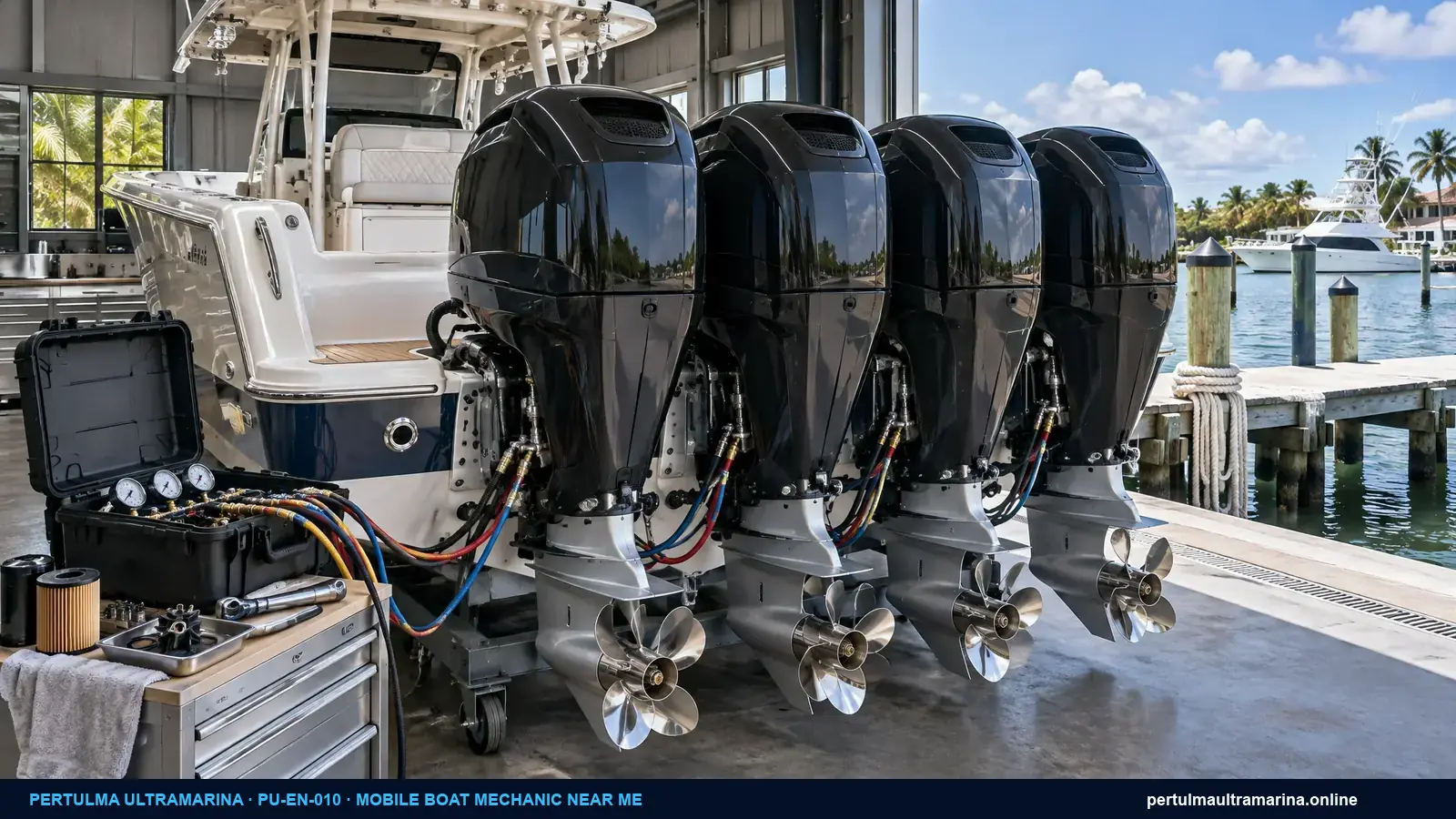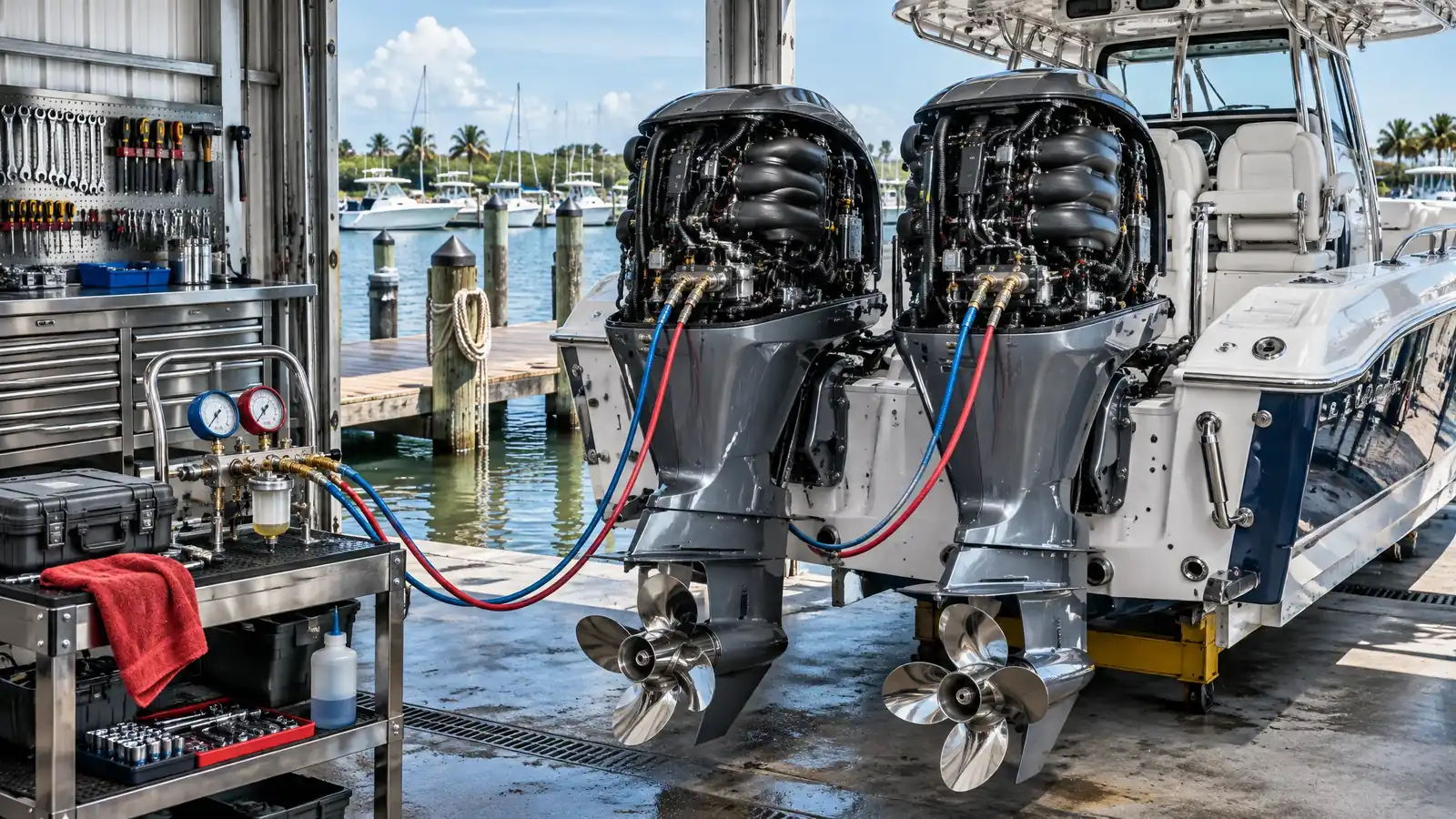
Finding certified outboard repairs near me requires evaluating factory diagnostic capabilities, computerized pressure rigs, and technical competence across multi-port fuel injection, ignition coils, and lower unit gearcases. Through the engineering network of Pertulma Ultramarina, captains and yacht owners connect with certified marine workshops, factory-trained master technicians, and mobile mechanics audited for OEM compliance across major coastal cruising corridors.
Core Marine Propulsion Systems: EFI, High-Energy Ignition and Closed Cooling
Modern four-stroke and direct-injected two-stroke outboards from manufacturers such as Yamaha, Mercury, Suzuki, and Honda are sophisticated marine powerplants operating in severe electrolytic environments. Unlike automotive engines, outboards operate under continuous high torque loads comparable to driving a truck continuously uphill while sucking corrosive saltwater through their cooling passages.
A thorough technical assessment of outboard powerheads focuses on three interconnected subsystems:
- Electronic Fuel Injection (EFI) and Vapor Separation: The high-pressure fuel loop begins at the low-pressure mechanical lift pump, flows into the Vapor Separator Tank (VST), and is compressed by an internal electric turbine pump to between 38 and 55 PSI (or up to 110 PSI on direct-injected two-stroke rails). Even microscopic particulate contamination or phase-separated ethanol varnishes fuel injector pintles, causing lean combustion cycles that melt aluminum piston crowns.
- High-Energy Digital Inductive Ignition: Modern Engine Control Modules (ECM/PCM) calculate ignition timing dynamically using crankshaft position sensors, knock sensors, and manifold air temperature inputs. Faulty ignition coils or degraded resistance within suppressed plug caps produce intermittent spark drops under load that mimic fuel starvation.
- Open-Loop Seawater Cooling Circuit: Driven by a flexible neoprene impeller located in the lower unit, raw seawater flows upward through the copper water tube, circulates past the cylinder liners, passes the pressure-relief poppet valve, and exits through calibrated thermostats opening between 122 and 140 degrees Fahrenheit (50 to 60 degrees Celsius).
Captains planning routine servicing or major overhauls can verify factory diagnostic credentials at Outboard Motor Repair Shops & Mobile Mechanics within the business directory.
Systematic Diagnostic Matrix: Symptoms, Root Causes and Workshop Procedures
Diagnosing marine propulsion failures systematically saves significant labor costs and prevents random parts swapping:
| Operational Symptom | Primary Fault Mode | Diagnostic Test Procedure | Technical Specification Threshold | Required Workshop Equipment |
|---|---|---|---|---|
| Engine Cranks but Fails to Start | Low VST fuel pressure or open lanyard kill switch | Fuel rail gauge check and lanyard continuity | 42 to 48 PSI high-pressure rail reading | High-pressure fuel manifold adapter |
| Bogging Down Under Acceleration | Clogged VST inlet filter or failing lift pump | Vacuum gauge on fuel supply line | Vacuum restriction < 4.0 inHg before pump | Fluid vacuum manometer and clear test hose |
| High-RPM Guardian Mode Alarm | Salt-encrusted poppet valve or worn impeller | Water pressure sensor check in ECM | 12 to 20 PSI water pressure at 4500 RPM | OEM diagnostic software (YDIS / CDS G3) |
| Severe Transom Vibration | Bent prop shaft or cavitation blade damage | Dial indicator runout test on prop shaft | Total Indicated Runout (TIR) < 0.006 in | Magnetic dial indicator base and V-blocks |
| Milky Lower Unit Gear Oil | Cut propeller shaft seal or shift rod O-ring | Dual pressure and vacuum decay test | Hold 10 to 12 PSI and 15 inHg for 5 min | Gearcase pressure/vacuum pump tester |
| Engine Making Oil (Rising Level) | Stuck-open thermostat or leaky low-pressure pump | Oil odor analysis and thermostat bench test | Thermostat fully closed below 120°F | Calibrated hot-water immersion tank |
For specialized propulsion repairs that can be executed dockside without moving the vessel to a haul-out slip, review our dedicated breakdown on Mobile Boat Repair Services.
Component-by-Component Field Inspection Breakdown (outboard repairs near me)
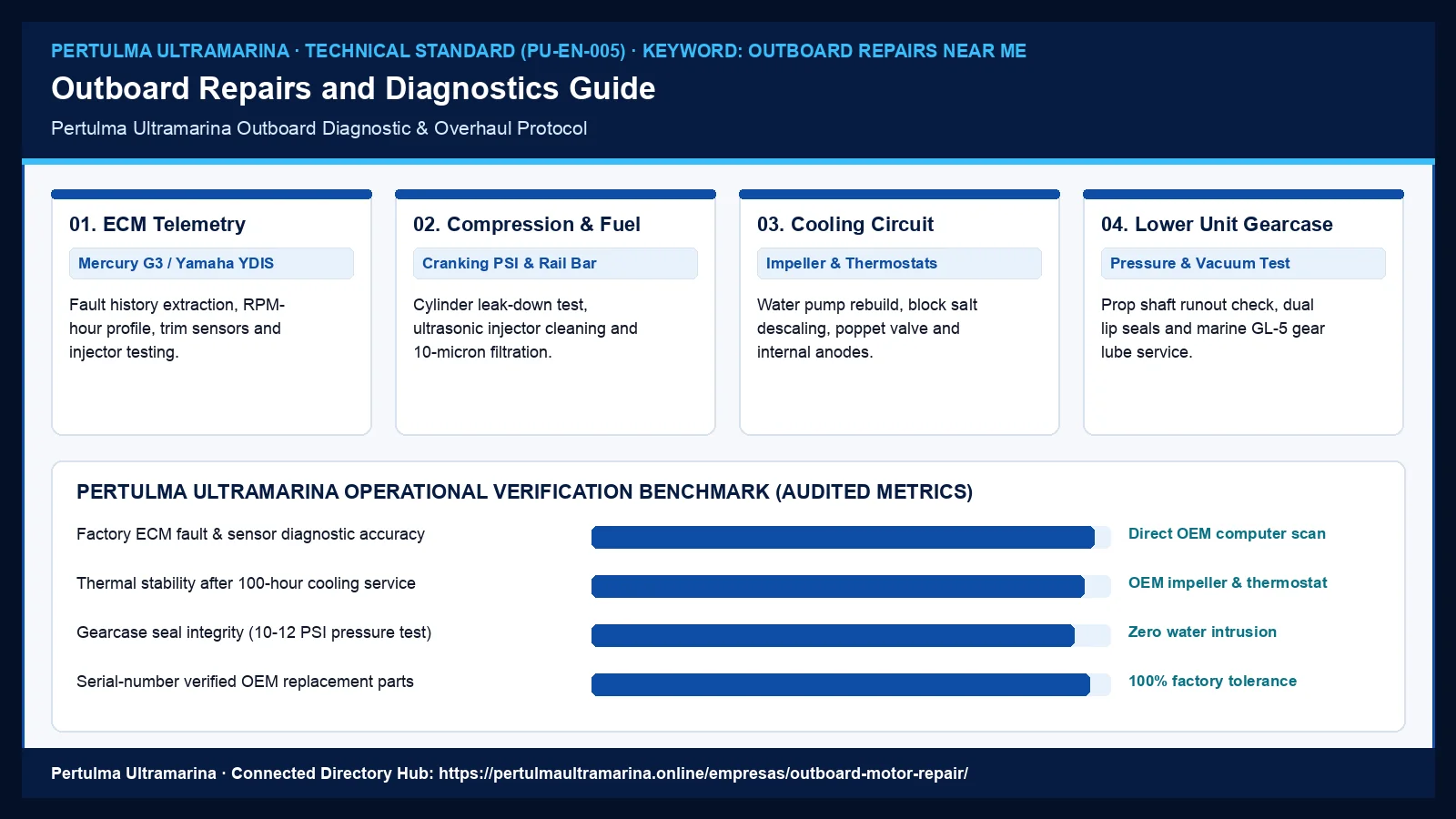
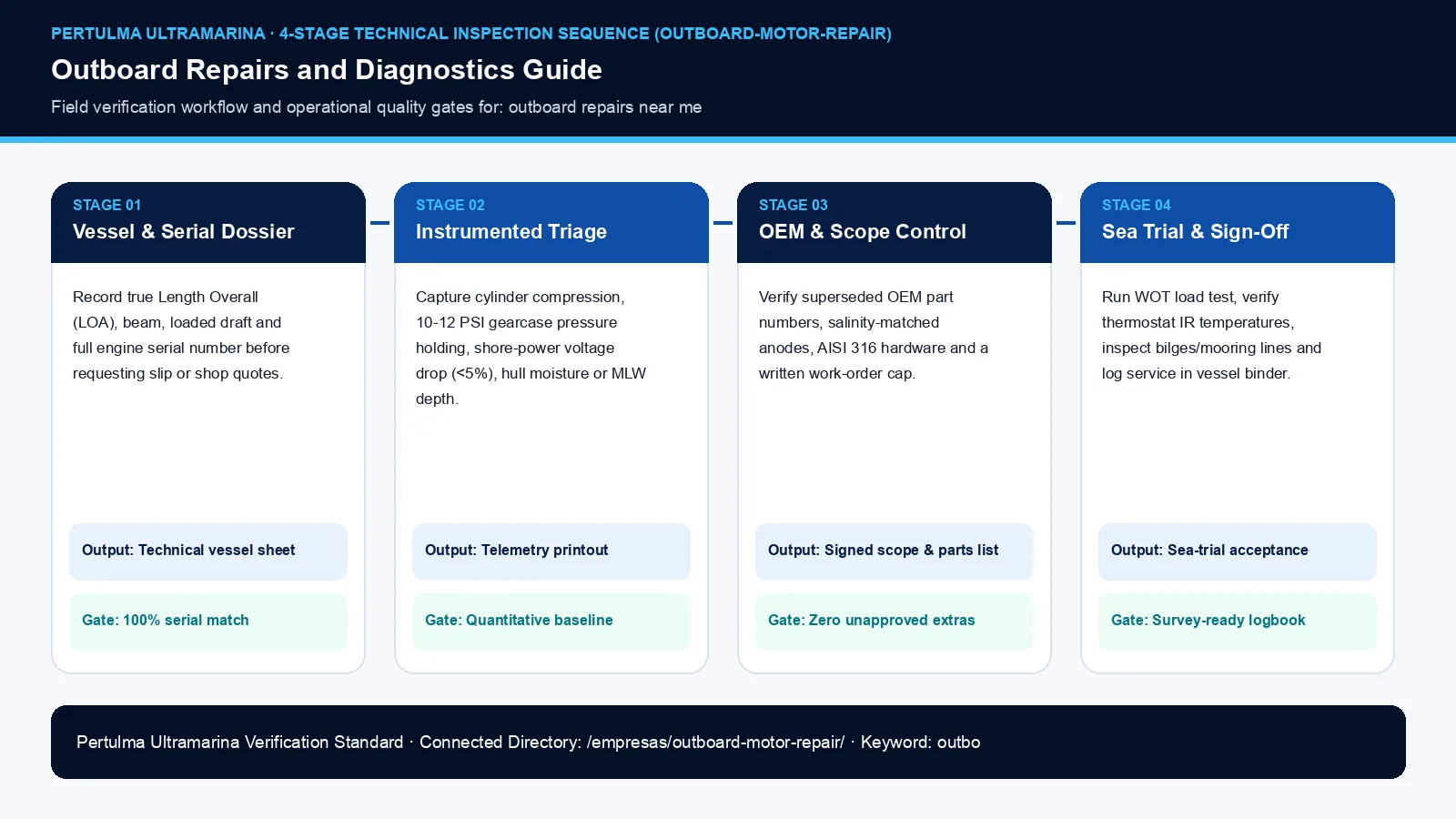
To ensure every outboard repairs near me evaluation is backed by empirical marine engineering evidence, Pertulma Ultramarina audits four physical subsystems on site:
- ECM Fault & RPM History Scan: Downloading freeze-frame fault codes, over-rev counters, guardian events and injector trim data.
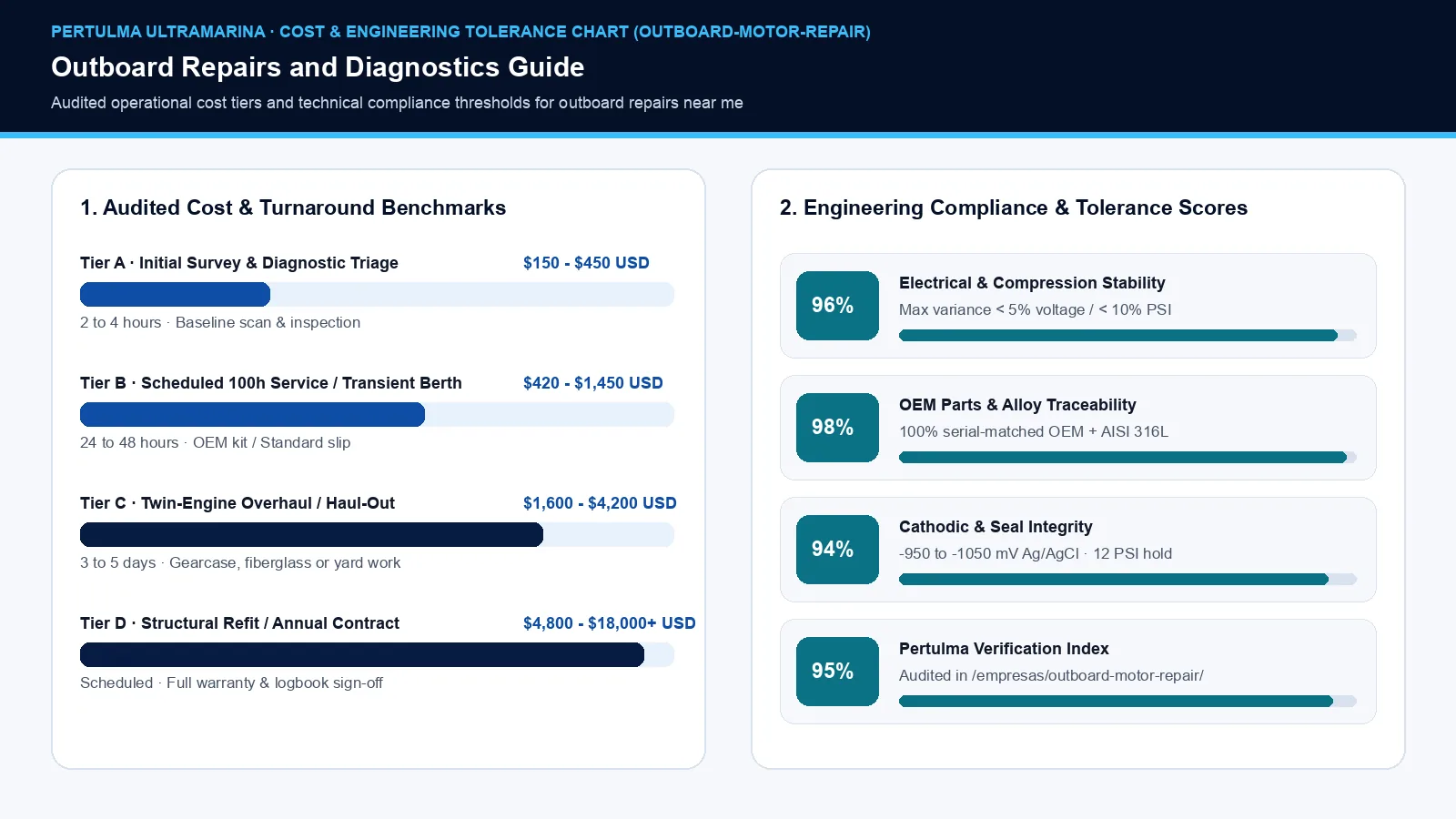
- Cranking Compression & Leakdown: Confirming cylinder-to-cylinder compression stays within an 8% to 10% variance window.
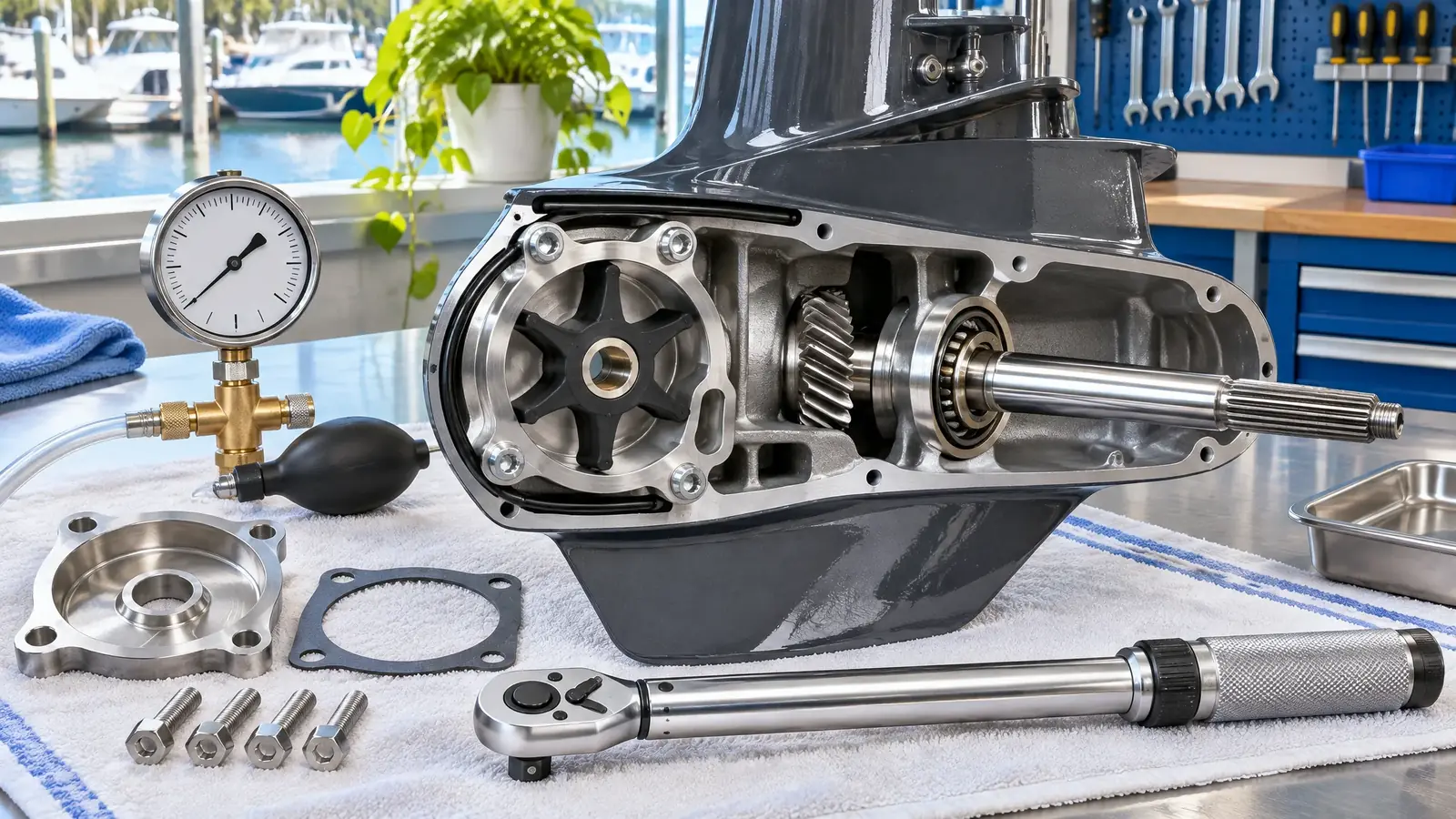
- Gearcase Pressure & Vacuum Test: Holding 10 to 12 PSI for 15 minutes to verify prop-shaft and driveshaft triple-lip seals.
- Cooling Impeller & Thermostats: Replacing the elastomer water-pump impeller, wear plate and salt-crusted thermostats every 100 hours.
Fuel System Troubleshooting: Ethanol Phase Separation, Lift Pumps and Ultrasonic Injector Cleaning
Fuel-related failures account for more than 65 percent of all unexpected outboard breakdowns. Marine gasoline blended with 10 percent ethanol (E10) is hygroscopic, absorbing ambient moisture directly through open fuel tank vents.
When water saturation reaches 0.5 percent by volume at 60 degrees Fahrenheit, the ethanol chemically uncouples from the hydrocarbon matrix and sinks to the bottom of the fuel cell as an acidic ethanol-water layer. When an outboard ingests this bottom layer, two destructive events happen simultaneously:
- Octane Depletion: The remaining upper fuel layer loses 3 to 4 octane points, causing severe pre-ignition detonation under cruise throttle.
- Corrosion of VST Components: The acidic water-alcohol layer corrodes the cast aluminum VST body, strips copper windings inside the electric pump, and clogs the micro-screen inlet basket.
Certified outboard technicians do not merely replace fuel pumps. They remove the multi-port fuel rail, place the fuel injectors into a heated ultrasonic cleaning bath with specialized solvent, pulse the solenoids electronically, and test spray patterns and dynamic flow balance on a computer-controlled calibration bench. Flow discrepancies exceeding 3 percent between injectors require replacement to prevent individual cylinder leaning.
To coordinate mechanical diagnostics with professional haul-out and yard storage, explore comprehensive marine facilities in Pertulma Ultramarina Marine Directory.
Cooling Circuit Dynamics: Impellers, Thermostats, Poppet Valves and Salt Remediation
Outboard powerheads operate in tight thermal windows. Overheating causes cylinder head warping, exhaust plate gasket failure, and catastrophic piston seizure.
The cooling circuit operates under two distinct hydraulic regimes:
- Low-Speed Idle Regime: At idle (600 to 1000 RPM), water pressure remains low (typically 2 to 5 PSI). Cooling flow is governed strictly by the thermostats. If a thermostat is jammed with calcium or salt encrustation, water bypasses the cylinder head or remains trapped, causing localized steam pockets.
- High-Speed Planing Regime: Above 3000 RPM, water volume from the lower unit impeller increases dramatically. To prevent over-pressurization of the water jackets, a spring-loaded bypass valve (commonly known as the poppet or pressure relief valve) opens automatically. A poppet valve jammed open causes the engine to run too cold at idle (causing fuel condensation and oil dilution), whereas a poppet valve stuck shut triggers high-temperature guardian alarms at wide-open throttle.
Technicians operating under the guidelines of Pertulma Ultramarina recommend replacing the neoprene water pump impeller every 100 to 300 hours or annually. When cruising in shallow, sandy, or mangrove-heavy waterways, abrasive silt scores the stainless steel wear plate and brass housing cup, drastically degrading pump efficiency even if the rubber vanes appear visually intact.
For detailed factory procedures on specific four-stroke platforms, consult our in-depth reference on Mercury Outboard Engine Repair.
Lower Unit Gearcase Overhaul: Resealing, Backlash Shimming and Shaft Straightening
The lower unit gearcase transfers high crankshaft RPM into forward and reverse hydrodynamic thrust through spiral bevel gears housed in a streamlined aluminum casting. Operating completely submerged under extreme torque, it requires immaculate seal integrity and precise gear tooth mesh tolerances.
Whenever water contamination is detected during scheduled oil drainage, the technician performs an internal teardown:
- Drive Shaft and Propeller Shaft Seals: Dual opposing rubber oil seals are installed back-to-back. The inner seal retains synthetic gear lubricant, while the outer seal excludes raw seawater. Technicians inspect the shaft surface beneath the seal lips for grooving. If minor wear is present, a micro-sleeve (Speedi-Sleeve) is press-fitted to restore a mirror finish.
- Pinion and Forward Gear Backlash Shimming: Spiral bevel gears must mesh with exact clearance (typically 0.012 to 0.018 inches of backlash, depending on horsepower). Technicians use precision depth micrometers and dial indicators to measure pinion height and gear contact patterns using Prussian blue marking compound. Improper shimming causes whining gear noise, accelerated tooth chipping, and lower unit lockup at speed.
- Propeller Shaft Runout Measurement: Groundings on sandbars, coral heads, or submerged logs bend propeller shafts. Using a dial indicator mounted on the cavitation plate, total indicated runout (TIR) must not exceed 0.006 inches (0.15 mm). Bent shafts cannot be corrected by eye and must be cold-straightened on a hydraulic press using dial gauge monitoring or replaced completely.
If propeller blade deformation or hub slippage accompanied the gearcase strike, vessel owners can consult specialized propulsion repair guidelines documented in Mercury Outboard Engine Repair.
How to Vet an Outboard Repair Shop: Certifications, Tooling and Estimates
Entrusting an expensive modern outboard to an unqualified mechanic can lead to improper torquing, electrical harness damage, and voided factory warranties. Vessel owners must evaluate repair centers against objective engineering criteria.
Crucial standards verified by Pertulma Ultramarina when indexing marine service centers:
- Factory OEM Certifications: Look for active certifications from Mercury Marine (Master Technician), Yamaha Marine (Master Technician), Suzuki Marine, or Honda Marine. Factory certification requires recurring school training every two years on updated CAN-bus protocols and direct-injection calibrations.
- Current Proprietary Diagnostic Software: Ensure the shop subscribes to live diagnostic packages (such as Yamaha YDIS 3.0, Mercury CDS G3, or Suzuki SDS-Mobile). Generic automotive scan tools cannot command individual injector drop tests, dynamic cylinder balance sweeps, or prime electric VST pumps.
- Written Estimates and Work Order Transparency: A professional marine facility provides itemized estimates detailing OEM part numbers, labor hour allocations based on standard marine flat-rate manuals, and environmental disposal fees for hazardous oils and solvents.
- Clean Work Bays and Closed-Loop Storage: Professional repair shops maintain clean, covered disassembly benches, hydraulic lifting gantries, and test tanks with water recirculation to load-test engines before returning them to the customer.
Vessel captains can review verified local and regional workshops across all marine specialties in our international directory at Pertulma Ultramarina Marine Directory and Pertulma Ultramarina to secure reliable technical service.
Frequently Asked Questions
What are the most common signs that an outboard motor needs professional diagnostics?
Frequent indicators include an audible warning buzzer from the helm console, sudden drop into guardian or limp-home mode with engine RPM limited to 2000, rough idling with misfiring cylinders, excessive fuel consumption, and milky white emulsion visible on the lower unit drain plug.
How often should an outboard fuel-water separator and VST filter be replaced?
The primary boat-mounted 10-micron fuel-water separator canister should be replaced every 100 operating hours or annually. The high-pressure Vapor Separator Tank (VST) internal filter should be serviced every 300 operating hours or immediately if ethanol phase separation or tank contamination is suspected.
Can a bent outboard propeller shaft be straightened without replacement?
If the total indicated runout (TIR) is moderate and there are no surface cracks or severe kinks near the bearing journal, specialized marine machine shops can cold-straighten the shaft on a hydraulic press using dial indicators. Shafts with runout exceeding 0.030 inches or structural metallurgical fatigue should always be replaced.
Why is OEM diagnostic software essential for modern outboard troubleshooting?
OEM diagnostic software communicates directly with the engine Propulsion Control Module via CAN-bus architecture. It reads active and historical fault codes, displays real-time fuel rail pressures and manifold absolute pressures, records historical RPM histograms, and allows technicians to perform automated cylinder cutoff tests without mechanical disassembly.