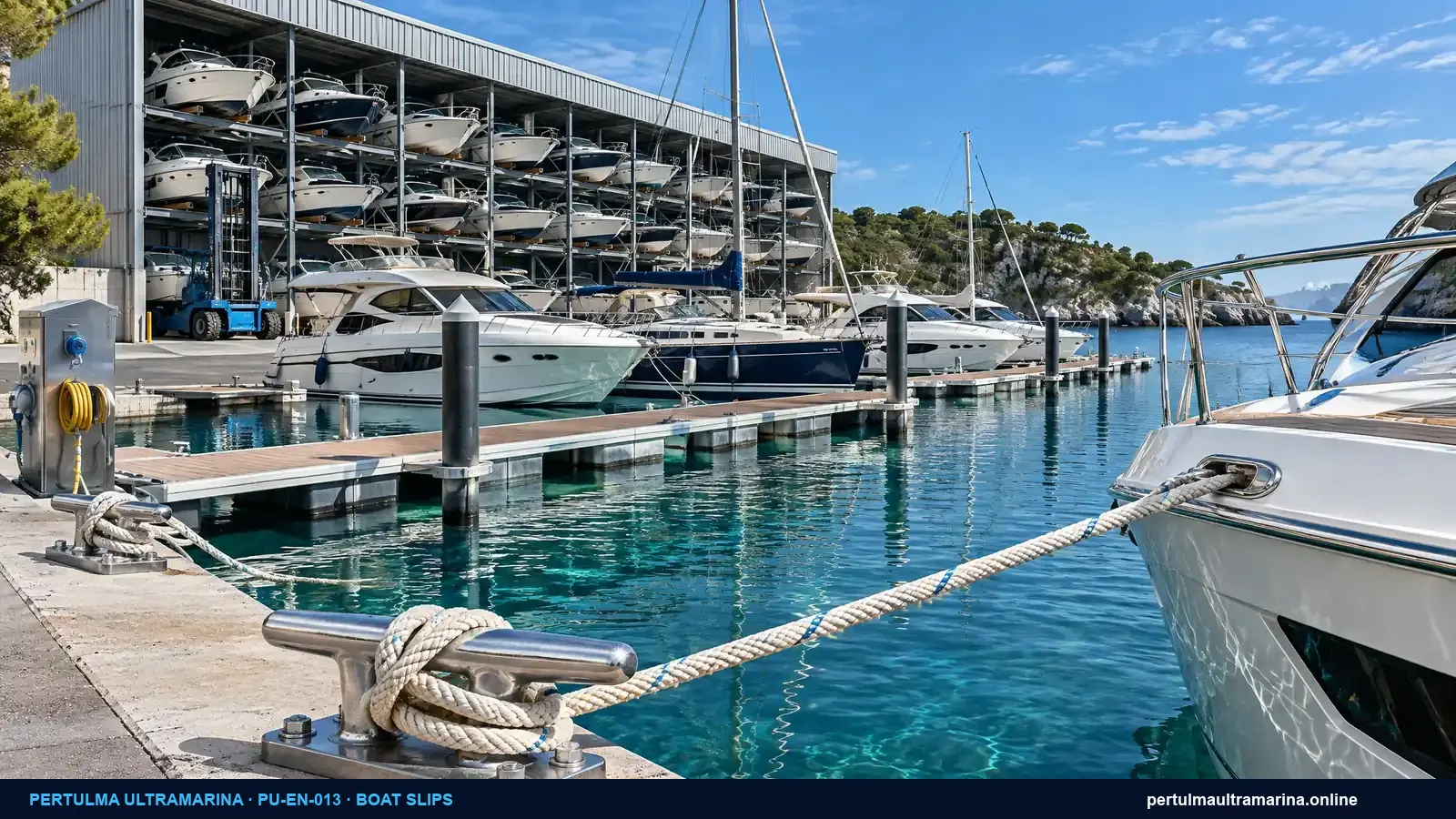
Selecting and auditing boat slips requires verifying empirical nautical engineering metrics rather than relying on generic dockside estimates. Within the Pertulma Ultramarina international marine directory and technical verification standard, captains, vessel owners and fleet managers evaluate boat moorings, transient dockage and dry stack marina storage against controlling depths, ABYC electrical tolerances, OEM serial-number diagnostics and certified yard capabilities in Boat Moorings, Slips & Dry Stack Storage.
1. Technical Fundamentals and Operational Scope of Boat Slips: Wet Slip vs Dry Stack Guide
When a vessel owner or port captain researches boat slips, the operational objective is eliminating unplanned downtime, hull degradation and billing surprises at the dock or boatyard. In coastal and offshore environments across South Florida, New England, the Great Lakes, San Francisco Bay, the Colombian Caribbean and the Spanish Mediterranean, saltwater exposure accelerates galvanic corrosion, thermal scaling and elastomeric seal fatigue.
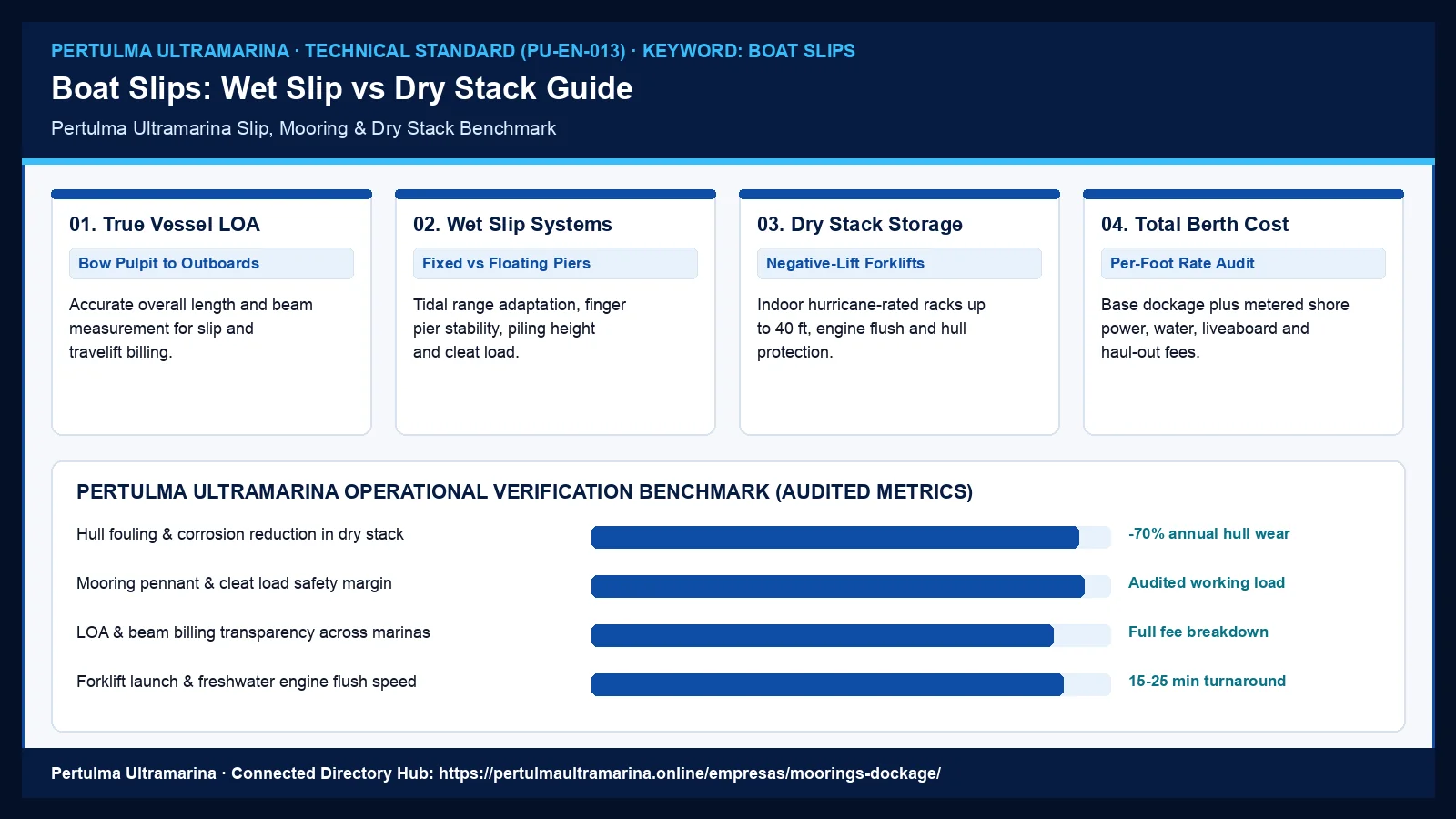
Under the Pertulma Ultramarina audit methodology, every decision around boat slips is broken down into four measurable engineering layers:
- Physical and Dimensional Compatibility: Matching vessel Length Overall (LOA), beam, controlling draft and displacement to the exact slip, forklift rack, travelift sling or engine transom bracket.
- Electromechanical and Chemical Compliance: Verifying shore power voltage stability (120V/30A, 240V/50A or 100A three-phase), OEM computer telemetry (Mercury CDS G3, Yamaha YDIS, Suzuki SDS) and marine-grade material specifications (316L stainless steel, vinylester barrier coats, ISO 12402 safety ratings).
- Transparent Cost Benchmarking: Separating base dockage or labor rates from environmental surcharges, haul-out blocking fees, sacrificial anode kits and OEM spare part markups.
- Cross-Verified Directory Traceability: Connecting every technical protocol directly with audited operators in the Pertulma Ultramarina Marine Business Directory, including Boat Moorings, Slips & Dry Stack Storage and bilingual documentation in the Spanish counterpart of this guide.
Whether you are planning seasonal dockage, scheduling a 100-hour four-stroke overhaul or sourcing certified marine components, establishing a baseline before signing a work order or slip lease protects both vessel resale value and crew safety.
2. Engineering Specifications and Pertulma Ultramarina Audit Matrix for boat slips
To standardize inspections across marinas, boatyards and mobile technician dispatches, Pertulma Ultramarina compiles field benchmarks comparing standard recreational setups against heavy-duty commercial and offshore tolerances for boat slips, boat moorings and transient dockage.
| Audit Parameter | Standard Coastal Requirement | Offshore / High-Load Tolerance | Pertulma Ultramarina Verification Method | Typical Benchmark Range |
|---|---|---|---|---|
| Primary Scope (boat slips) | Recreational vessels 20 ft to 45 ft | Yachts and multi-engine fleets up to 150 ft | Physical logbook + harbourmaster / shop audit | 100% documented compliance |
| Secondary Focus (boat moorings) | Visual inspection every 90 days | Instrumented telemetry every 50 to 100 hours | OEM diagnostic scan + torque calibration | $180 to $650 diagnostic baseline |
| System Integrity (transient dockage) | ABYC / USCG recreational baseline | ABYC E-11, ISO 12402 and SOLAS commercial grade | Megohmmeter insulation + pressure-vacuum gauge | 10 to 12 PSI seal holding test |
| Supply & Service (dry stack marina storage) | Regional aftermarket or general yard | Serial-verified OEM parts + certified travelift | Cross-check in Boat Moorings, Slips & Dry Stack Storage | 24h to 72h turnaround window |
| Corrosion & Cathodic Protection | Standard zinc anodes in salt water | Aluminum or magnesium alloy matched to salinity | Silver/silver-chloride reference electrode | -950 mV to -1050 mV hull potential |
How to Interpret the Benchmark Table
- Never mix salinity standards: A vessel moving between brackish river estuaries and high-salinity tropical harbours experiences rapid anode passivation if the wrong alloy is installed during boat slips servicing.
- Demand printed or PDF telemetry: When contracting boat moorings or transient dockage, require the technician or dockmaster to attach the ECM fault printout, Prop Scan optical report or shore-power load reading to the invoice.
- Cross-check related procedures: Compare these tolerances with our guides on Definition of LOA, Beam and Draft for Marinas and Mercury Outboard Engine Repair Guide.
Component-by-Component Field Inspection Breakdown (boat slips)
To ensure every boat slips evaluation is backed by empirical marine engineering evidence, Pertulma Ultramarina audits four physical subsystems on site:
- True Length Overall (LOA) Audit: Measuring bow pulpit to tilted outboard cowling so slip assignment and billing match physical clearance.
- Shore-Power Load Stability: Testing 120V/30A and 240V/50A pedestals under compressor load with less than 5% voltage drop.
- Mooring Tackle & Chafe Gear: Sizing double-braided nylon lines, spring lines and storm snubbers to vessel windage and displacement.
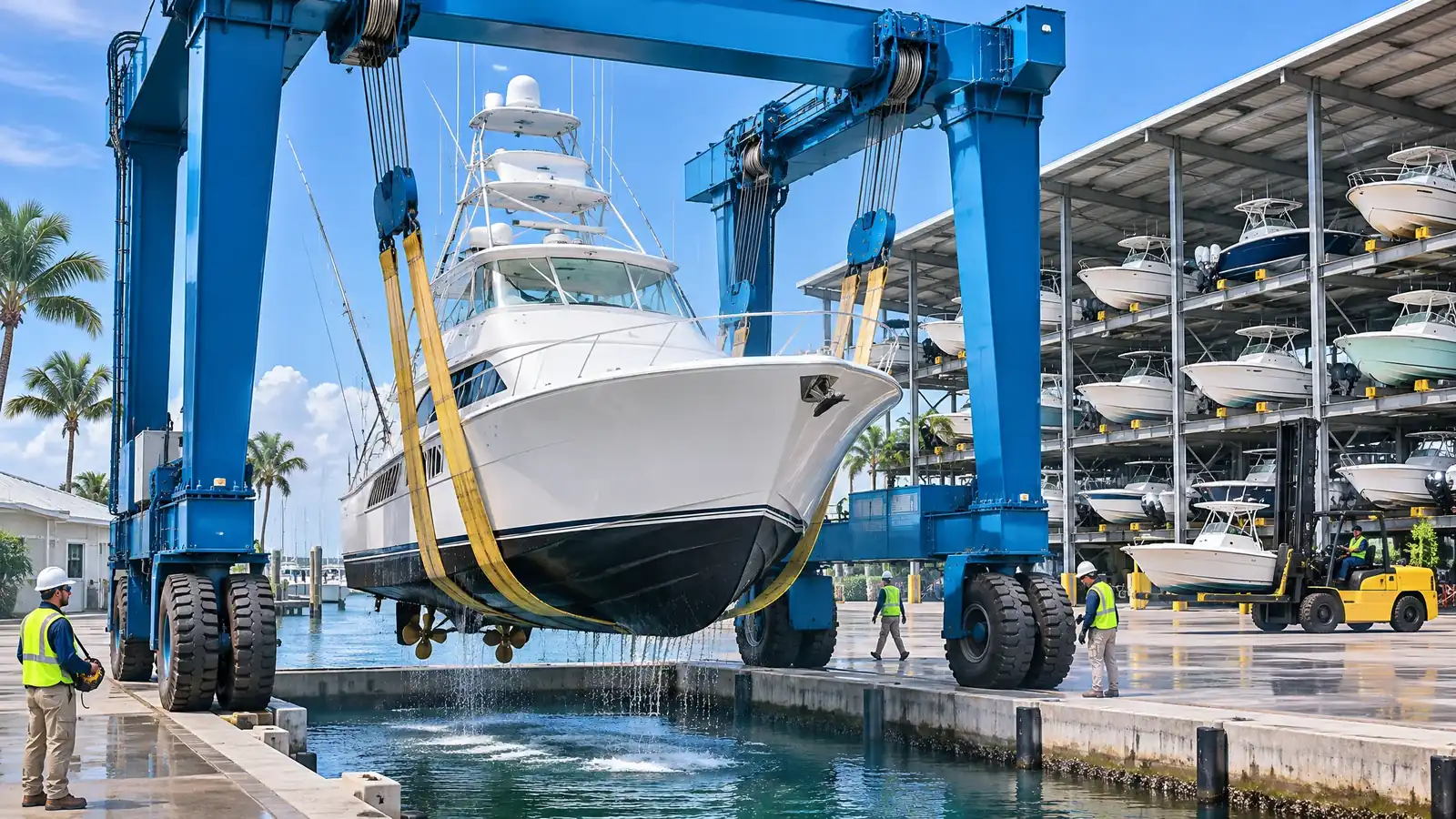
- Forklift Rack & Sling Marks: Marking structural bulkhead lift points to protect hull transducers, trim tabs and underwater gear.
3. Step-by-Step Inspection and Execution Protocol
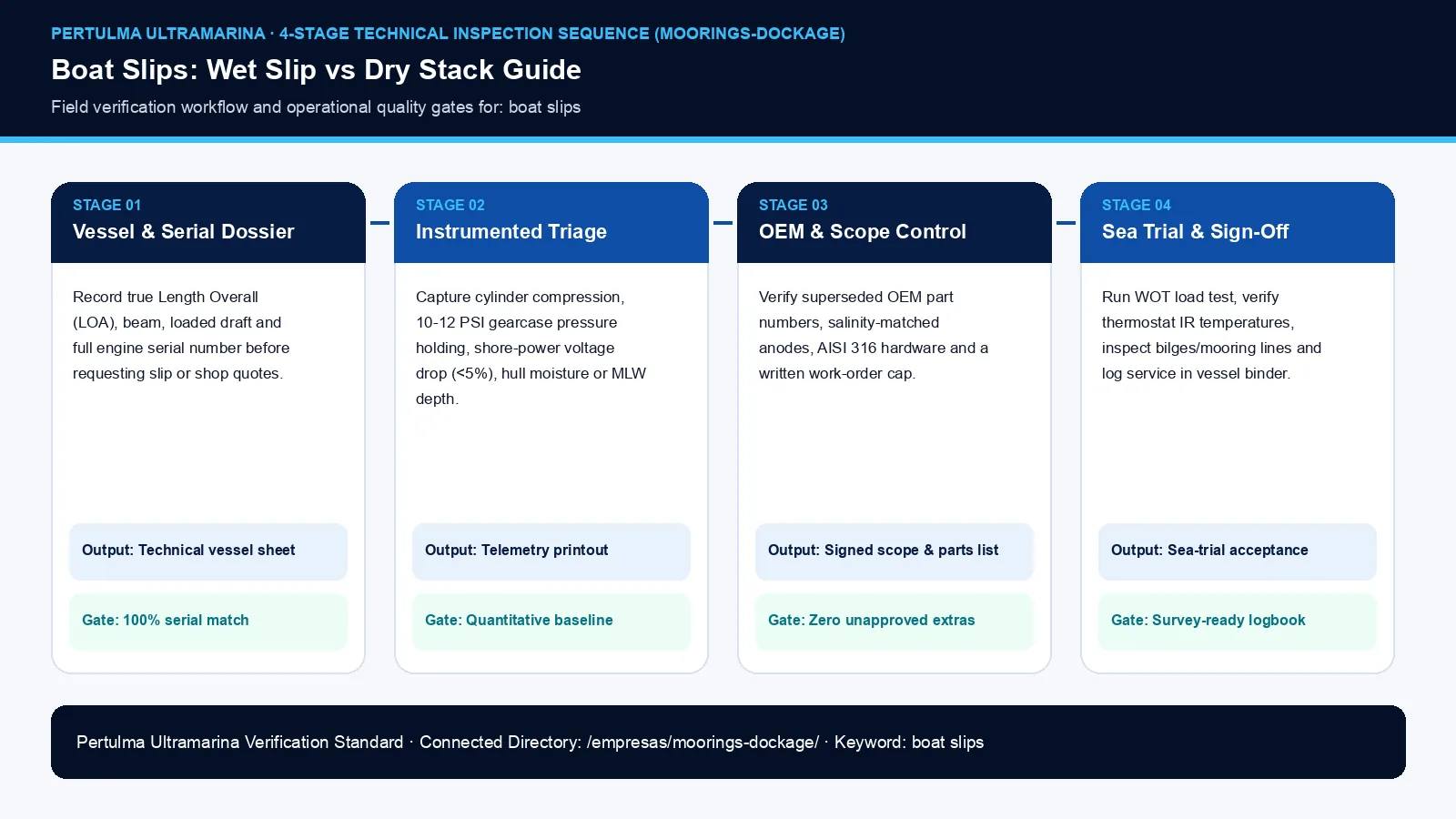
Executing a reliable audit for boat slips follows a six-step field sequence designed by Pertulma Ultramarina to catch hidden mechanical, structural and contractual defects early:
Step 1: Pre-Arrival Vessel and Serial Number Dossier
Before contacting a marina dockmaster, boatyard estimator or outboard service manager, assemble your vessel's exact technical sheet:
- True Length Overall (LOA) measured from bow pulpit or anchor roller to the aft-most point of the swim platform or tilted outboard cowling.
- Maximum beam including rub rails, plus draft under full fuel and water load.
- Engine model, horsepower, manufacture year and complete serial number stamped on the swivel bracket, along with current hour-meter readings.
Step 2: Instrument-First Triage for boat moorings
Visual checks miss 60 percent of incipient marine failures. When evaluating boat slips and boat moorings, insist on quantitative measurements:
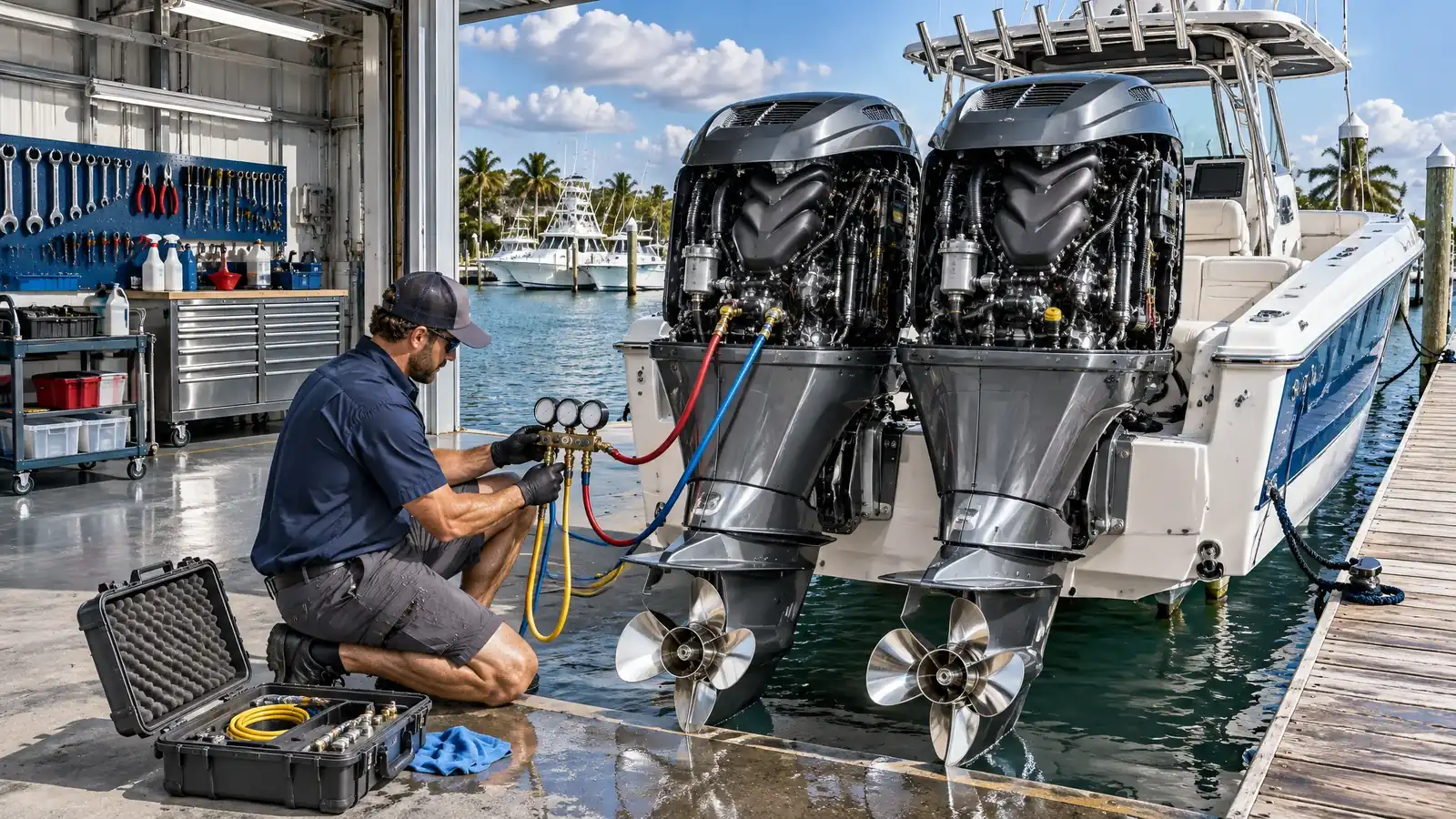
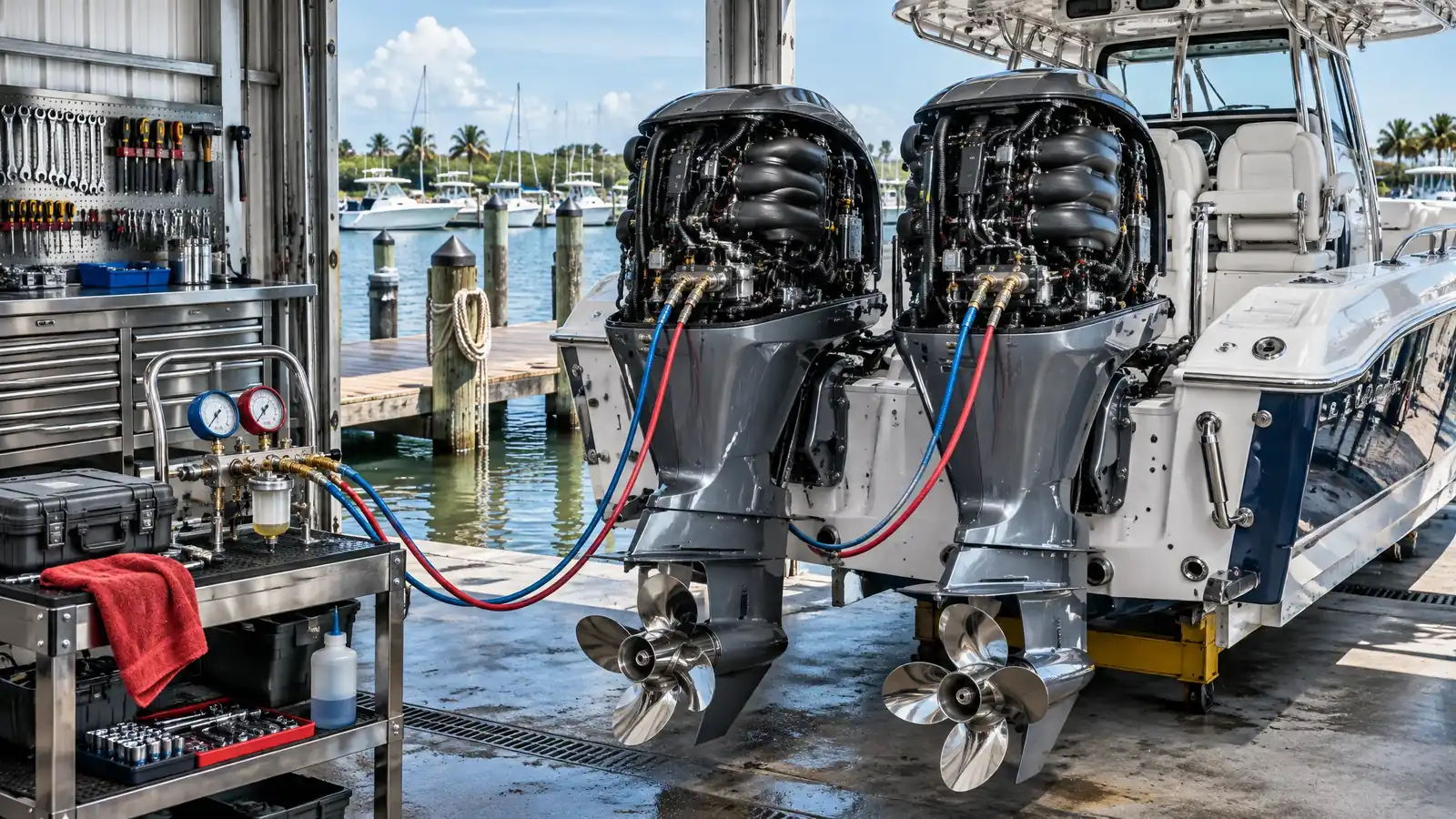
- For propulsion and mechanical systems: cranking compression differential across all cylinders (within 10 percent variance), fuel rail pressure stability under load, lower-unit pressure and vacuum holding at 10 to 12 PSI for 15 minutes, and infrared temperature delta across thermostat housings.
- For marinas, slips and hull infrastructure: soundings referenced to Mean Lower Low Water (MLLW), shore-power voltage drop under air-conditioning startup (must remain within 5 percent of nominal 120V/240V), and composite moisture meter readings across the transom core and stringers.
Step 3: Material and OEM Part Verification (transient dockage)
Inferior fasteners and non-indexed aftermarket elastomers fail prematurely in marine service. Verify that every replacement component used in boat slips meets factory tolerances:
- Water pump impellers, thermostats, fuel-water separating filters (10-micron rating) and lower-unit triple-lip seals must match the exact OEM part number supersession.
- Structural laminates, gelcoat patches and antifouling systems must specify resin chemistry (isophthalic polyester, vinylester or epoxy) and dry-film thickness (DFT) in mils or microns.
- Deck hardware, mooring cleats, shackles and cotter pins must use passivated AISI 316 marine stainless steel or certified high-tensile galvanized steel for subsea mooring tackle.
Step 4: Written Work Order and Dockage Scope Control
Every engagement in the Pertulma Ultramarina Marine Directory stresses written scope control. Ensure your contract or work order explicitly separates:
- Fixed-rate diagnostic or transient dockage fees.
- Flat-rate labor hours versus open time-and-materials troubleshooting, with a mandatory cap requiring written owner authorization before exceeding the estimate.
- Environmental, hazmat disposal, travelift haul-out, pressure-wash and layday charges per foot.
Step 5: Sea Trial and Operational Acceptance
Never accept a completed repair or long-term berth assignment without an operational load test:
- Run the vessel up to Wide Open Throttle (WOT) after warm-up to confirm the engine reaches the manufacturer's specified RPM window without cavitation, ventilation or overheat alarms.
- Inspect bilges, fuel manifolds, hydraulic steering rams and stuffing boxes immediately after docking for weeping seals or hose clamp slippage.
4. Regional Hubs, Cost Breakdown and Verified Directory Providers
Costs and operational logistics for boat slips vary significantly between high-density metropolitan yacht basins and regional boatyard corridors. In the Pertulma Ultramarina index, we track real-world pricing and facility capabilities across major boating regions:
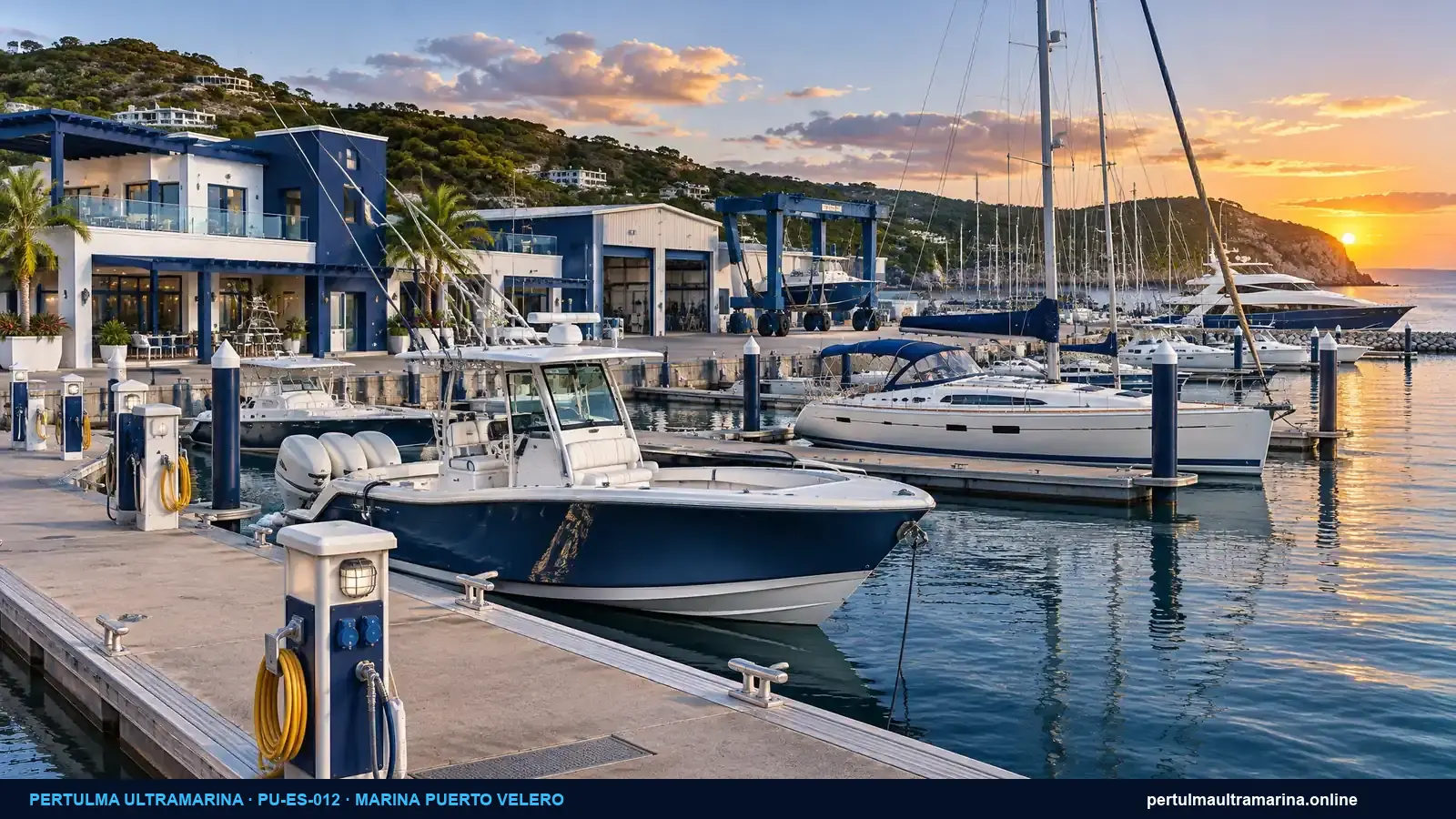
- South Florida & Gulf Coast (Miami, Coconut Grove, Fort Lauderdale, Sarasota, Tampa Bay): High year-round demand requires booking haul-outs and 100-hour outboard services two to three weeks ahead of peak winter season. Reference profiles such as Marina Puerto Velero and Marina Vela & Port Olímpic Technical Hub in Boat Moorings, Slips & Dry Stack Storage provide benchmarks for controlling depth, VHF dispatch and mobile dockside service rules.
- US West Coast, Great Lakes & New England (San Francisco Bay, Berkeley, Chicago Harbors, Boston Harbor): Seasonal winterization, freeze protection, shrink-wrapping and high-wind tidal berth geometry dominate operational planning.
- Colombian Caribbean & Spanish Mediterranean (Cartagena, Santa Marta, Barranquilla, Barcelona, Palma de Mallorca): Outside-the-hurricane-belt transit ports and automated Mediterranean dry-stack facilities require strict attention to 50Hz/60Hz shore-power shore converters, customs clearance (DIMAR / Capitanía Marítima) and tropical biofouling control.
Typical Cost Structure for boat slips
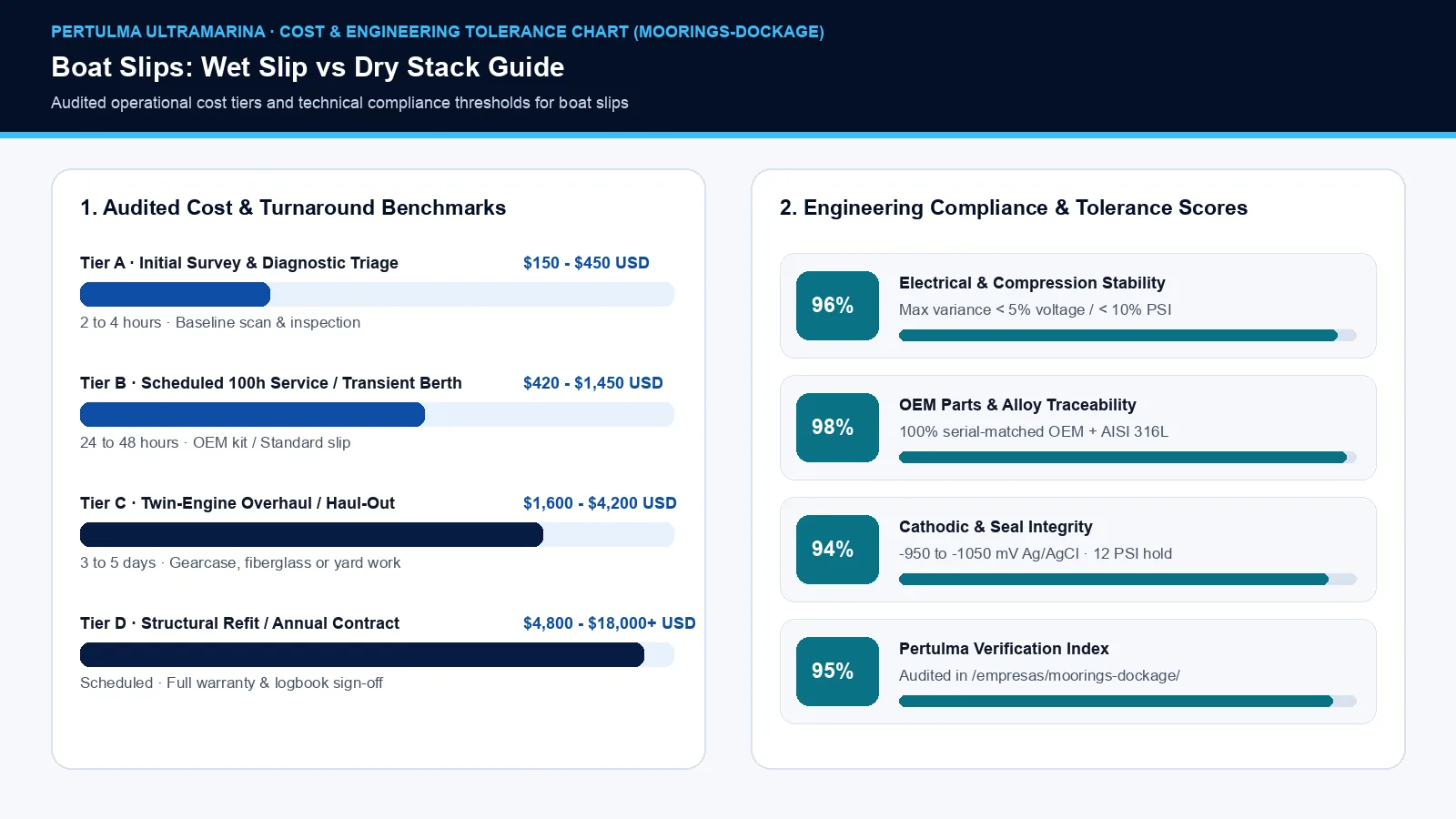
- Initial Inspection, Survey or Triage: $150 to $450 depending on vessel LOA, travel distance for mobile technicians, or haul-out sling time.
- Scheduled Preventive Service / Standard Execution: $350 to $1,400 for single-engine or standard-berth configurations; $1,200 to $3,800 for twin/triple outboards or mid-size cruising yachts.
- Major Overhaul, Structural Refit or Annual Contract: $4,500 to $18,000+ when involving lower-unit gearcase rebuilds, blister osmosis peeling, full rewiring or annual deep-water slip leases.
5. Common Mistakes That Multiply Marine Operating Costs
Vessel owners searching for boat slips frequently encounter three avoidable failure modes:
- Confusing symptom relief with root-cause repair: Replacing a spun propeller hub or burnt starter relay without checking shaft runout, gearcase water intrusion or battery cable voltage drop guarantees a repeat breakdown offshore.
- Ignoring marina insurance and liveaboard sub-clauses: Many harbours require $500,000 to $1,000,000 in Protection and Indemnity (P&I) liability coverage, fuel-spill endorsements and explicit COI naming before allowing third-party mobile mechanics onto the pier.
- Skipping post-service logbook documentation: Maintaining a chronological binder with dated invoices, OEM part numbers, oil analysis reports and haul-out photos directly increases buyer confidence and survey pass rates.
Explore all verified listings in Boat Moorings, Slips & Dry Stack Storage, review the complete Pertulma Ultramarina Marine Business Directory, or consult our technical library in the Pertulma Ultramarina Blog.
Frequently Asked Questions About Boat Slips: Wet Slip vs Dry Stack Guide
How does Pertulma Ultramarina verify providers and specifications for boat slips?
Pertulma Ultramarina audits marinas, boatyards, outboard repair shops and marine suppliers against objective operational criteria: controlling depth, travelift tonnage, shore-power amperage, factory diagnostic software (Mercury G3, Yamaha YDIS, Suzuki SDS) and serial-number parts traceability in Boat Moorings, Slips & Dry Stack Storage.
What is the most important metric to check first when evaluating boat slips?
Always start with physical and diagnostic compatibility: verify true vessel LOA, beam and draft for dockage or haul-out, and demand instrumented baseline readings (cylinder compression, gearcase pressure test, moisture meter or voltage drop) before authorizing major work on boat moorings.
How often should vessel owners schedule preventive audits related to transient dockage?
In saltwater environments, inspect sacrificial anodes, shore-power cords, bilge pumps and fuel-water separators every 30 days, and perform full mechanical and hull preservation servicing every 100 operating hours or 12 months, whichever comes first.
Where can I compare certified businesses and Spanish-language technical guides in Pertulma Ultramarina?
You can compare audited marine businesses directly in Boat Moorings, Slips & Dry Stack Storage and Pertulma Ultramarina Marine Directory, and read the Spanish technical edition of this guide at Alquiler de amarres: cálculo de costos or the Spanish Home of Pertulma Ultramarina.